Thank you for visiting SNEWPapers!
Sign up free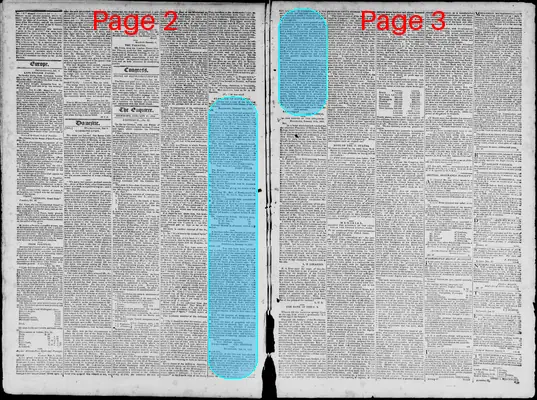
The Enquirer
Richmond, Henrico County, Virginia
What is this article about?
In January 1811, Virginia Governor John Tyler resigned to become a federal judge. The state legislature elected James Monroe as the new governor with 129 votes against 58 for George W. Smith. Correspondence confirmed Monroe's alignment with the republican administration.
Merged-components note: Continuation of Governor election article including Monroe's letter across pages; relabeling 'letter_to_editor' portion to fit overall domestic news on state politics.
Clippings

1 of 2
OCR Quality
Full Text
On Tuesday last a copy of the following letter was delivered to both houses of the legislature;
Richmond, January 15th, 1811.
SIR,
Having just received and accepted an appointment from the President of the United States, as a judge of the District Court, in and for the state of Virginia, in the room of Cyrus Griffin, esq. dec'd.; it becomes my duty to resign the office of Governor or Chief Magistrate of the State, into those hands from which I had the honor to receive it—I, therefore, now beg leave to surrender to the Legislature of my country that office, with permission to express the grateful sense I feel for the many distinguished marks of favor and honor conferred on me from my early life to the present day.
This measure, it is confidently hoped, will not be considered as a dereliction of public duties so recently confided to me since it is but an exchange of the labors of a year, for those of a life, which always has been and still will be devoted to my country and its dearest interests; which by divine assistance, and under a wise, just and liberal policy, can never cease to prosper.
I am with considerations of high respect,
Your most ob't. humble servant,
JOHN TYLER.
To the Speaker.
The H. of D. immediately entered into a resolution to proceed by joint ballot with the Senate, to the election of another Governor—the resolution was sent to the Senate for their concurrence.
MR. JAMES PRESTON rose to nominate James Monroe, Esq.
Time forbids our giving the details of his remarks.
Yesterday Mr. Ball, of Northumberland, nominated Geo W. Smith, Esq. the present Lieut.-Governor,
The Senate announced their concurrence in the resolution of the House.
Mr. Stanard (of Spotsylvania) supported the nomination of Col. Monroe. General Blackburn (of Bath) declared his opposition to his election—Mr. Prunty and Mr. Mercer (of Loudoun) replied to Gen Blackburn.
On counting the Ballots, the votes were:
For James Monroe, 129
G. W. Smith, 58
Scattering 10
Colonel Monroe is, of course, elected Governor.
A few days before the election of Governor took place, a letter was addressed by Mr. Chapman Johnson of the Senate to Mr. Monroe—of which and the reply, copies have been obtained.—They are as follows:
Richmond, January 12, 1811.
DEAR SIR
You may have been informed that it is the wish of many of your old friends and of the friends of the administration, that you should fill the vacancy, in the office of Governor of this Commonwealth, which is anticipated, from the appointment of Mr. Tyler to the bench of the federal court. You already know that it would give me great satisfaction to promote your election. You are assured too, I hope, that I feel the greatest confidence, in your political principles, and in the sincerity of your disposition to promote the interest of the republican cause. This confidence will be my justification, to the republicans for using my exertions, to effect a general concert amongst the friends the administration, in your favor. But I find that there are amongst them, gentlemen who hesitate in giving you their support, and hesitate only from an apprehension, that in doing so, they will afford the public reason to believe, that they distrust an administration, in which they have confidence, and countenance an opposition, which they disapprove. Though these are not my fears, yet I have no hesitation in thinking, that they are honestly the fears of others, and that in acting under their influence, they feel that they are obeying an impulse of duty to their cause and country.
It is for the purpose of being enabled to remove these fears that I trouble you with this letter.
If your own sense of propriety will permit, I should be pleased, that you could authorise me to say, whether, if elected, you would carry into the government, a disposition to co-operate with the administration, and to encourage union and harmony, for the purpose of ensuring success to their measures.
With very great respect,
Your obedient servant,
CH: JOHNSON.
(A Copy—signed)
Richmond, Jan. 14, 1811:
DEAR SIR,
Your letter of the 12th inst. has afforded me great satisfaction, because it manifests a spirit of amity and conciliation, which ought always to characterise the conduct of those, who are attached to the same principles, and engaged in support of the same great cause. It is evidently your object to correct errors in the minds of others, not to impose conditions on me.
My support of the republican cause has been the result of feeling, and of my own
The just judgment. It commenced at a very early period, and has been continued in every situation in which I have been placed. The same principles will animate and guide me through life.
I cannot conceive on what ground an idea is entertained, that I should carry into the government of the commonwealth, a disposition unfriendly to the administration, and a desire to embarrass its measures. Such a suspicion is entirely destitute of foundation. As I believe the Executive to be attached to free government, the natural bias of my mind and feelings is in its favor. I wish the administration success, because its success will promote that of the republican cause, and the general prosperity of my country. I add with pleasure that there is nothing, of a personal nature, in the relation between the chief magistrate and myself, that can possibly impair the force of this sentiment.
I cannot presume that any one of the gentlemen, who entertain the apprehensions to which you allude, feels disposed to approve, without examination and conviction, every measure of any administration. Such a disposition, cannot be indulged and acted on, without a surrender of the first principles of free government: Those principles which our constitution was instituted to preserve, and which the administration must, and no doubt does revere. All that any administration can desire, of a free and independent people, is a rational and manly support of its conduct, when it bears the test of impartial investigation, by the standard of the constitution, and by its tendency to promote the public welfare. In any situation in which I may be placed, I shall expect the support of my fellow citizens, on no other condition. On the same condition I shall not fail to afford it to the government of the U. States.
I am, with great respect, your very obedient servant,
JAS. MONROE.
What sub-type of article is it?
What keywords are associated?
What entities or persons were involved?
Where did it happen?
Domestic News Details
Primary Location
Richmond, Virginia
Event Date
January 1811
Key Persons
Outcome
james monroe elected governor with 129 votes; g. w. smith received 58 votes; scattering 10 votes.
Event Details
John Tyler resigned as Governor of Virginia on January 15, 1811, to accept a federal judgeship. The legislature proceeded to elect a new governor by joint ballot. James Monroe was nominated and elected over George W. Smith. Pre-election letters between Chapman Johnson and Monroe addressed concerns about Monroe's support for the administration.