Thank you for visiting SNEWPapers!
Sign up free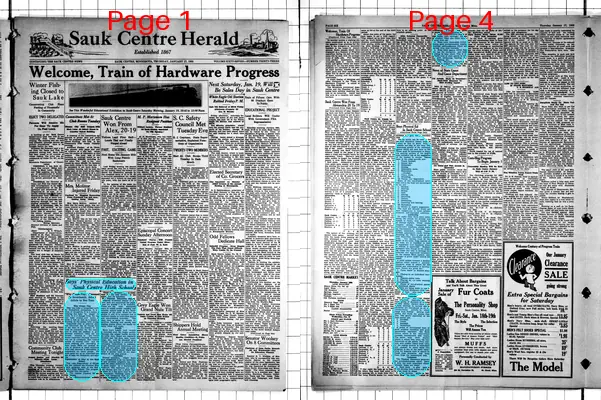
The Sauk Centre Herald
Sauk Centre, Stearns County, Minnesota
What is this article about?
Ben Tonn's article details the boys' physical education program at Sauk Centre High School, including organized classes for grades 7-10 with health checks, team games like basketball and volleyball, leadership roles, point awards, extra-curricular sports, and benefits for physical, social, and lifelong development.
Merged-components note: This is a continued article on Boys Physical Education from page 1 to page 6, with sequential reading order and explicit 'Continued on Page Six' indicator.
Clippings
1 of 2
OCR Quality
Full Text
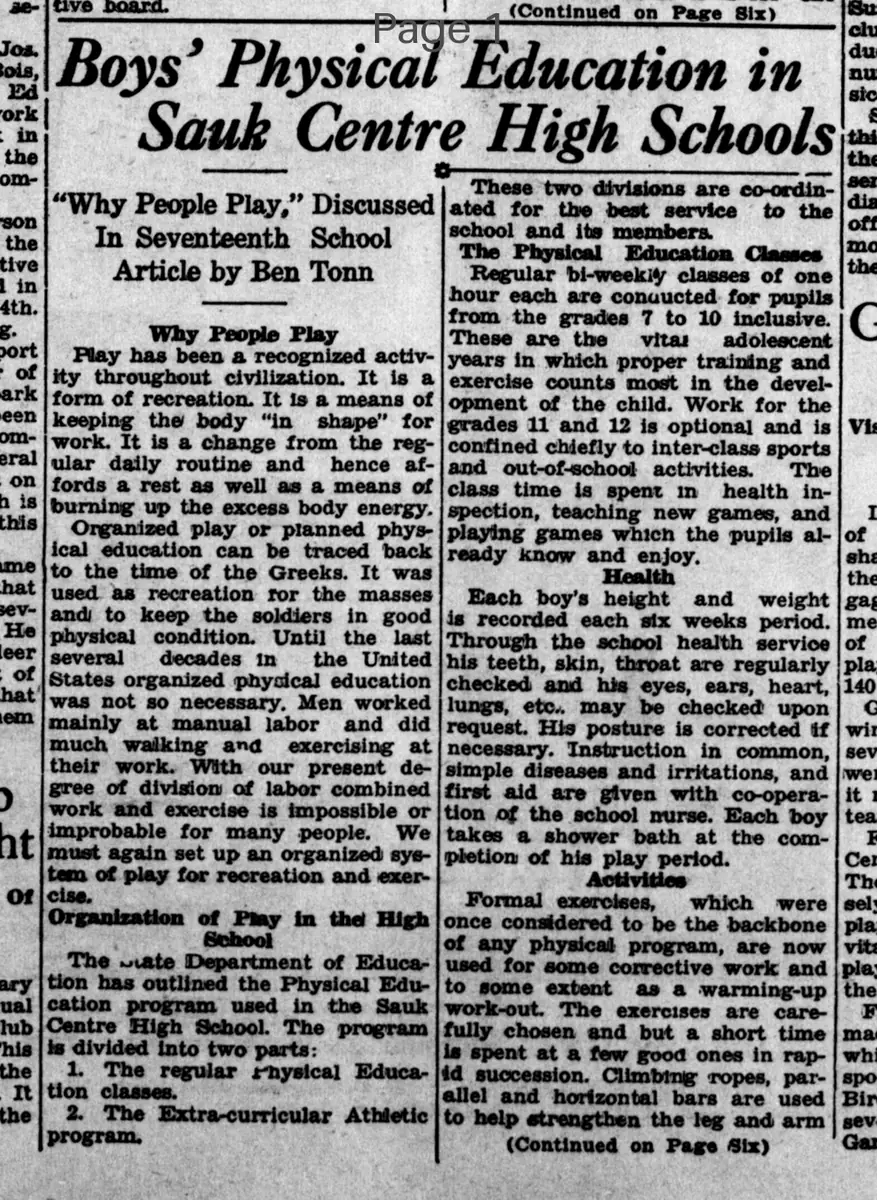
"Why People Play." Discussed In Seventeenth School Article by Ben Tonn
Why People Play
Play has been a recognized activity throughout civilization. It is a form of recreation. It is a means of keeping the body "in shape" for work. It is a change from the regular daily routine and hence affords a rest as well as a means of burning up the excess body energy.
Organized play or planned physical education can be traced back to the time of the Greeks. It was used as recreation for the masses and to keep the soldiers in good physical condition. Until the last several decades in the United States organized physical education was not so necessary. Men worked mainly at manual labor and did much walking and exercising at their work. With our present degree of division of labor combined work and exercise is impossible or improbable for many people. We must again set up an organized system of play for recreation and exercise.
Organization of Play in the High School
The State Department of Education has outlined the Physical Education program used in the Sauk Centre High School. The program is divided into two parts:
1. The regular Physical Education classes.
2. The Extra-curricular Athletic program.
These two divisions are co-ordinated for the best service to the school and its members.
The Physical Education Classes
Regular bi-weekly classes of one hour each are conducted for pupils from the grades 7 to 10 inclusive. These are the vital adolescent years in which proper training and exercise counts most in the development of the child. Work for the grades 11 and 12 is optional and is confined chiefly to inter-class sports and out-of-school activities. The class time is spent in health inspection, teaching new games, and playing games which the pupils already know and enjoy.
Health
Each boy's height and weight is recorded each six weeks period. Through the school health service his teeth, skin, throat are regularly checked and his eyes, ears, heart, lungs, etc. may be checked upon request. His posture is corrected if necessary. Instruction in common, simple diseases and irritations, and first aid are given with co-operation of the school nurse. Each boy takes a shower bath at the completion of his play period.
Activities
Formal exercises, which were once considered to be the backbone of any physical program, are now used for some corrective work and to some extent as a warming-up work-out. The exercises are carefully chosen and but a short time is spent at a few good ones in rapid succession. Climbing ropes, parallel and horizontal bars are used to help strengthen the leg and arm muscles and give better coordination.
Games which can be used in the physical education classes must be chosen so that as many boys as possible can play at one time. This eliminates several of the individual games which are used later in life. These must be encouraged in separate activity periods at the pupil's own initiative but at the suggestion of the teacher in charge. Games used in the class periods, are:
1. Touch football,
2. Soccer ball.
3. Kitteaball
4. Boxing.
5. Gymnastics races
6. Basketball.
7. Volleyball,
8. Track work
9. Wrestling.
10. Tennis (for beginners),
Some of the out-of-school activities which the boys are encouraged to try are:
1. Hockey.
2. Skating.
3. Skiing.
4. Golf.
5. Hiking.
6. Bicycling.
7. Tennis.
8. Swimming.
9. Canoeing and boating:
10. Horseshoe.
11. Others at pupil's suggestion.
The boys are allowed credit per hour competition in these outside of-school, self-organized activities.
Leadership
To make class work more interesting, the classes are divided into squads or teams, each headed by an elected captain. These teams compete among themselves in round-robin schedules which make up tournaments in kittenball, volleyball, basketball, track, touch-football, gymnastics, track, boxing, wrestling, etc. There is also an annual inter-class basketball tournament.
The captain must be the leader of his team, keep records of the team, act as mediator in case of arguments over decisions when no official is appointed. Student managers take charge of the dressing rooms and help to arrange the materials and apparatus necessary for the classes. Each captain and manager is given credit toward his award
A point system wherein a student receives credit toward a physical education letter or award for his efforts and attainments in development. Points are given for:
1. Team leader or student manager.
2. Placing in an individual tournament
3. Passing ability tests.
4. Playing on the team winning a tournament.
5. Hours of out-of-school games as mentioned above.
Efforts are being made to organize a Physical Education Club composed of boys who have earned their athletic awards.
The physical education classes are organized especially for the large group of students of varying athletic ability. Certain boys have special abilities in various sports. Athletics are introduced as an extra-curricular activity in which these boys further develop their
1. Football.
2. Track.
3. Baseball.
4. Basketball.
A group of well-trained boys of good physical-condition and good scholarship represent the Sauk Centre school in the inter-school contests, tournaments and meets.
The junior boys have similar teams in which they learn the fundamentals of the sports. They compete with similar teams from some of the nearby schools in basketball and baseball. In many cases this program is one of the main incentives for keeping boys in school to finish their education and keep them from the unemployed lists.
Outcomes
The Physical Education program has accomplishments which place it with the most important school subjects, Some are listed:
1. Boys learn to play games which develop their bodies and help to keep them in shape.
2. Boys develop skills in balance, flexibility, body and mind co-ordination.
3. Boys form healthful habits of cleanliness, body carriage, disease prevention. They also learn fundamental first aid.
4. Boys learn leadership, followership, good sportsmanship, loyalty courtesy, self-confidence which are carried over into business.
5. Boys learn games which they can use for recreation and body building in later years. This is especially true of such games as tennis, golf, swimming, boating, skiing, skating, etc.
Finally. Physical Education is the school subject which gives the greatest direct value in later life.
What sub-type of article is it?
What keywords are associated?
What entities or persons were involved?
Where did it happen?
Domestic News Details
Primary Location
Sauk Centre High School
Key Persons
Outcome
boys develop physical skills, healthful habits, leadership, sportsmanship, and recreational games for later life.
Event Details
Article discusses the physical education program for boys in grades 7-12 at Sauk Centre High School, including bi-weekly classes with health inspections, games like touch football, soccer, basketball, and out-of-school activities; leadership through team captains and point system for awards; extra-curricular athletics in football, track, baseball, basketball; outcomes include body development, coordination, cleanliness, first aid knowledge, and lifelong recreation skills.