Thank you for visiting SNEWPapers!
Sign up free
Gazette Of The United States
New York, New York County, New York
What is this article about?
Proceedings of the U.S. House of Representatives in Philadelphia from March 8 to April 10, covering debates on Treasury reports, veto override on representation bill, passage of lighthouse and apportionment bills, and other legislative actions including votes and amendments.
Merged-components note: Merged multiple components reporting on congressional proceedings, including the apportionment table, into a single domestic_news component as they form a continuous narrative of House activities.
Clippings
1 of 2
OCR Quality
Full Text
PHILADELPHIA.
HOUSE OF REPRESENTATIVES,
THURSDAY, MARCH 8.
Debate on the resolution reported by a select committee—That the Secretary of the Treasury be directed to report his opinion to the House, on the best mode of raising those additional supplies which the public service may require for the current year.
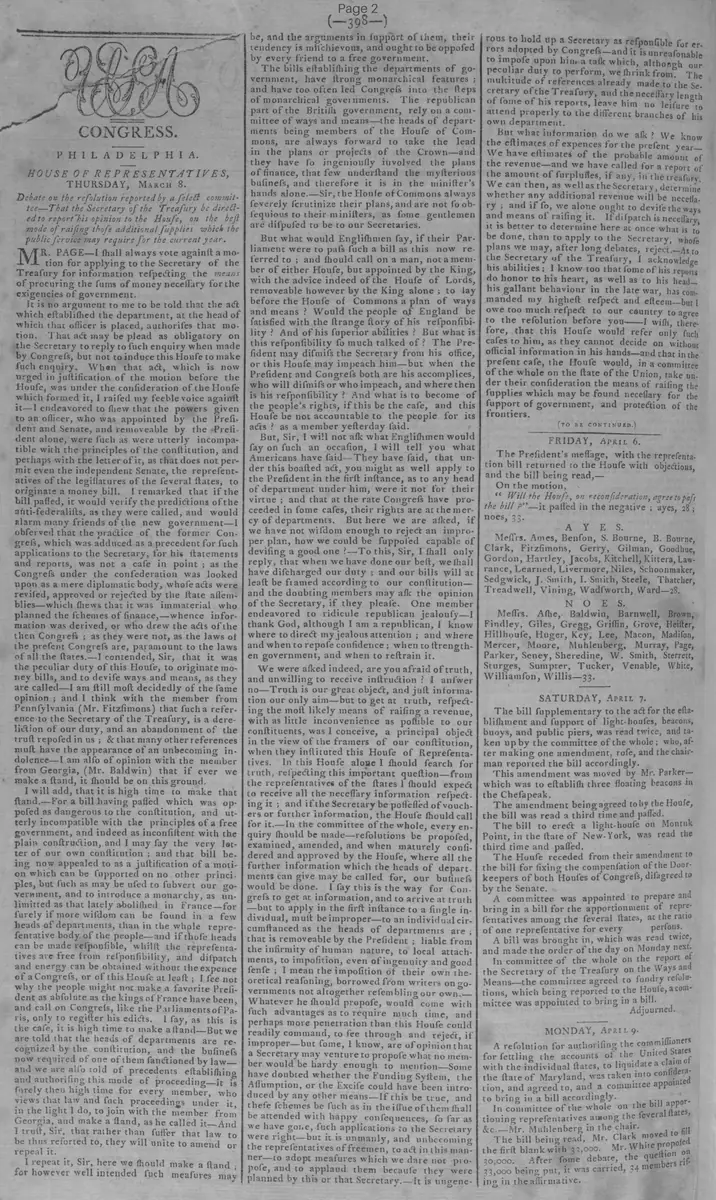
MR. PAGE—I shall always vote against a motion for applying to the Secretary of the Treasury for information respecting the means of procuring the sums of money necessary for the exigencies of government. It is no argument to me to be told that the act which established the department, at the head of which that officer is placed, authorizes that motion. That act may be pleaded as obligatory on the Secretary to reply to such enquiry when made by Congress, but not to induce this House to make such enquiry. When that act, which is now urged in justification of the motion before the House, was under the consideration of the House which formed it, I raised my feeble voice against it—I endeavored to show that the powers given to an officer, who was appointed by the President and Senate, and removable by the President alone, were such as were utterly incompatible with the principles of the constitution, and perhaps with the letter of it, as that does not permit even the independent Senate, the representatives of the legislatures of the several states, to originate a money bill. I remarked that if the bill passed, it would verify the predictions of the anti-federalists, as they were called, and would alarm many friends of the new government—I observed that the practice of the former Congress, which was adduced as a precedent for such applications to the Secretary, for his statements and reports, was not a case in point; as the Congress under the confederation was looked upon as a mere diplomatic body, whose acts were revised, approved or rejected by the state assemblies—which shows that it was immaterial who planned the schemes of finance,—whence information was derived, or who drew the acts of the then Congress; as they were not, as the laws of the present Congress are, paramount to the laws of all the states.—I contended, Sir, that it was the peculiar duty of this House, to originate money bills, and to devise ways and means, as they are called—I am still most decidedly of the same opinion; and I think with the member from Pennsylvania (Mr. Fitzsimons) that such a reference to the Secretary of the Treasury, is a dereliction of our duty, and an abandonment of the trust reposed in us; & that many other references must have the appearance of an unbecoming indolence—I am also of opinion with the member from Georgia, (Mr. Baldwin) that if ever we make a stand, it should be on this ground. I will add, that it is high time to make that stand.—For a bill having passed which was opposed as dangerous to the constitution, and utterly incompatible with the principles of a free government, and indeed as inconsistent with the plain construction, and I may say the very letter of our own constitution; and that bill being now appealed to as a justification of a motion which can be supported on no other principles, but such as may be used to subvert our government, and to introduce a monarchy, as unlimited as that lately abolished in France—for surely if more wisdom can be found in a few heads of departments, than in the whole representative body of the people—and if those heads can be made responsible, whilst the representatives are free from responsibility, and dispatch and energy can be obtained without the expense of a Congress, or of this House at least; I see not why the people might not make a favorite President as absolute as the kings of France have been, and call on Congress, like the Parliaments of Paris, only to register his edicts. I say, as this is the case, it is high time to make a stand—But we are told that the heads of departments are recognized by the constitution, and the business now required of one of them sanctioned by law— and we are also told of precedents establishing and authorizing this mode of proceeding—it is surely then high time for every member, who views that law and such proceedings under it, in the light I do, to join with the member from Georgia, and make a stand, as he called it—And I trust, Sir, that rather than suffer that law to be thus resorted to, they will unite to amend or repeal it. I repeat it, Sir, here we should make a stand: for however well intended such measures may be, and the arguments in support of them, their tendency is mischievous, and ought to be opposed by every friend to a free government.
FRIDAY, APRIL 6.
The President's message, with the representation bill returned to the House with objections, and the bill being read,—
On the motion,
"Will the House, on reconsideration, agree to pass the bill?"—it passed in the negative; ayes, 28; noes, 33.
AYES.
Messrs. Ames, Benson, S. Bourne, B. Bourne, Clark, Fitzsimons, Gerry, Gilman, Goodhue, Gordon, Hartley, Jacobs, Kitchell, Kittera, Lawrence, Learned, Livermore, Niles, Schoonmaker, Sedgwick, J. Smith, I. Smith, Steele, Thatcher, Treadwell, Vining, Wadsworth, Ward—28.
NOES.
Messrs. Ashe, Baldwin, Barnwell, Brown, Findley, Giles, Gregg, Griffin, Grove, Hiester, Hillhouse, Huger, Key, Lee, Macon, Madison, Mercer, Moore, Muhlenberg, Murray, Page, Parker, Seney, Sheredine, W. Smith, Sterrett, Sturges, Sumter, Tucker, Venable, White, Williamson, Willis—33.
SATURDAY, APRIL 7.
The bill supplementary to the act for the establishment and support of light-houses, beacons, buoys, and public piers, was read twice, and taken up by the committee of the whole; who, after making one amendment, rose, and the chairman reported the bill accordingly.
This amendment was moved by Mr. Parker— which was to establish three floating beacons in the Chesapeake.
The amendment being agreed to by the House, the bill was read a third time and passed.
The bill to erect a light-house on Montauk Point, in the state of New-York, was read the third time and passed.
The House receded from their amendment to the bill for fixing the compensation of the Door-keepers of both Houses of Congress, disagreed to by the Senate.
A committee was appointed to prepare and bring in a bill for the apportionment of representatives among the several states, at the ratio of one representative for every 33,000 persons.
and made the order of the day on Monday next.
A bill was brought in, which was read twice,
In committee of the whole on the report of the Secretary of the Treasury on the Ways and Means—the committee agreed to sundry resolutions, which being reported to the House, a committee was appointed to bring in a bill.
Adjourned.
MONDAY, APRIL 9.
A resolution for authorizing the commissioners for settling the accounts of the United States with the individual states, to liquidate a claim of the state of Maryland, was taken into consideration, and agreed to, and a committee appointed to bring in a bill accordingly.
In committee of the whole on the bill apportioning representatives among the several states, &c.—Mr. Muhlenberg in the chair.
The bill being read, Mr. Clark moved to fill the first blank with 33,000. Mr. White proposed 30,000. After some debate, the question on 33,000 being put, it was carried, 34 members rising in the affirmative.
| New-Hampshire | 4 | Delaware | 1 |
| Massachusetts | 14 | Maryland | 8 |
| Vermont | 2 | Virginia | 19 |
| Rhode-Island | 2 | Kentucky | 2 |
| Connecticut | 7 | North-Carolina | 10 |
| New-York | 10 | South-Carolina | 6 |
| New-Jersey | 5 | Georgia | 2 |
| Pennsylvania | 13 |
The committee then rose and reported the bill with one amendment. The House took this amendment into consideration—on the question to agree to the same, the ayes and noes being demanded, are as follow:
AYES.
Messrs. Ames, Barnwell, Benson, S. Bourne, B. Bourne, Boudinot, Clark, Dayton, Fitzsimons, Gilman, Goodhue, Gerry, Gordon, Gregg, Hartley, Heister, Hillhouse, Huger, Jacobs, Kitchell, Kittera, Learned, Livermore, Niles, Sedgwick, J. Smith, I. Smith, W. Smith, Sturges, Sylvester, Thatcher, Vining, Wadsworth, Ward—34.
NOES.
Messrs. Ashe, Baldwin, Brown, Findley, Giles, Griffin, Grove, Key, Lawrence, Lee, Macon, Madison, Mercer, Moore, Muhlenberg, Murray, Page, Parker, Schoonmaker, Seney, Sheredine, Steele, Sterrett, Sumter, Treadwell, Tucker, Venable, White, Williamson, Willis—30.
The blanks were then filled up, as follow:
It was then ordered that the bill be engrossed for a third reading to-morrow.
The bill for altering the times of holding the Circuit Courts, &c. was taken into consideration; some amendments were agreed to, the bill read the third time, and passed.
A Message from the Senate, by Mr. Secretary Otis, informed the House that the Senate have agreed to the amendments of the House to the bill providing for the establishment and support of light-houses, &c.
A communication from the Secretary of War, pursuant to orders from the President of the United States, was read, accompanied with various papers relative to the late expedition under General St. Clair.
In committee of the whole on the bill to extend the time heretofore granted for the payment of duties on certain teas.—Mr. W. Smith in the chair.—The committee made no amendment to the bill, and the House ordered that it be engrossed for a third reading.
In committee of the whole on the bill received from the Senate, concerning Consuls and Vice-Consuls. Mr. B. Bourne in the chair.
The committee went through the discussion of the bill, and made sundry amendments; one of which was to strike out the 8th section—which were reported to the House;—the House took the amendments into consideration, and adopted the same.
Adjourned.
TUESDAY, APRIL 10.
Passed, the bill concerning Consuls and Vice-Consuls—the bill to extend the time heretofore granted for the payment of the duties on certain teas imported since 3d March, 1791—and the new Representation bill.
Mr. Findley, of the committee on the memorial of Henry Hill, reported that it would be proper to annex a provisionary clause to the bill now pending before the House, for the indemnification of the estate of the late Major-General Greene—This report was referred to the committee of the whole on the above bill.
A report was read on the memorial of Moses Young, which was in favor of the memorial.
A bill was read three times, to charge the settlement of a certain claim of the state of Maryland and made the order of the day to-morrow.
In committee of the whole, on the bill to indemnify the estate of the late Maj-General Nathaniel Greene—Mr. Seney in the chair—On motion of Mr. B. Bourne, the provisionary clause above mentioned, was added to the bill—some other amendments were added—and then the committee rose, and the amendments were reported to the House—The House took the same into consideration, and agreed to them, except the proviso—several other amendments were made, and on the question for engrossing, the ayes were 37—noes 23—As follow,
AYES.
Messrs. Ames, Baldwin, Barnwell, Benson, S. Bourne, B. Bourne, Findley, Fitzsimons, Gerry, Giles, Gordon, Gregg, Griffin, Hartley, Heister, Huger, Key, Kittera, Lawrence, Learned, Lee, Livermore, Macon, Mercer, Muhlenberg, Murray, Page, Parker, Sedgwick, Sheredine, W. Smith, Sterrett, Thatcher, Venable, Vining, Wadsworth, Willis—37.
NOES.
Messrs. Ashe, Boudinot, Brown, Clark, Goodhue, Grove, Hillhouse, Jacobs, Kitchell, Moore, Niles, Schoonmaker, Seney, J. Smith, I. Smith, Steele, Sturges, Sumter, Treadwell, Ward, White, Williamson—23.
Mr. Bourne, of the committee of enrollment, reported that they had examined four bills, and found them duly enrolled.
A message was received from the Senate, informing the House that they have passed the bill apportioning Representatives according to the first enumeration.
Another message from the Senate informed the House that they agree to the amendments of the House to the bill for altering the times of holding the circuit Courts, &c. also to the amendments to the bill concerning Consuls and Vice-Consuls.
The House took into consideration the amendments of the Senate to the militia bill—and agreed to the principal part; the consideration of two additional sections proposed by the Senate was postponed till to-morrow—and then the House adjourned.
What sub-type of article is it?
What keywords are associated?
What entities or persons were involved?
Where did it happen?
Domestic News Details
Primary Location
Philadelphia
Event Date
March 8 To April 10
Key Persons
Outcome
representation bill veto sustained (28-33); apportionment bill passed with 33,000 ratio and state allocations; lighthouse bills passed; various other bills passed or amended; votes on amendments and engrossing recorded.
Event Details
House debates resolution for Treasury Secretary report on raising supplies; Mr. Page opposes referencing executive on money matters. President's veto on representation bill sustained. Bills passed for lighthouses, beacons in Chesapeake, Montauk Point; apportionment of representatives at 1 per 33,000 with state numbers; circuit courts times; consuls; tea duties extension; Greene estate indemnification. Communications on St. Clair expedition and Maryland claim.