Thank you for visiting SNEWPapers!
Sign up free
Editorial
November 2, 1862
The Chattanooga Daily Rebel
Chattanooga, Hamilton County, Tennessee
What is this article about?
Confederate editorial urging reliance on God for military success, praising pious generals like Lee and Jackson, criticizing profane officers, and encouraging perseverance amid war reverses, comparing to the Revolutionary War.
Clipping
OCR Quality
85%
Good
Full Text
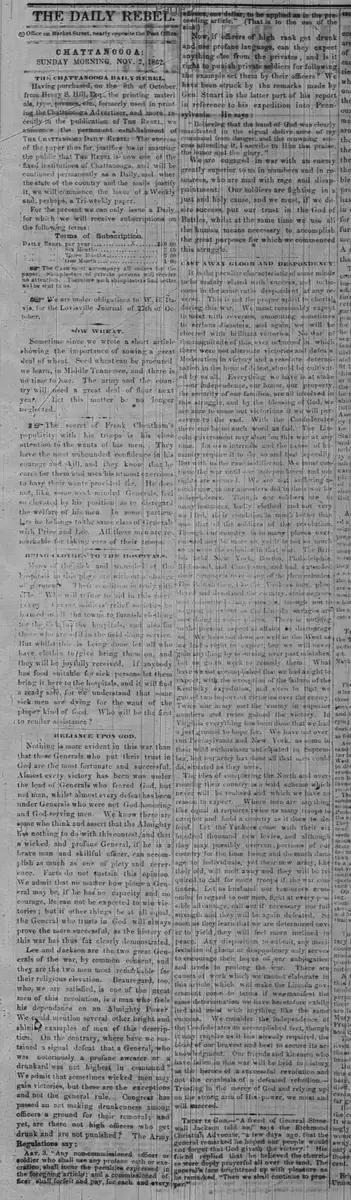
RELIANCE UPON GOD.
Nothing is more evident in this war than that those Generals who put their trust in God are the most fortunate and successful. Almost every victory has been won under the lead of Generals who feared God, but not man, whilst almost every defeat has been under Generals who were not God-honoring and God-serving men. We know there are some who think and assert that the Almighty has nothing to do with this contest, and that a wicked and profane General, if he is a brave man and skillful officer, can accomplish as much as one of piety and reverence. Facts do not sustain this opinion.
We admit that no matter how pious a General may be, if he has no capacity and no courage, he cannot be expected to win victories; but if other things be at all equal, the General who trusts in God will always prove the more successful, as the history of this war has thus far clearly demonstrated.
Lee and Jackson are the two great Generals of the war, by common consent, and they are the two men most remarkable for their religious elevation. Beauregard, too, who, we are satisfied, is one of the great men of this revolution, is a man who feels his dependence on an Almighty Power. We could mention several other bright and shining examples of men of this description. On the contrary, where have we sustained a signal defeat that a General, who was notoriously a profane swearer or a drunkard was not highest in command?
We admit that sometimes wicked men may gain victories, but these are the exceptions and not the general rule. Congress has passed an act making drunkenness among officers a ground for their removal; and yet, are there not high officers who get drunk and are not punished? The Army Regulations say:
Art. 3. 'Any non-commissioned officer or soldier who shall use any profane oath or execration, shall incur the penalties expressed in the foregoing article; and a commissioned officer shall forfeit and pay, for each and every such offence, one dollar, to be applied as in the preceding article.' That is to the use of the sick.
Now, if officers of high rank get drunk and use profane language, can they expect anything else from the privates, and is it right to punish private soldiers for following the example set them by their officers? We have been struck by the remarks made by Gen. Stuart in the latter part of his report in reference to his expedition into Pennsylvania. He says:
'Believing that the hand of God was clearly manifested in the signal deliverance of my command from danger, and the crowning success attending it I ascribe to Him the praise, the honor, and the glory.'
We are engaged in war with an enemy greatly superior to us in numbers and in resources, who are mad with rage and disappointment. Our soldiers are fighting in a just and holy cause, and we must, if we desire success, put our trust in the God of Battles, whilst at the same time we use all the human means necessary to accomplish the great purposes for which we commenced this struggle.
[Continuation from Reading Order 2]
Enemies unduly elated with success, and to be confident in the same ratio despondent at any reverse. This is not the proper spirit to cherish during this war. We must reasonably expect to meet with reverses, amounting sometimes to serious disasters, and again we will be cheered with brilliant victories. No war of the magnitude of this ever occurred in which there were not alternate victories and defeats. Moderation in victory and a resolute determination in the hour of defeat, should be cultivated by us all. Everything we have is at stake—our independence, our honor, our property, the security of our families; are all involved in this struggle, and by the blessing of God, we are sure to come out victorious if we will persevere to the end. With the Confederates there can be no such word as fail. The Lincoln government may abandon this war at any time its interests and the cause of humanity require it to do so and that speedily. But with us the case is different. We must continue the war until our independence and our rights are secure. We are now suffering as our ancestors did in their war for independence. Though our soldiers be in many instances badly clothed and not well fed, their condition is much better than was that of the soldiers of the revolution. Though our country is in many places overrun and may be more so, yet it is not so much so as were the colonies in that war. The British held New York, Boston, Philadelphia, Richmond, and Charleston, and had extended their conquests over many of the thirteen colonies. They had then, like Yankees now, plundered and desolated the country, stole negroes at one time, though not to so great an extent as Lincoln savages are now in some places. There is nothing in the present aspect of affairs to discourage us. We have not done so well in the West as we had a right to expect but we will never gain anything by mourning over past mistakes. Let us go to work to remedy them. What have we not accomplished that we had a right to expect, with the exception of the failure of the Kentucky expedition, and even in that we gained two important victories over the enemy. Twice our army met the enemy in superior numbers and, twice gained the victory. In Virginia everything has been done that we had a just ground to hope for. We have not overrun Pennsylvania and New York, as some in their wild enthusiasm anticipated in September, but our army has done all that men could do, situated as they were.
The idea of conquering the North and overrunning their country is a wild scheme which never will be realized and which we have no reason to expect. Where men are anything like equal it requires twice as many troops to conquer and hold a country as it does to defend. Let the Yankees come with their six hundred thousand new levies, and although they may possibly overrun portions of our country for the time being and do much damage to individuals, yet their new army, like their old, will melt away and they will be required to call for more troops if the war continues. Let us husband our resources—economize in regard to our men, fight at every possible advantage, call out if necessary our full strength and they will be again defeated. So soon as they learn that we are determined never to yield they will feel more inclined to peace. Any disposition to submit, any manifestation of gloom or despondency only serves to encourage their hopes of our subjugation and tends to prolong the war. There are causes at work which we cannot elaborate in this article which will make the Lincoln government come to terms if we maintain the same determination we have heretofore exhibited and meet with anything like the same success. We consider the independence of the Confederates an accomplished fact, though it may require, as it has already required, the blood of our bravest and best to secure its acknowledgment. Our friends and kinsmen who have fallen in this war will be held in history as the heroes of a successful revolution and not the criminals of a defeated rebellion.
Trusting in the mercy of God and relying upon the strong arm of His power, we must and will succeed.
TRUST IN GOD.—'A friend of General Stonewall Jackson told us,' says the Richmond Christian Advocate, 'a few days ago, that the general remarked he hoped our people would not forget that God giveth the victory. His friend replied that he believed the churches were deeply prayerful all over the land. The general's face brightened up with pleasure as he remarked, "Then we shall continue to prosper."'
Nothing is more evident in this war than that those Generals who put their trust in God are the most fortunate and successful. Almost every victory has been won under the lead of Generals who feared God, but not man, whilst almost every defeat has been under Generals who were not God-honoring and God-serving men. We know there are some who think and assert that the Almighty has nothing to do with this contest, and that a wicked and profane General, if he is a brave man and skillful officer, can accomplish as much as one of piety and reverence. Facts do not sustain this opinion.
We admit that no matter how pious a General may be, if he has no capacity and no courage, he cannot be expected to win victories; but if other things be at all equal, the General who trusts in God will always prove the more successful, as the history of this war has thus far clearly demonstrated.
Lee and Jackson are the two great Generals of the war, by common consent, and they are the two men most remarkable for their religious elevation. Beauregard, too, who, we are satisfied, is one of the great men of this revolution, is a man who feels his dependence on an Almighty Power. We could mention several other bright and shining examples of men of this description. On the contrary, where have we sustained a signal defeat that a General, who was notoriously a profane swearer or a drunkard was not highest in command?
We admit that sometimes wicked men may gain victories, but these are the exceptions and not the general rule. Congress has passed an act making drunkenness among officers a ground for their removal; and yet, are there not high officers who get drunk and are not punished? The Army Regulations say:
Art. 3. 'Any non-commissioned officer or soldier who shall use any profane oath or execration, shall incur the penalties expressed in the foregoing article; and a commissioned officer shall forfeit and pay, for each and every such offence, one dollar, to be applied as in the preceding article.' That is to the use of the sick.
Now, if officers of high rank get drunk and use profane language, can they expect anything else from the privates, and is it right to punish private soldiers for following the example set them by their officers? We have been struck by the remarks made by Gen. Stuart in the latter part of his report in reference to his expedition into Pennsylvania. He says:
'Believing that the hand of God was clearly manifested in the signal deliverance of my command from danger, and the crowning success attending it I ascribe to Him the praise, the honor, and the glory.'
We are engaged in war with an enemy greatly superior to us in numbers and in resources, who are mad with rage and disappointment. Our soldiers are fighting in a just and holy cause, and we must, if we desire success, put our trust in the God of Battles, whilst at the same time we use all the human means necessary to accomplish the great purposes for which we commenced this struggle.
[Continuation from Reading Order 2]
Enemies unduly elated with success, and to be confident in the same ratio despondent at any reverse. This is not the proper spirit to cherish during this war. We must reasonably expect to meet with reverses, amounting sometimes to serious disasters, and again we will be cheered with brilliant victories. No war of the magnitude of this ever occurred in which there were not alternate victories and defeats. Moderation in victory and a resolute determination in the hour of defeat, should be cultivated by us all. Everything we have is at stake—our independence, our honor, our property, the security of our families; are all involved in this struggle, and by the blessing of God, we are sure to come out victorious if we will persevere to the end. With the Confederates there can be no such word as fail. The Lincoln government may abandon this war at any time its interests and the cause of humanity require it to do so and that speedily. But with us the case is different. We must continue the war until our independence and our rights are secure. We are now suffering as our ancestors did in their war for independence. Though our soldiers be in many instances badly clothed and not well fed, their condition is much better than was that of the soldiers of the revolution. Though our country is in many places overrun and may be more so, yet it is not so much so as were the colonies in that war. The British held New York, Boston, Philadelphia, Richmond, and Charleston, and had extended their conquests over many of the thirteen colonies. They had then, like Yankees now, plundered and desolated the country, stole negroes at one time, though not to so great an extent as Lincoln savages are now in some places. There is nothing in the present aspect of affairs to discourage us. We have not done so well in the West as we had a right to expect but we will never gain anything by mourning over past mistakes. Let us go to work to remedy them. What have we not accomplished that we had a right to expect, with the exception of the failure of the Kentucky expedition, and even in that we gained two important victories over the enemy. Twice our army met the enemy in superior numbers and, twice gained the victory. In Virginia everything has been done that we had a just ground to hope for. We have not overrun Pennsylvania and New York, as some in their wild enthusiasm anticipated in September, but our army has done all that men could do, situated as they were.
The idea of conquering the North and overrunning their country is a wild scheme which never will be realized and which we have no reason to expect. Where men are anything like equal it requires twice as many troops to conquer and hold a country as it does to defend. Let the Yankees come with their six hundred thousand new levies, and although they may possibly overrun portions of our country for the time being and do much damage to individuals, yet their new army, like their old, will melt away and they will be required to call for more troops if the war continues. Let us husband our resources—economize in regard to our men, fight at every possible advantage, call out if necessary our full strength and they will be again defeated. So soon as they learn that we are determined never to yield they will feel more inclined to peace. Any disposition to submit, any manifestation of gloom or despondency only serves to encourage their hopes of our subjugation and tends to prolong the war. There are causes at work which we cannot elaborate in this article which will make the Lincoln government come to terms if we maintain the same determination we have heretofore exhibited and meet with anything like the same success. We consider the independence of the Confederates an accomplished fact, though it may require, as it has already required, the blood of our bravest and best to secure its acknowledgment. Our friends and kinsmen who have fallen in this war will be held in history as the heroes of a successful revolution and not the criminals of a defeated rebellion.
Trusting in the mercy of God and relying upon the strong arm of His power, we must and will succeed.
TRUST IN GOD.—'A friend of General Stonewall Jackson told us,' says the Richmond Christian Advocate, 'a few days ago, that the general remarked he hoped our people would not forget that God giveth the victory. His friend replied that he believed the churches were deeply prayerful all over the land. The general's face brightened up with pleasure as he remarked, "Then we shall continue to prosper."'
What sub-type of article is it?
Moral Or Religious
Military Affairs
What keywords are associated?
Reliance On God
Pious Generals
Confederate Morale
War Perseverance
Religious Elevation
What entities or persons were involved?
Lee
Jackson
Beauregard
Gen. Stuart
Lincoln Government
Confederates
Editorial Details
Primary Topic
Reliance On God For Success In The Civil War
Stance / Tone
Encouraging Trust In God And Perseverance
Key Figures
Lee
Jackson
Beauregard
Gen. Stuart
Lincoln Government
Confederates
Key Arguments
Pious Generals Like Lee And Jackson Achieve Victories
Profane Or Drunken Officers Lead To Defeats
Army Regulations Against Profanity And Drunkenness Should Be Enforced
Maintain Moderation In Victory And Resolve In Defeat
Compare Current Struggles Favorably To Revolutionary War
Confederate Independence Is Assured With Perseverance And Divine Trust