Thank you for visiting SNEWPapers!
Sign up free
The New York Journal, And Daily Patriotic Register
New York, New York County, New York
What is this article about?
Transcript of debates at the New-York Ratifying Convention on June 20, 1788, where the Chancellor responds to criticisms and Mr. M. Smith objects to the representation clause in Article I, Section 2 of the proposed U.S. Constitution, emphasizing fair representation and risks of corruption.
Clipping
OCR Quality
Full Text
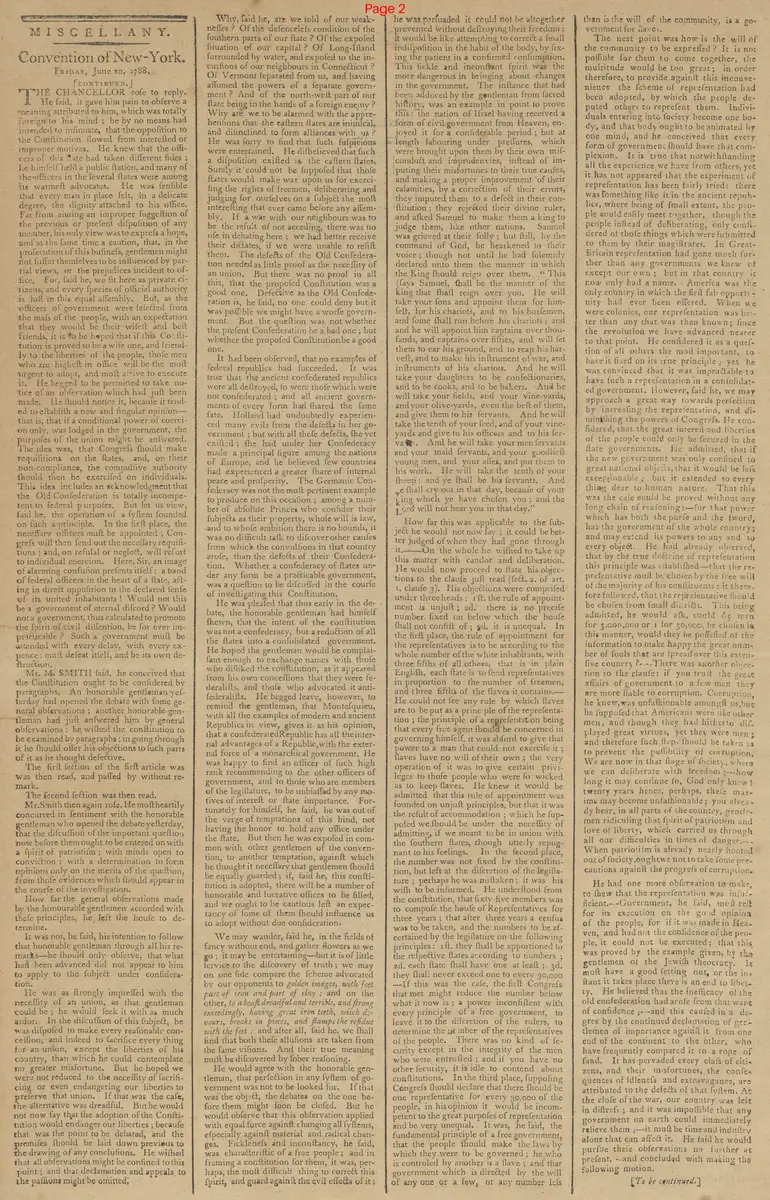
Convention of New-York.
FRIDAY, June 20, 1788.
[CONTINUED.]
The CHANCELLOR rose to reply. He said, it gave him pain to observe a meaning attributed to him, which was totally foreign to his mind; he by no means had intended to insinuate, that the opposition to the Constitution flowed from interested or improper motives. He knew that the officers of this state had taken different sides; he himself held a public station, and many of the officers in the several states were among its warmest advocates. He was sensible that every man in place felt, in a delicate degree, the dignity attached to his office. Far from aiming an improper suggestion of the previous or present disposition of any member, his only view was to express a hope, and at the same time a caution, that, in the prosecution of this business, gentlemen might not suffer themselves to be influenced by partial views, or the prejudices incident to office. For, said he, we sit here as private citizens, and every species of official authority is lost in this equal assembly. But, as the officers of government were selected from the mass of the people, with an expectation that they would be their wisest and best friends, it is to be hoped that if this Constitution is proved to be a wise one, and friendly to the liberties of the people, those men who are highest in office will be the most urgent to adopt, and most active to execute it. He begged to be permitted to take notice of an observation which had just been made. He should notice it, because it tended to establish a new and singular opinion—that is, that if a conditional power of coercion only, was lodged in the government, the purposes of the union might be answered. The idea was, that Congress should make requisitions on the states, and, on their non-compliance, the compulsive authority should then be exercised on individuals. This idea includes an acknowledgment that the Old Confederation is totally incompetent to federal purposes. But let us view, said he, the operation of a system founded on such a principle. In the first place, the necessary officers must be appointed; Congress will then send out the necessary requisitions; and, on refusal or neglect, will resort to individual coercion. Here, Sir, an image of alarming confusion presents itself: a band of federal officers in the heart of a state, acting in direct opposition to the declared sense of its united inhabitants! Would not this be a government of eternal discord? Would not a government, thus calculated to promote the spirit of civil dissension, be for ever impracticable? Such a government must be attended with every delay, with every expense: must defeat itself, and be its own destruction.
Mr. M. SMITH said, he conceived that the Constitution ought to be considered by paragraphs. An honorable gentleman yesterday had opened the debate with some general observations; another honorable gentleman had just answered him by general observations: he wished the constitution to be examined by paragraphs; in going through it he should offer his objections to such parts of it as he thought defective. The first section of the first article was then read, and passed by without remark. The second section was then read.
Mr. Smith then again rose. He most heartily concurred in sentiment with the honorable gentleman who opened the debate yesterday, that the discussion of the important question now before them ought to be entered on with a spirit of patriotism; with minds open to conviction; with a determination to form opinions only on the merits of the question, from those evidences which should appear in the course of the investigation. How far the general observations made by the honourable gentlemen accorded with these principles, he left the house to determine.
It was not, he said, his intention to follow that honorable gentleman through all his remarks—he should only observe, that what had been advanced did not appear to him to apply to the subject under consideration. He was as strongly impressed with the necessity of an union, as that gentleman could be; he would seek it with as much ardor. In the discussion of this subject, he was disposed to make every reasonable concession, and indeed to sacrifice every thing for an union, except the liberties of his country, than which he could contemplate no greater misfortune. But he hoped we were not reduced to the necessity of sacrificing or even endangering our liberties to preserve that union. If that was the case, the alternative was dreadful. But he would not now say that the adoption of the Constitution would endanger our liberties; because that was the point to be debated, and the premises should be laid down previous to the drawing of any conclusions. He wished that all observations might be confined to this point; and that declamation and appeals to the passions might be omitted.
Why, said he, are we told of our weaknesses? Of the defenceless condition of the southern parts of our state? Of the exposed situation of our capital? Of Long-Island surrounded by water, and exposed to the incursions of our neighbours in Connecticut? Of Vermont separated from us, and having assumed the powers of a separate government? And of the north-west part of our state being in the hands of a foreign enemy? Why are we to be alarmed with the apprehensions that the eastern states are inimical, and disinclined to form alliances with us? He was sorry to find that such suspicions were entertained. He disbelieved that such a disposition existed in the eastern states. Surely it could not be supposed that those states would make war upon us or exercising the rights of freemen, deliberating and judging for ourselves on a subject the most interesting that ever came before any assembly. If a war with our neighbours was to be the result of not acceding, there was no use in debating here: we had better receive their dictates, if we were unable to resist them. The defects of the Old Confederation needed as little proof as the necessity of an union. But there was no proof in all this, that the proposed Constitution was a good one. Defective as the Old Confederation is, he said, no one could deny but it was possible we might have a worse government. But the question was not whether the present Confederation be a bad one: but whether the proposed Constitution be a good one.
It had been observed, that no examples of federal republics had succeeded. It was true that the ancient confederated republics were all destroyed, so were those which were not confederated; and all ancient governments of every form had shared the same fate. Holland had undoubtedly experienced many evils from the defects in her government; but with all these defects, she yet existed; she had under her Confederacy made a principal figure among the nations of Europe, and he believed few countries had experienced a greater share of internal peace and prosperity. The Germanic Confederacy was not the most pertinent example to produce on this occasion; among a number of absolute Princes who consider their subjects as their property, whose will is law, and to whose ambition there is no bounds, it was no difficult task to discover other causes from which the convulsions in that country arose, than the defects of their Confederation. Whether a confederacy of states under any form be a practicable government, was a question to be discussed in the course of investigating this Constitution.
He was pleased that thus early in the debate, the honorable gentleman had himself shewn, that the intent of the constitution was not a confederacy, but a reduction of all the states into a consolidated government. He hoped the gentleman would be complaisant enough to exchange names with those who disliked the constitution, as it appeared from his own concessions that they were federalists, and those who advocated it anti-federalists. He begged leave, however, to remind the gentleman, that Montesquieu, with all the examples of modern and ancient Republics in view, gives it as his opinion, that a confederated Republic has all the internal advantages of a Republic, with the external force of a monarchical government. He was happy to find an officer of such high rank recommending to the other officers of government, and to those who are members of the legislature, to be unbiased by any motives of interest or state importance. Fortunately for himself, he said, he was out of the verge of temptations of this kind, not having the honor to hold any office under the state. But then he was exposed in common with other gentlemen of the convention, to another temptation, against which he thought it necessary that gentlemen should be equally guarded; if, said he, this constitution is adopted, there will be a number of honorable and lucrative offices to be filled, and we ought to be cautious lest an expectancy of some of them should influence us to adopt without due consideration.
We may wander, said he, in the fields of fancy without end, and gather flowers as we go; it may be entertaining—but it is of little service to the discovery of truth; we may on one side compare the scheme advocated by our opponents to golden images, with feet part of iron and part of clay; and on the other, to a beast dreadful and terrible, and strong exceedingly, having great iron teeth, which devours, breaks in pieces, and stamps the residue with the feet: and after all, said he, we shall find that both these allusions are taken from the same visions. And their true meaning must be discovered by sober reasoning.
He would agree with the honorable gentleman, that perfection in any system of government was not to be looked for. If that was the object, the debates on the one before them might soon be closed. But he would observe that this observation applied with equal force against changing all systems, especially against material and radical changes. Fickleness and inconstancy, he said, was characteristic of a free people; and in framing a constitution for them, it was, perhaps, the most difficult thing to correct this spirit, and guard against the evil effects of it; he was persuaded it could not be altogether prevented without destroying their freedom: it would be like attempting to correct a small indisposition in the habit of the body, by fixing the patient in a confirmed consumption. This fickle and inconstant spirit was the more dangerous in bringing about changes in the government. The instance that had been adduced by the gentleman from sacred history, was an example in point to prove this: the nation of Israel having received a form of civil government from Heaven, enjoyed it for a considerable period; but at length labouring under pressures, which were brought upon them by their own misconduct and imprudencies, instead of imputing their misfortunes to their true causes, and making a proper improvement of their calamities, by a correction of their errors, they imputed them to a defect in their constitution; they rejected their divine ruler, and asked Samuel to make them a king to judge them, like other nations. Samuel was grieved at their folly; but still, by the command of God, he hearkened to their voice; though not until he had solemnly declared unto them the manner in which the King should reign over them. "This (says Samuel) shall be the manner of the king that shall reign over you. He will take your sons and appoint them for himself, for his chariots, and to his horsemen, and some shall run before his chariots; and he will appoint him captains over thousands, and captains over fifties, and will set them to ear his ground, and to reap his harvest, and to make his instruments of war, and instruments of his chariots. And he will take your daughters to be confectionaries, and to be cooks, and to be bakers. And he will take your fields, and your vineyards, and your olive-yards, even the best of them, and give them to his servants. And he will take the tenth of your seed, and of your vineyards and give to his officers and to his servants. And he will take your men servants and your maid servants, and your goodliest young men, and your asses, and put them to his work. He will take the tenth of your sheep: and ye shall be his servants. And ye shall cry out in that day, because of your king which ye have chosen you; and the Lord will not hear you in that day."
How far this was applicable to the subject he would not now say; it could be better judged of when they had gone through it. On the whole he wished to take up this matter with candor and deliberation. He would now proceed to state his objections to the clause just read (sect. 2. of art. I, clause 3). His objections were comprised under three heads: 1st. the rule of appointment is unjust; 2d. there is no precise number, fixed on below which the house shall not consist of: 3d. it is unequal. In the first place, the rule of appointment for the representatives is to be according to the whole number of the white inhabitants, with three fifths of all others, that is in plain English, each state is to send representatives in proportion to the number of freemen, and three fifths of the slaves it contains. He could not see any rule by which slaves are to be put as a principle of the representation; the principle of a representation being that every free agent should be concerned in governing himself, it was absurd to give that power to a man that could not exercise it; slaves have no will of their own; the very operation of it was to give certain privileges to those people who were so wicked as to keep slaves. He knew it would be admitted that this rule of appointment was founded on unjust principles, but that it was the result of accommodation; which he supposed we should be under the necessity of admitting, if we meant to be in union with the southern states, though utterly repugnant to his feelings. In the second place, the number was not fixed by the constitution, but left at the discretion of the legislature; perhaps he was mistaken; it was his wish to be informed. He understood from the constitution, that sixty-five members was to compose the house of Representatives for three years; that after three years a census was to be taken, and the numbers to be ascertained by the legislature on the following principles: 1st. they shall be apportioned to the respective states according to numbers: 2d, each state shall have one at least; 3d. they shall never exceed one to every 30,000 ———If this was the case, the first Congress that met might reduce the number below what it now is; a power inconsistent with every principle of a free government, to leave it to the discretion of the rulers, to determine the number of the representatives of the people. There was no kind of security except in the integrity of the men who were entrusted; and if you have no other security, it is idle to contend about constitutions. In the third place, supposing Congress should declare that there should be one representative for every 30,000 of the people, in his opinion it would be incompetent to the great purposes of representation and be very unequal. It was, he said, the fundamental principle of a free government, that the people should make the laws by which they were to be governed; he who is controlled by another is a slave; and that government which is directed by the will of any one or a few, or any number less than is the will of the community, is a government for slaves.
The next point was how is the will of the community to be expressed? It is not possible for them to come together, the multitude would be too great; in order therefore, to provide against this inconvenience the scheme of representation had been adopted, by which the people deputed others to represent them. Individuals entering into society become one body, and that body ought to be animated by one mind, and he conceived that every form of government should have that complexion. It is true that notwithstanding all the experience we have from others, yet it has not appeared that the experiment of representation has been fairly tried: there was something like it in the ancient republics, where being of small extent, the people could easily meet together, though the people instead of deliberating, only considered of those things which were submitted to them by their magistrates. In Great-Britain representation had gone much further than any governments we knew of except our own; but in that country it now only had a name. America was the only country in which the first fair opportunity had ever been offered. When we were colonies, our representation was better than any that was then known; since the revolution we have advanced nearer to that point. He considered it as a question of all others the most important, to have it fixed on its true principle; yet he was convinced that it was impracticable to have such a representation in a consolidated government. However, said he, we may approach a great way towards perfection by increasing the representation, and diminishing the powers of Congress. He considered, that the great interest and liberties of the people could only be secured in the state governments. He admitted, that if the new government was only confined to great national objects, that it would be less exceptionable; but it extended to every thing dear to human nature. That this was the case could be proved without any long chain of reasoning: for that power which has both the purse and the sword, has the government of the whole country; and may extend its powers to any, and to every object. He had already observed, that by the true doctrine of representation this principle was established—that the representative must be chosen by the free will of the majority of his constituents: it therefore followed, that the representative should be chosen from small districts. This being admitted, he would ask, could 65 men for 3,000,000 or 1 for 30,000, be chosen in this manner, would they be possessed of the information to make happy the great number of souls that are spread over this extensive country? There was another objection to the clause: if you trust the great affairs of government to a few men they are more liable to corruption. Corruption, he knew, was unfashionable amongst us, but he supposed that Americans were like other men; and though they had hitherto displayed great virtues, yet they were men; and therefore such steps should be taken as to prevent the possibility of corruption. We are now in that stage of society, where we can deliberate with freedom ;---how long it may continue so, God only knew! twenty years hence, perhaps, these maxims may become unfashionable; you already hear, in all parts of the country, gentlemen ridiculing that spirit of patriotism and love of liberty, which carried us through all our difficulties in times of danger. When patriotism is already nearly hooted out of society, ought we not to take some precautions against the progress of corruption?
He had one more observation to make, to shew that the representation was insufficient. Government, he said, must rest for its execution on the good opinion of the people, for if it was made in Heaven, and had not the confidence of the people, it could not be executed; that this was proved by the example given, by the gentlemen of the Jewish theocracy. It must have a good setting out, or the instant it takes place there is an end to liberty. He believed that the inefficacy of the old confederation had arose from that want of confidence ;—and this caused in a degree by the continued declamation of gentlemen of importance against it from one end of the continent to the other, who have frequently compared it to a rope of sand. It has pervaded every class of citizens, and their misfortunes, the consequences of idleness and extravagance, are attributed to the defects of that system. At the close of the war, our country was left in distress; and it was impossible that any government on earth could immediately relieve them ;---it must be time and industry alone that can effect it. He said he would pursue these observations no further at present, —and concluded with making the following motion.
[To be continued.]
What sub-type of article is it?
What keywords are associated?
What entities or persons were involved?
Where did it happen?
Domestic News Details
Primary Location
New York
Event Date
Friday, June 20, 1788
Key Persons
Event Details
The Chancellor defends his earlier remarks on impartiality in the debate over the Constitution and critiques a proposed system of conditional coercion. Mr. M. Smith advocates for paragraph-by-paragraph examination, concurs on the need for union but prioritizes liberties, objects to the representation rule in Article I, Section 2 for including slaves, lacking a fixed minimum number of representatives, and being unequal and prone to corruption.