Thank you for visiting SNEWPapers!
Sign up free
Editorial
October 1, 1838
Lynchburg Virginian
Lynchburg, Virginia
What is this article about?
Editorial defends Henry Clay against charges of favoring heavy internal improvement spending, accuses Jackson administration of hypocrisy by vetoing Maysville Road for personal reasons while approving and spending far more on similar projects than Adams did. Compares expenditures: Adams $490,814 (1825-1828); Jackson $6,102,463 (1829-1836).
Clipping
OCR Quality
95%
Excellent
Full Text
"PRECEPT AND PRACTICE."
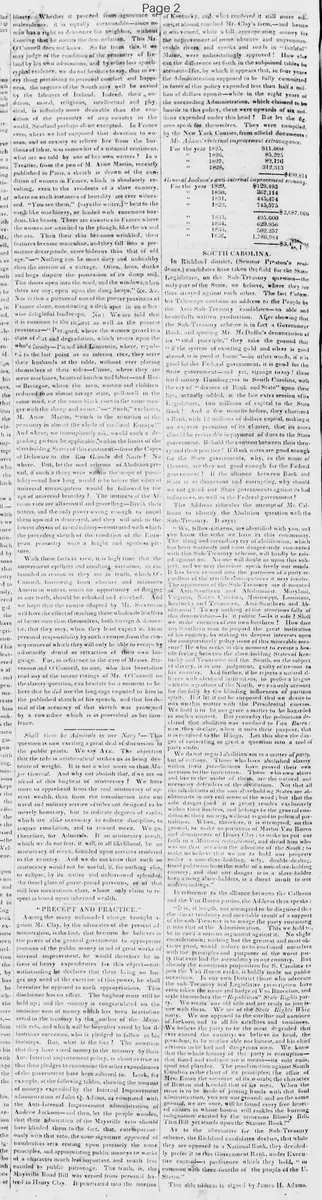
Among the many unfounded charges brought against Mr. Clay, by the advocates of the present administration, is the fact, that because he believes in the power of the general government to appropriate portions of the public money in aid of great works of internal improvement, he would therefore be in favor of heavy expenditures for this object—notwithstanding he declares that there being no longer any need of the exercise of this power, he shall hereafter be opposed to such appropriations. This disclaimer has no effect. The bugbear must still be held up; and the country is congratulated on the immense sum of money which has been heretofore saved to the treasury by the author of the Maysville veto, and which will be hereafter saved by his illustrious successor, who is pledged to follow in his footsteps. But, what is the fact? The assertion that they have saved money to the treasury by their Anti-Internal improvement policy, is about as true as that their pledges to economize the other expenditures of the government have been adhered to. Look, for example, at the following tables, showing the amount of moneys expended by the Internal Improvement administration of John Q. Adams, as compared with the Anti-Internal Improvement administration of Andrew Jackson—and then, let the people wonder that their admiration of the Maysville veto should have blinded them to the fact, that, cotemporaneously with that veto, the same signature approved of numberless acts resting upon precisely the same principles, and appropriating public moneys to works of a character much less important, and much less entitled to public patronage. The truth, is, the Maysville Road Bill was vetoed from personal hatred to Henry Clay. It penetrated into the interior of Kentucky, and, what rendered it still more odious, it almost touched Mr. Clay's farm,—and hence it was vetoed, while a bill appropriating money for the improvement of some obscure and unpronounceable rivers and creeks and roads in "faithful" Maine, were unhesitatingly approved! How else can the difference set forth in the subjoined tables be accounted for, by which it appears that, in four years the Administration supposed to be fully committed in favor of this policy expended less than half a million of dollars upon it—while in the eight years of the succeeding Administration, which claimed to be hostile to this policy, there were upwards of six millions expended under this head? But let the figures speak for themselves. They were compiled, by the New York Courier, from official documents:
Mr. Adams's internal improvement extravagance.
For the year 1825, $11,000
1826, 85,325
1827, 82,176
1828, 312,313
$490,814
General Jackson's anti-internal improvement economy.
For the year 1829, $129,493
1830, 367,114
1831, 445,474
1832, 745,575
$2,687,666
1833, 495,600
1834, 629,956
1835, 502,257
1836, 1,786,984
$3,414,797
Among the many unfounded charges brought against Mr. Clay, by the advocates of the present administration, is the fact, that because he believes in the power of the general government to appropriate portions of the public money in aid of great works of internal improvement, he would therefore be in favor of heavy expenditures for this object—notwithstanding he declares that there being no longer any need of the exercise of this power, he shall hereafter be opposed to such appropriations. This disclaimer has no effect. The bugbear must still be held up; and the country is congratulated on the immense sum of money which has been heretofore saved to the treasury by the author of the Maysville veto, and which will be hereafter saved by his illustrious successor, who is pledged to follow in his footsteps. But, what is the fact? The assertion that they have saved money to the treasury by their Anti-Internal improvement policy, is about as true as that their pledges to economize the other expenditures of the government have been adhered to. Look, for example, at the following tables, showing the amount of moneys expended by the Internal Improvement administration of John Q. Adams, as compared with the Anti-Internal Improvement administration of Andrew Jackson—and then, let the people wonder that their admiration of the Maysville veto should have blinded them to the fact, that, cotemporaneously with that veto, the same signature approved of numberless acts resting upon precisely the same principles, and appropriating public moneys to works of a character much less important, and much less entitled to public patronage. The truth, is, the Maysville Road Bill was vetoed from personal hatred to Henry Clay. It penetrated into the interior of Kentucky, and, what rendered it still more odious, it almost touched Mr. Clay's farm,—and hence it was vetoed, while a bill appropriating money for the improvement of some obscure and unpronounceable rivers and creeks and roads in "faithful" Maine, were unhesitatingly approved! How else can the difference set forth in the subjoined tables be accounted for, by which it appears that, in four years the Administration supposed to be fully committed in favor of this policy expended less than half a million of dollars upon it—while in the eight years of the succeeding Administration, which claimed to be hostile to this policy, there were upwards of six millions expended under this head? But let the figures speak for themselves. They were compiled, by the New York Courier, from official documents:
Mr. Adams's internal improvement extravagance.
For the year 1825, $11,000
1826, 85,325
1827, 82,176
1828, 312,313
$490,814
General Jackson's anti-internal improvement economy.
For the year 1829, $129,493
1830, 367,114
1831, 445,474
1832, 745,575
$2,687,666
1833, 495,600
1834, 629,956
1835, 502,257
1836, 1,786,984
$3,414,797
What sub-type of article is it?
Infrastructure
Partisan Politics
Economic Policy
What keywords are associated?
Internal Improvements
Maysville Veto
Henry Clay
Andrew Jackson
Government Expenditures
Public Works
What entities or persons were involved?
Mr. Clay
John Q. Adams
Andrew Jackson
New York Courier
Editorial Details
Primary Topic
Hypocrisy In Jackson Administration's Internal Improvement Expenditures
Stance / Tone
Strongly Anti Jackson, Pro Clay
Key Figures
Mr. Clay
John Q. Adams
Andrew Jackson
New York Courier
Key Arguments
Clay Believes In Government's Power For Internal Improvements But Opposes Current Appropriations Due To No Need
Jackson's Veto Of Maysville Road Was Due To Personal Hatred For Clay, Not Policy
Jackson Approved Similar Appropriations Elsewhere Despite Veto
Adams Administration Spent Less Than Half A Million On Internal Improvements In Four Years
Jackson Administration Spent Over Six Million In Eight Years Despite Claiming Opposition