Thank you for visiting SNEWPapers!
Sign up free
Virginia Argus
Richmond, Virginia
What is this article about?
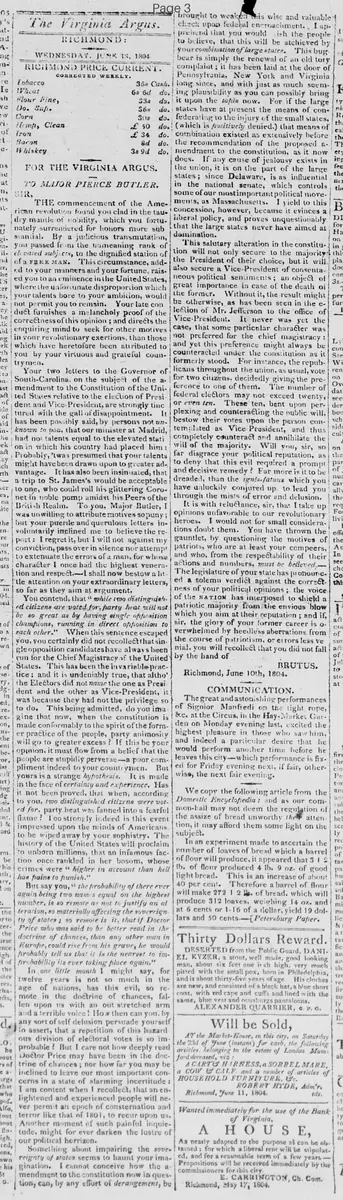
An anonymous letter from Richmond, dated June 10, 1804, criticizes Major Pierce Butler's opposition to the 12th Amendment to the US Constitution, which separates presidential and vice-presidential elections. The writer argues it prevents repeats of the 1800 election crisis, accuses Butler of personal disappointment and flawed reasoning, and defends the amendment against claims of impairing state sovereignty.
Clipping
OCR Quality
Full Text
SIR,
The commencement of the American revolution found you clad in the tawdry mantle of nobility, which you fortunately surrendered for honors more substantial. By a judicious transmutation, you passed from the unmeaning rank of elevated subjects, to the dignified station of a FREE MAN. This circumstance, added to your manners and your fortune, raised you to an eminence in the United States, where the unfortunate disproportion which your talents bore to your ambition, would not permit you to remain. Your late conduct furnishes a melancholy proof of the correctness of this opinion; and directs the enquiring mind to seek for other motives in your revolutionary exertions, than those which have heretofore been attributed to you by your virtuous and grateful countrymen.
Your two letters to the Governor of South-Carolina, on the subject of the amendment to the Constitution of the United States relative to the election of President and Vice-President, are strongly tinctured with the gall of disappointment. It has been possibly said, by persons not unknown to you, that our minister at Madrid, had not talents equal to the elevated station in which his country had placed him: Probably, 'twas presumed that your talents might have been drawn upon to greater advantage. It has also been insinuated, that a trip to St. James's would be acceptable to one, who could roll his glittering Coronet in noble pomp amidst his Peers of the British Realm. To you, Major Butler, I was unwilling to attribute motives so puny; but your puerile and querulous letters involuntarily inclined me to believe the report: I regret it, but I will not against my conviction, pass over in silence nor attempt to extenuate the errors of a man, for whose character I once had the highest veneration and respect.—I shall now bestow a little attention on your extraordinary letters, so far as they aim at argument.
You contend, that "while two distinguished citizens are voted for; party heat will not be so great as by having single opposition champions, running in direct opposition to each other." When this sentence escaped you, you certainly did not recollect that single opposition candidates have always been run for the Chief Magistracy of the United States. This has been the invariable practice: and it is undeniably true, that altho' the Electors did not name the one as President and the other as Vice-President, it was because they had not the privilege so to do. This being admitted, do you imagine that now, when the constitution is made conformably to the spirit of the former practice of the people, party animosity will go to greater excess? If this be your opinion, it must flow from a belief that the people are stupidly perverse—a poor compliment indeed to your countrymen. But yours is a strange hypothesis. It is made in the face of certainty and experience. Has it not been proved, that when, according to you, two distinguished citizens were voted for, party heat was fanned into a fearful flame? Too strongly indeed is this event impressed upon the minds of Americans to be wiped away by your sophistry. The history of the United States will proclaim to unborn millions, that an infamous faction once rankled in her bosom, whose crimes were "higher in account than hell has chains to punish."
But say you, "the probability of there ever again being two names equal on the highest number, is so remote as not to justify an alteration, so materially affecting the sovereignty of states: so remote is it, that if Doctor Price who was said to be better read in the doctrine of chances, than any other man in Europe, could rise from his grave, he would probably tell us that it in the nearest to impossibility its ever taking place again." In one little month I might say, for twelve years is not so much in the age of nations, has this evil, so remote in the doctrine of chances, fallen upon us with an out stretched arm and a terrible voice! How then can you, by any sort of self delusion persuade yourself to assert, that a repetition of this hazardous division of electoral votes is so improbable? But I care not how deeply read Doctor Price may have been in the doctrine of chances; nor how far you may be inclined to leave our most important concerns in a state of alarming incertitude: I am content when I recollect, that an enlightened and experienced people will never permit an epoch of consternation and terror like that of 1801, to recur upon us. Another moment of such painful inquietude, might for ever darken the lustre of our political horizon.
Something about impairing the sovereignty of states seems to haunt your imagination. I cannot conceive how the amendment to the constitution now in question, can, by any effort of derangement, be brought to view this wise and valuable check upon federal encroachment. I apprehend that you wish the people to believe, that this will be achieved by your combination of large states. This bug bear is simply the renewal of an old tory complaint; it has been laid at the door of Pennsylvania, New York and Virginia long since, and with just as much seeming plausibility as you can possibly bring it upon the tapis now. For if the large states have at present the means of confederating to the injury of the small states, (which is positively denied.) that means of combination existed as extensively before the recommendation of the proposed amendment to the constitution, as it now does. If any cause of jealousy exists in the union, it is on the part of the large states; since Delaware, is as influential in the national senate, which controls some of our most important political movements, as Massachusetts. I yield to this concession, however, because it evinces a liberal policy, and proves unquestionably that the large states never have aimed at domination.
This salutary alteration in the constitution will not only secure to the majority the President of their choice, but it will also secure a Vice-President of consentaneous political sentiments; an object of great importance in case of the death of the former. Without it, the result might be otherwise, as has been seen in the election of Mr. Jefferson to the office of Vice-President. It never was yet the case, that some particular character was not preferred for the chief magistracy: and yet this preference might always be counteracted under the constitution as it formerly stood. For instance, the republicans throughout the union, as usual, vote for two citizens, decidedly giving the preference to one of them. The number of federal electors may not exceed twenty, or even ten. These ten, bent upon perplexing and counteracting the public will, bestow their votes upon the person contemplated as Vice-President, and thus completely counteract and annihilate the will of the majority. Will you, sir, so far disgrace your political reputation, as to deny that this evil required a prompt and decisive remedy? Far more is it to be dreaded, than the ignis-fatuus which you have unluckily conjured up, to lead you through the mists of error and delusion.
It is with reluctance, sir, that I take up opinions unfavorable to our revolutionary heroes. I would not for small considerations doubt them. You have thrown the gauntlet, by questioning the motives of patriots, who are at least your compeers, and who, from the respectability of their actions and numbers, must be believed. The legislature of your state has pronounced a solemn verdict against the correctness of your political opinions; the voice of the Nation has interposed to shield a patriotic majority from, the envious blow which you aim at their reputation; and if, sir, the glory of your former career is overwhelmed by heedless aberrations from the course of patriotism, or errors less venial, you will recollect that you did not fall by the hand of
BRUTUS.
Richmond, June 10th, 1804.
What sub-type of article is it?
What themes does it cover?
What keywords are associated?
What entities or persons were involved?
Letter to Editor Details
Recipient
Major Pierce Butler
Main Argument
the 12th amendment to the constitution is necessary to prevent repeats of the 1800 election crisis by ensuring the majority's choice for president and vice-president; major butler's opposition stems from personal disappointment and flawed arguments about party heat and state sovereignty.
Notable Details