Thank you for visiting SNEWPapers!
Sign up free
The Virginia Gazette
Richmond, Williamsburg, Richmond County, Virginia
What is this article about?
Letter from St. Kitt's details French naval threats and British defenses in the Caribbean from February to May. Multiple French fleets probed for attacks but retreated without engaging, thanks to British reinforcements from Admiral Byron. A Cork convoy narrowly escaped capture.
Clipping
OCR Quality
Full Text
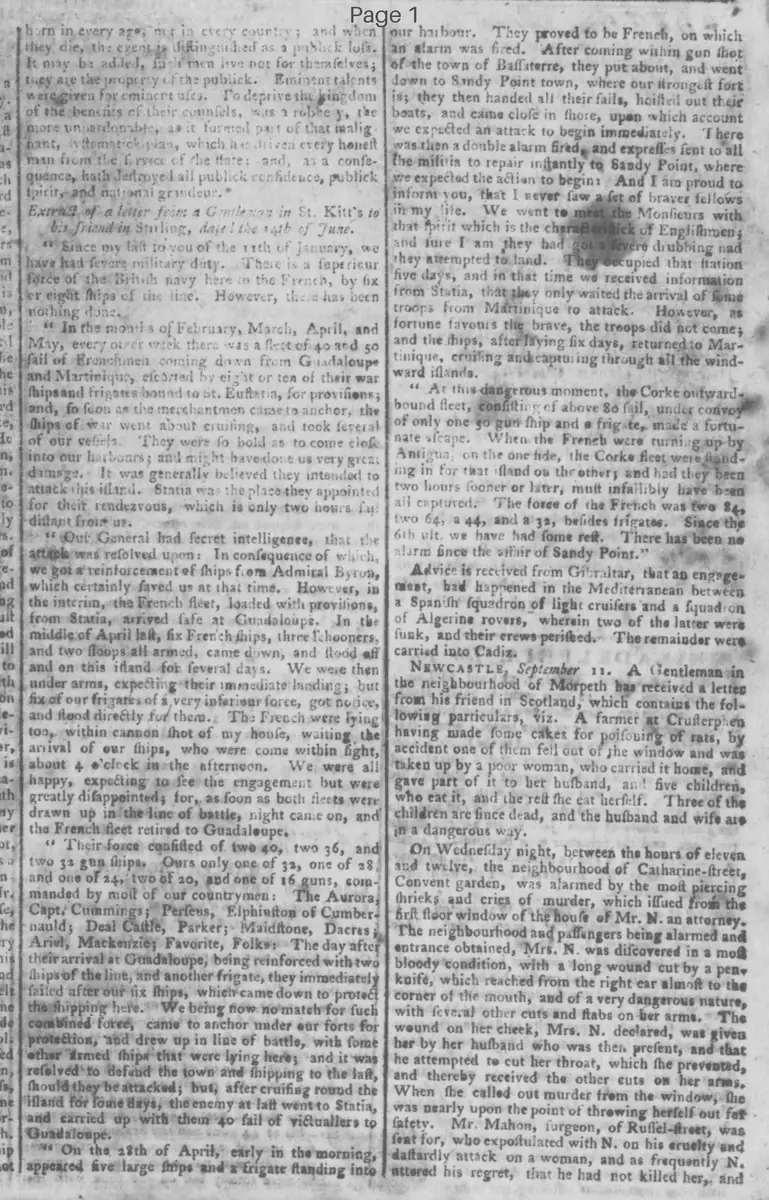
"Since my last to you of the 15th of January, we have had severe military duty. There is a superior force of the British navy here to the French, by six or eight ships of the line. However, there has been nothing done.
In the months of February, March, April, and May, every other week there was a fleet of 40 and 50 sail of Frenchmen coming down from Guadaloupe and Martinique, escorted by eight or ten of their war ships and frigates bound to St. Eustatia, for provisions; and, so soon as the merchantmen came to anchor, the ships of war went about cruising, and took several of our vessels. They were so bold as to come close into our harbours; and might have done us very great damage. It was generally believed they intended to attack this island. Statia was the place they appointed for their rendezvous, which is only two hours distant from us.
Our General had secret intelligence, that the attack was resolved upon: In consequence of which, we got a reinforcement of ships from Admiral Byron, which certainly saved us at that time. However, in the interim, the French fleet, loaded with provisions, from Statia, arrived safe at Guadaloupe. In the middle of April last, six French ships, three schooners, and two sloops all armed, came down, and stood off and on this island for several days. We were then under arms, expecting their immediate landing; but six of our frigates of a very inferior force, got notice, and stood directly for them. The French were lying too, within cannon shot of my house, waiting the arrival of our ships, who were come within sight, about 4 o'clock in the afternoon. We were all happy, expecting to see the engagement but were greatly disappointed; for, as soon as both fleets were drawn up in the line of battle, night came on, and the French fleet retired to Guadaloupe.
Their force consisted of two 40, two 36, and two 32 gun ships. Ours only one of 32, one of 28 and one of 24, two of 20, and one of 16 guns, commanded by most of our countrymen: The Aurora, Capt. Cummings; Perseus, Elphinston of Cumberland; Deal Castle, Parker; Maidstone, Dacres; Ariel, Mackenzie; Favorite, Folkes; The day after their arrival at Guadaloupe, being reinforced with two ships of the line, and another frigate, they immediately sailed after our six ships, which came down to protect the shipping here. We being now no match for such combined force, came to anchor under our forts for protection, and drew up in line of battle, with some other armed ships that were lying here; and it was resolved to defend the town and shipping to the last, should they be attacked; but, after cruising round the island for some days, the enemy at last went to Statia, and carried up with them 40 sail of victuallers to Guadaloupe.
On the 28th of April, early in the morning, appeared five large ships and a frigate standing into our harbour. They proved to be French, on which an alarm was fired. After coming within gun shot of the town of Basseterre, they put about, and went down to Sandy Point town, where our strongest fort is; they then handed all their sails, hoisted out their boats, and came close in shore, upon which account we expected an attack to begin immediately. There was then a double alarm fired, and express sent to all the militia to repair instantly to Sandy Point, where we expected the action to begin: And I am proud to inform you, that I never saw a set of braver fellows in my life. We went to meet the Monieurs with that spirit which is the characteristic of Englishmen; and sure I am they had got a severe drubbing had they attempted to land. They occupied that station five days, and in that time we received information from Statia, that they only waited the arrival of some troops from Martinique to attack. However, as fortune favours the brave, the troops did not come; and the ships, after lying six days, returned to Martinique, cruising and capturing through all the windward islands.
At this dangerous moment, the Corke outward-bound fleet, consisting of above 80 sail, under convoy of only one 70 gun ship and a frigate, made a fortunate escape. When the French were turning up by Antigua, on the one side, the Corke fleet were standing in for that island on the other; and had they been two hours sooner or later, must infallibly have been all captured. The force of the French was two 84, two 64, a 44, and a 32, besides frigates. Since the 6th ult. we have had some rest. There has been no alarm since the affair of Sandy Point."
What sub-type of article is it?
What keywords are associated?
What entities or persons were involved?
Where did it happen?
Foreign News Details
Primary Location
St. Kitt's
Event Date
February To May, Specific Incidents In Middle Of April And 28th April
Key Persons
Outcome
no engagements occurred; french threats averted by british reinforcements and militia readiness; several british vessels captured by french cruisers; cork convoy of over 80 sail escaped capture
Event Details
French fleets from Guadaloupe and Martinique repeatedly approached St. Kitt's for provisions at St. Eustatia, escorted by warships that captured British vessels and probed harbors. British forces, reinforced by Admiral Byron's ships, prepared defenses. In mid-April, six French armed vessels faced off against inferior British frigates but retreated at night. Later reinforced French pursued but British sheltered under forts. On 28th April, five French ships and frigate threatened landing at Sandy Point but withdrew after six days without troops from Martinique arriving. Militia mobilized bravely. No attacks materialized.