Thank you for visiting SNEWPapers!
Sign up free
Portland Gazette, And Maine Advertiser
Portland, Cumberland County, Maine
What is this article about?
Massachusetts Senate committee reports on the Penobscot Bank's mismanagement since its 1806 charter. Stockholders loaned nearly all capital to themselves, leading to 1809 payment suspension, bill depreciation, and failed recovery efforts. Recommends legislative intervention before 1812 charter expiration.
Clipping
OCR Quality
Full Text
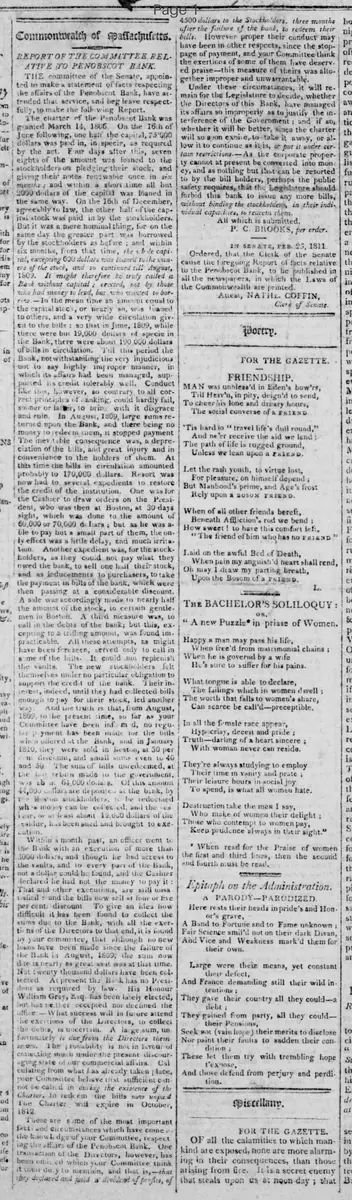
REPORT OF THE COMMITTEE RELATIVE
TO PENOBSCOT BANK.
THE committee of the Senate, appointed to make a statement of facts respecting the affairs of the Penobscot Bank, have attended that service, and beg leave respectfully, to make the following Report.
The charter of the Penobscot Bank was granted March 14, 1806. On the 16th of June following, one half the capital, 75,000 dollars was paid in, in specie, as required by the act. Four days after this, seven eighths of the amount was loaned to the stockholders on pledging their stock, and giving their notes renewable once in six months; and within a short time all but 2000 dollars of the capital was loaned in the same way. On the 16th of December, agreeably to law, the other half of the capital stock was paid in by the stockholders. But it was a mere nominal thing. for on the same day the greater part was borrowed by the stockholders as before; and within six months, from that time, the whole capital, excepting 600 dollars was loaned to the owners of the stock, and so continued till August, 1809. It might therefore be truly called a Bank without capital; erected, not by those who had money to lend, but who wanted to borrow. In the mean time an amount equal to the capital stock, or nearly so, was loaned to others, and a very wide circulation given to the bills: so that in June, 1809, while there were but 19,000 dollars of specie in the Bank, there were about 190,000 dollars of bills in circulation. Till this period the Bank, notwithstanding the very injudicious, to say highly improper manner, in which its affairs had been managed, supported its credit tolerably well. Conduct like this, however, so contrary to all correct principles of banking, could hardly fail, sooner or later, to bring, with it disgrace and ruin. In August, 1809, large sums returned upon the Bank, and there being no money to redeem them, it stopped payment. The inevitable consequence was, a depreciation of the bills, and great injury and inconvenience to the holders of them. At this time the bills in circulation amounted probably to 170,000 dollars. Resort was now had to several expedients to restore the credit of the institution. One was for the Cashier to draw orders on the President, who was then at Boston, at 30 days sight, which was done to the amount of 60,000 or 70,000 dollars: but as he was able to pay but a small part of them, the only effect was a little delay, and much irritation. Another expedient was, for the stockholders, as they could not pay what they owed the bank, to sell one half their stock, and as inducements to purchasers, to take the payment in bills of the bank, which were then passing at a considerable discount. A sale was accordingly made to nearly half the amount of the stock, to certain gentlemen in Boston. A third measure was, to call in the debts of the bank; but this, excepting to a trifling amount, was found impracticable. All these attempts, as might have been foreseen, served only to call in some of the bills. It could not replenish the vaults. The new stockholders felt themselves under no particular obligation to support the credit of the bank. Their interest, indeed, until they had collected bills enough to pay for their stock, led another way. And the truth is that, from August, 1809, to the present time, so far as your Committee have been informed, no regular payment has been made for the bills when offered at the Bank, and in January 1810, they were sold in Boston, at 30 per cent discount, and small sums even to 40 and 50. The sum of bills unredeemed, at the last return made to the government, was about 61,000 dollars. Of this amount 44,000 dollars are deposited at the bank, by the Boston stockholders, to be redeemed when money can be collected, and the remainder, or at least about 12,000 dollars of the residue, has been sued and brought to execution.
Within a month past, an officer went to the Bank with an execution of more than 2000 dollars, and though, he had access to the vaults, and to every part of the Bank, not a dollar could be found, and the Cashier declared he had not the money to pay it: That and other executions are still unsatisfied: and the bills now sell at four or five per cent. discount. To give an idea how difficult it has been found to collect the sums due to the Bank, with all the exertions of the Directors to that end, it is found by your committee, that although no new loans have been made since the failure of the Bank in August, 1809; the sum now due is nearly as great as it was at that time. Not twenty thousand dollars have been collected. At present the Bank has no President as required by law. His Honour William Gray, Esq. has been lately elected, but has neither accepted nor declined the office. What success will in future attend the exertions of the Directors, to collect the debts, is uncertain. A large sum, unfortunately is due from the Directors themselves. The probability is not in favour of collecting much under the present discouraging state of our commercial affairs. Calculating from what has already taken place, your Committee believe that sufficient cannot be called in during the existence of the Charter, to redeem the bills now unpaid. The Charter will expire in October, 1812.
These are some of the most important facts and circumstances which have come to the knowledge of your Committee, respecting the affairs of the Penobscot Bank. One transaction of the Directors, however, has been omitted which your Committee think it their duty to mention, and that is,-that they declared and paid a dividend of profits, of 4500 dollars to the Stockholders, three months after the failure the bank, to redeem their bills. However proper their conduct may have been in other respects, since the stoppage of payment, and your Committee think the exertions of some of them have deserved praise--this measure of theirs was altogether improper and unwarrantable.
Under these circumstances, it will remain for the Legislature to decide. whether the Directors of this Bank, have managed its affairs so improperly as to justify the interference of the Government; and if so, whether it will be better, since the charter will so soon expire, to take it away, or allow it to continue as it is, or put it under certain restrictions.--As the corporate property cannot at present be converted into money, and as nothing but that can be resorted to by the bill holders, perhaps the public safety requires, that the Legislature should forbid this bank to issue any more bills, without binding the stockholders, in their individual capacities, to redeem them.
All which is submitted.
P. C. BROOKS, per order.
IN SENATE, FEB. 25, 1811.
Ordered, that the Clerk of the Senate cause the foregoing Report of facts relative to the Penobscot Bank, to be published in all the newspapers, in which the Laws of the Commonwealth are printed.
Attest, NATHL. COFFIN. JR.
Clerk of Senate.
What sub-type of article is it?
What keywords are associated?
What entities or persons were involved?
Where did it happen?
Domestic News Details
Primary Location
Penobscot Bank, Massachusetts
Event Date
Charter Granted March 14, 1806; Stopped Payment August 1809; Report In Senate, Feb. 25, 1811
Key Persons
Outcome
bank stopped payment in august 1809; bills depreciated to 30-50% discount; unredeemed bills about 61,000 dollars; executions unsatisfied; charter expires october 1812; improper dividend paid post-failure
Event Details
Senate committee details mismanagement of Penobscot Bank: capital loaned almost entirely to stockholders; specie low while bills circulated widely; failed recovery attempts including orders on president, stock sales, debt calls; no regular redemptions since 1809; recommends legislative action like restricting further issues or revoking charter