Thank you for visiting SNEWPapers!
Sign up free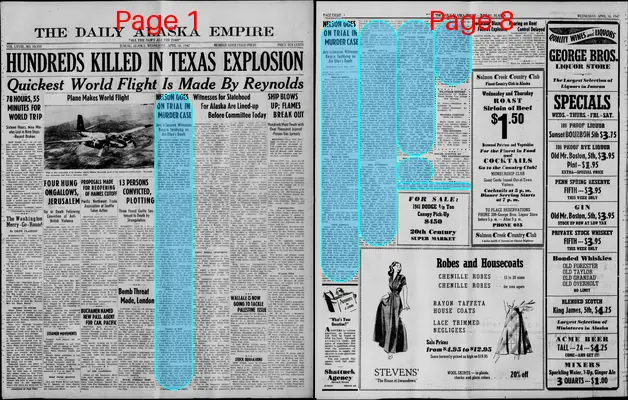
The Daily Alaska Empire
Juneau, Juneau County, Alaska
What is this article about?
In Juneau, Alaska, Austin Nelson's trial for the Dec. 22, 1946, razor murder of grocer Jim Ellen proceeds with witnesses describing body discovery, Nelson's presence at the store, arrest with bloodied items, forged check, and incriminating conversations. Prosecution nears rest.
Merged-components note: Merged continued story on murder trial.
Clippings

1 of 2
OCR Quality
Full Text
ON TRIAL IN
MURDER CASE
Jury Is Secured, Witnesses
Begin Testifying on
Jim Ellen's Death
BULLETIN-Dollie Silver told a packed courtroom this afternoon she saw Austin Nelson in the Jim Ellen grocery store, and leaving the store at approximately the time of the murder, a little before 3 o'clock Sunday morning, Dec. 22.
She testified she saw Nelson enter the store and talking to Ellen: later saw him leave by the rear door after the lights were turned out.
At press time the prosecution was to call the last two witnesses, two FBI laboratory experts from Washington, D. C. who were to give testimony regarding hair and blood found at the scene of the crime, and would probably rest its case and the defense take over.
The trial of Austin Nelson for the alleged murder of Jim Ellen is underway in U. S. District Court following a late start yesterday.
Nelson is charged with cutting the late Juneau groceryman in the throat with a razor December 22, 1946 at Ellen's store on Willoughby Avenue. Nelson is being tried for first degree murder following an indictment by the Federal Grand Jury here two weeks ago.
The first witness, Miss Gerry Fitzgerald, was called to the stand at 4:30 p.m. yesterday. She told of discovering Ellen's body on the morning of December 22, 1946 in his grocery store. She said that she had come into the store to make a purchase and, not seeing Ellen, had wandered around the store until she came across his body laying in a pool of blood behind one of the counters.
The next witness, Mark Jensen, truck driver, told of Miss Fitzgerald's running out into the street and flagging him down as he was driving by. He said that he went back into the store with her and then called the police.
George R. Fletcher, special agent of the Federal Bureau of Investigation, was next to testify. He identified photographs which he said that he had taken of the body at the scene of the crime and at the morgue, later. U. S. District Attorney P. J. Gilmore, Jr. then introduced the photographs as Government Exhibits No. 1 and No. 2.
Police Witnesses
Milo G. Clouse, then Assistant Chief of Police, and Patrolman Solon Dore were the last two witnesses yesterday. Both testified as to the discovery of a check on the premises containing Nelson's name. They said that they then went, with Deputy U. S. Marshal Walter G. Hellan, to the Ismail Rooms and arrested Nelson. They identified a pair of rubbers which were introduced as Government Exhibits No. 3-A and 3-B. They said that they had picked up the rubbers in Nelson's room at the time of his arrest.
Position of Body
Deputy Marshal Hellan was the first witness to be called this morning and was on the stand for more than an hour. He stated that he was called into the case at the request of Resident FBI Agent John B. Hayes who was ill and unable to answer the call. A detailed drawing of Ellen's store made by Hellan was introduced as Government Exhibit No. 4. Hellan described the position of the body when he arrived at the scene, telling of the considerable amount of blood on and around it.
Hellan testified that he had discovered the cash register open and, upon inspection, empty of currency and checks. He said it contained only silver. Then, he said, he and the City Police found a check made out to and endorsed by Nelson and purported to be signed by W. D. Gross.
Upon identification.
the
(Continued on Page Eight)
NELSON GOES ON TRIAL IN MURDER CASE
Jury Is Secured, Witnesses Begin Testifying on Jim Ellen's Death
(Continued from Page One)
A check was presented as Government Exhibit No. 5.
Blood On Rubbers
Hellan said that he and the City Police went to Nelson's hotel room and interviewed him. He said that he observed a brown jacket and a pair of blue trousers drying on the radiator. He said that they were wet in spots. He also saw a pair of rubbers which he believed to have blood on them. Hellan said that he asked Nelson if he had any objections to the officers making a search of his room. When Nelson stated that he did object and that the officers should have a search warrant, according to Hellan, they put him under arrest after a short struggle in which it was necessary to put Nelson in handcuffs.
Hellan told the court of taking Nelson to the City jail where he discovered what he said to appear to be a small smear of blood on the sweat band of Nelson's hat. At this point, Gilmore introduced the hat, after Hellan's identification, as Exhibit No. 6. Hellan continued, saying that he then secured a search warrant from the U. S. Commissioner and then, in company with City Police, took Nelson back to his room where they conducted a thorough search and picked up several items.
Blood On Towel
They picked up the previously described jacket and trousers and an empty case for a straight edged razor and a blood stained towel, Hellan said. The empty razor case, which Hellan said Nelson told him he found in the hall outside of his room a month or two before, was introduced as Government Exhibit No. 7. The towel was marked as Exhibit No. 8, the trousers as No. 9 and the jacket as No. 10 after being identified by Hellan.
During the introduction of the parade of exhibits, defense attorney Henry A. Roden asked if all of the items had been taken legally and after a short recess was taken for the procurement of the search warrant from the U. S. Commissioner's office. Roden, following the examination of the warrant, appeared satisfied.
Hellan told the jury that he and FBI Agent Fletcher had talked with Nelson at the Federal jail on Dec. 24 about the $67.50 check found.
Check Explained
Nelson told them, at that time, Hellan said, that he had written the check in order to borrow $60 from Ellen and purchase two pints of whiskey and some cake. He said that he wrote the check with his own pen on a blank furnished by Ellen, according to Hellan. Hellan said that Nelson told him that Ellen had laughed when he offered the check and said that it wasn't any good unless it was endorsed.
Hellan said that Nelson claimed to have used Ellen's pen to make the endorsement. When asked what he did with the $60, Hellan says that Nelson told him he used part of it to pay his rent and "just fooled away the rest."
Hellan said Nelson changed his story on the wet clothes found on the radiator in his room. First, Hellan said that Nelson had told him that he had washed the clothes at 3:30 Saturday afternoon in a washroom upstairs. Hellan said that he later changed that story and claimed to have washed them downstairs at a later time Saturday night.
Hellan testified that all of the clothing, which he picked up at Nelson's room was turned over to the FBI here and then sent to the FBI Laboratory in Washington, D. C. for analysis.
Identifies Clothing
FBI Agent Fletcher was recalled to the stand this morning and identified Ellen's blood soaked shirt and trousers which were submitted as Government Exhibits No. 11 and No. 12. He also identified samples of head hair taken from Ellen's body and from Nelson. These were introduced as Government Exhibits for Identification No. 1-A and No. 1-B. He said that these had also been sent to the FBI Laboratory.
Zalmain Gross, manager of the W. D. Gross interests in Southeast Alaska and son of W. D. Gross, was called to the stand to identify the purported signature of his father on the check found at Ellen's store. Gross stated that the signature on the check "is not the signature of my father, W. D. Gross."
Eileen Nelson, student and part time employee of Ellen's, was called to describe Ellen's banking procedure and habits. She testified that she did his banking for him on Saturday mornings and that the check in question was not deposited on the day before the murder.
Ismail Vosotros, proprietor of the Ismail Rooms, was called in next, as the last witness in the morning session, to testify that Nelson did not make any payments of rent between December 17 and December 22. At this point, defense attorney Roden attacked the books which Vosotros had submitted and asked that one page of his records be subpoenaed as Defense Exhibit No. 1. Judge Harry E. Pratt granted the motion. Roden claimed that the books did not show the dates of payments and therefore contended that they could be used as proof of payment as well as proof of non-payment.
THIS AFTERNOON
Conversation regarding a purported "deal" in which the defendant Nelson was alleged to have proposed to crack a safe "down by Billy's," was testified to by a Seattle negro named Howard Charles Demry, whose surprising statements were the highlight of the early afternoon.
Demry, who came to Juneau last September 2, and first met Nelson here, related that the defendant had proposed the deal to him while the two were walking from the Ismael Hotel to the Dreamland Bar. Their conversation took place either late in November, 1946, or early December.
Over objection by Defense Counsel Roden, the witness amplified his damaging testimony, declaring though Nelson had not named the place where he proposed to crack the safe, the Jim Ellen's store was the only place that Demry considered he could have meant. He identified "Billy's" as the residence of Billy Avery, at 226 Willoughby avenue - a little north of and across the street from Ellen's.
Roden directed his cross-examination of Demry at attempting to impeach the witness, and perhaps to link Demry himself up with the crime; asking if Demry some days ago had not told defense counsel that he (Demry) was drunk on December 22 and could remember nothing about it?
Demry denied that and also denied that he had quarrelled with Nelson.
Fisherman Testifies
Rodney Hunter, native fisherman, added another link to the legal chain reaching toward Nelson.
He testified that he had seen Nelson, with "another colored fellow, Gene Lamour," standing in the doorway of Ellen's store at approximately 20 minutes past midnight on the night of the slaying.
He reported exchanging greetings with Nelson, whom he had previously known from fishing in the same area with him.
Slashes Described
Dr. C. C. Carter, who had acted as medical examiner on Ellen's body, previously had estimated that Ellen's death had occurred between 1 o'clock a. m. and 3:30 or 4 o'clock a. m.
Dr. Carter also submitted a full report on the autopsy on Ellen's body and described the various wounds he found. He listed as cause of death extreme hemorrhage resulting from long, deep slashes on either side of Ellen's neck, which had severed all major blood vessels in the victim's throat.
He reported Ellen's lungs and heart were found to be practically bloodless.
Questioned over Roden's objection, Dr. Carter said a "contused laceration" upon the top of Ellen's skull could have "stunned" Ellen. It could have been caused by a blow of any blunt instrument, he said. The throat gashes must have been made by a very sharp instrument. Dr. Carter answered U. S. Attorney Gilmore that an extremely sharp knife or a straight edge razor could have caused the neck wounds.
Dr. Carter described other cuts, apparently made by a sharp knife or similar weapon, found on Ellen's right hand. Dr. Carter made his first examination at Ellen's store, at about 11 o'clock that fatal Sunday morning.
Razor Entered In Case
The fact that the defendant had possessed a straight edge razor was established by witnesses William Avery and Hubert Brown, negroes.
Avery said he had given Nelson a "nice razor" at a time when they were sharing a room, approximately in September, 1946. He identified the case of the razor in evidence as that which he had given Nelson.
Brown reported seeing the same or a similar razor and case on visits to Nelson's room, the times being shortly before December 22.
James Smith, first witness called by the Government this afternoon, identified clothing in evidence as like that he saw worn by Nelson on occasions when he saw the defendant in the Alaskan Hotel late Saturday and early Sunday of the fatal week end. Hunter also said the sport jacket and green hat in evidence were like that worn by Nelson when he saw the defendant in the doorway of Ellen's store.
The jury for the case, which was finally secured at 4:30 o'clock yesterday is composed of Fred S. Alexander, Jessie L. Geeslin, Mrs. Beatrice Guerin, Joseph A. La Pierre, Odelia Light, Curtis Shattuck, Orin H. Bliss, Robert Simpson, Erwin Hachmeister, Herman Savikko, D. G. Taylor and Elmer Howerter. Named as alternate jurors are: Frank E. Cashel and Mrs. H. S. Waldemar.
What sub-type of article is it?
What themes does it cover?
What keywords are associated?
What entities or persons were involved?
Where did it happen?
Story Details
Key Persons
Location
U. S. District Court, Juneau, Alaska; Ellen's Grocery Store On Willoughby Avenue
Event Date
December 22, 1946
Story Details
Austin Nelson is on trial for first-degree murder of grocer Jim Ellen, whom he allegedly slit throat with razor at store. Witnesses testify to seeing Nelson at store near time of murder, discovery of body, arrest with bloody rubbers and clothes, forged check, and safe-cracking proposal. Prosecution presents evidence including photos, clothing, hair samples for FBI analysis.