Thank you for visiting SNEWPapers!
Sign up free
The Virginia Gazette
Williamsburg, Virginia
What is this article about?
Trial of printer Henry Sampson Woodfall for publishing Junius's seditious letter against the King. Attorney General prosecutes officially; defense argues for press freedom and public scrutiny of government. Jury finds him guilty only of printing and publishing.
Clipping
OCR Quality
Full Text
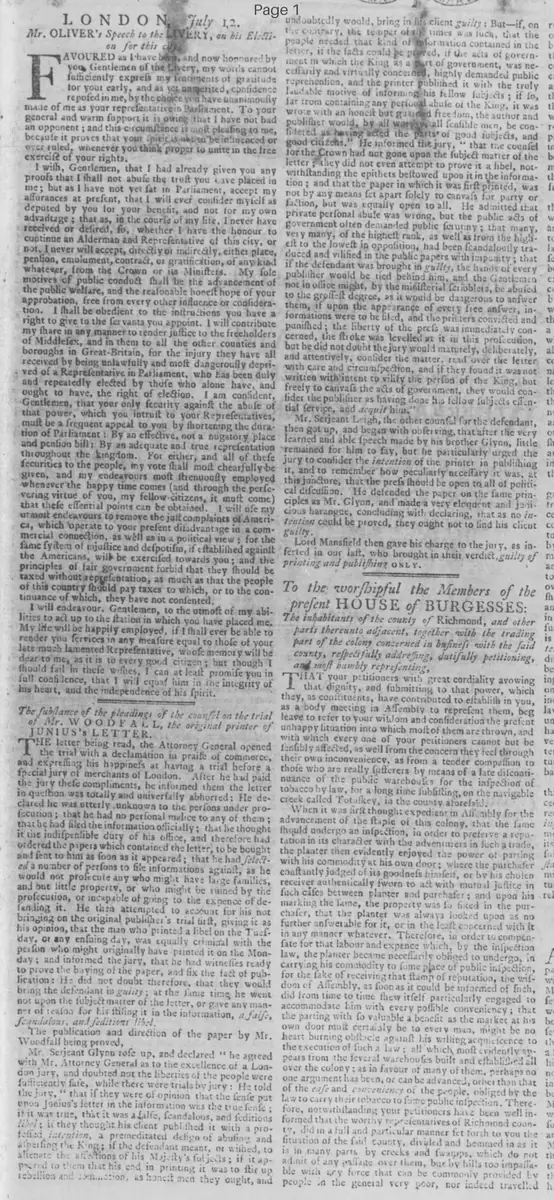
The letter being read, the Attorney General opened the trial with a declamation in praise of commerce, and expressing his happiness at having a trial before a special jury of merchants of London. After he had paid the jury these compliments, he informed them the letter in question was totally and universally abhorred: He declared he was utterly unknown to the persons under prosecution; that he had no personal malice to any of them; that he had filed the information officially: that he thought it the indispensable duty of his office, and therefore had ordered the papers which contained the letter, to be bought and sent to him as soon as it appeared: that he had selected a number of persons to file informations against, as he would not prosecute any who might have large families, and but little property, or who might be ruined by the prosecution, or incapable of going to the expense of defending it. He then attempted to account for his not bringing on the original publisher's trial till, giving it as his opinion, that the man who printed a libel on the Tuesday, or any ensuing day, was equally criminal with the person who might originally have printed it on the Monday; and informed the jury, that he had witnesses ready to prove the buying of the paper, and fix the fact of publication: He did not doubt therefore, that they would bring the defendant in guilty; at the same time he went not upon the subject matter of the letter, or gave any manner of reason for his styling it in the information, a false, scandalous, and seditious libel.
The publication and direction of the paper by Mr. Woodfall being proved,
Mr. Serjeant Glynn rose up, and declared he agreed with Mr. Attorney General as to the excellence of a London jury, and doubted not the liberties of the people were sufficiently safe, while there were trials by jury: He told the jury, "that if they were of opinion that the sense put upon Junius's letter in the information was the true sense: if it was true, that it was a false, scandalous, and seditious libel; if they thought his client published it with a professed intention, a premeditated design of abusing and asperging the King; if the defendant meant or wished, to alienate the affections of his Majesty's subjects; if it appeared to them that his end in printing it was to stir up rebellion and sedition, as honest men they ought, and undoubtedly would, bring in his client guilty: But if, on the contrary, the temper of the times was such, that the people needed that kind of information contained in the letter, if the facts could be proved, if the acts of government in which the King as a part of government, was necessarily and virtually concerned, highly demanded public reprehension, and the printer published it with the truly laudable motive of informing his fellow subjects; if so, far from containing any personal abuse of the King, it was wrote with an honest but guarded freedom, the author and publisher would, by all wise men, all sensible men, be considered as having acted the parts of good subjects, and good citizens." He informed the jury, "that the counsel for the Crown had not gone upon the subject matter of the letter; they did not even attempt to prove it a libel, notwithstanding the epithets bestowed upon it in the information; and that the paper in which it was first printed, was not by any means set apart solely to canvass for party or faction, but was equally open to all. He admitted that private personal abuse was wrong, but the public acts of government often demanded public scrutiny; that many, very many, of the highest rank, as well as from the highest to the lowest in opposition, had been scandalously traduced and vilified in the public papers with impunity; that if the defendant was brought in guilty, the hands of every publisher would be tied behind him, and the Gentlemen not in office might, by the ministerial scribblers, be abused to the grossest degree, as it would be dangerous to answer them, if upon the appearance of every free answer, informations were to be filed, and the printers convicted and punished; the liberty of the press was immediately concerned, the stroke was levelled at it in this prosecution, but he did not doubt the jury would maturely, deliberately, and attentively, consider the matter, read over the letter with care and circumscription, and if they found it was not written with intent to vilify the person of the King, but freely to canvass the acts of government, they would consider the publisher as having done his fellow subjects essential service, and acquit him."
Mr. Serjeant Leigh, the other counsel for the defendant, then got up, and began with observing, that after the very learned and able speech made by his brother Glynn, little remained for him to say, but he particularly urged the jury to consider the intention of the printer in publishing it, and to remember how peculiarly necessary it was, at this juncture, that the press should be open to all of political discussion. He defended the paper on the same principles as Mr. Glynn, and made a very eloquent and judicious harangue, concluding with declaring, that as no intention could be proved, they ought not to find his client guilty.
Lord Mansfield then gave his charge to the jury, as inserted in our last, who brought in their verdict, guilty of printing and publishing ONLY.
What sub-type of article is it?
What keywords are associated?
What entities or persons were involved?
Where did it happen?
Foreign News Details
Primary Location
London
Key Persons
Outcome
jury brought in their verdict, guilty of printing and publishing only
Event Details
Trial of Mr. Woodfall for printing and publishing Junius's letter, accused of being a false, scandalous, and seditious libel. Attorney General opens prosecution, emphasizing official duty and fact of publication without addressing letter's content. Defense by Serjeant Glynn and Serjeant Leigh argues for press freedom, public scrutiny of government acts, and lack of intent to vilify the King. Lord Mansfield charges jury, who return verdict guilty only of printing and publishing.