Thank you for visiting SNEWPapers!
Sign up free
East St. Louis Daily Journal
East Saint Louis, Saint Clair County, Illinois
What is this article about?
Illinois expects 510,000 automobile licenses in 1920, up from 478,500 in 1919, due to rapid growth in car ownership. Secretary of State Emmerson has secured 550,000 license sets. A new law effective next Thursday introduces car classifications, higher fees, speed rules, and right-of-way regulations at intersections.
Clipping
OCR Quality
Full Text
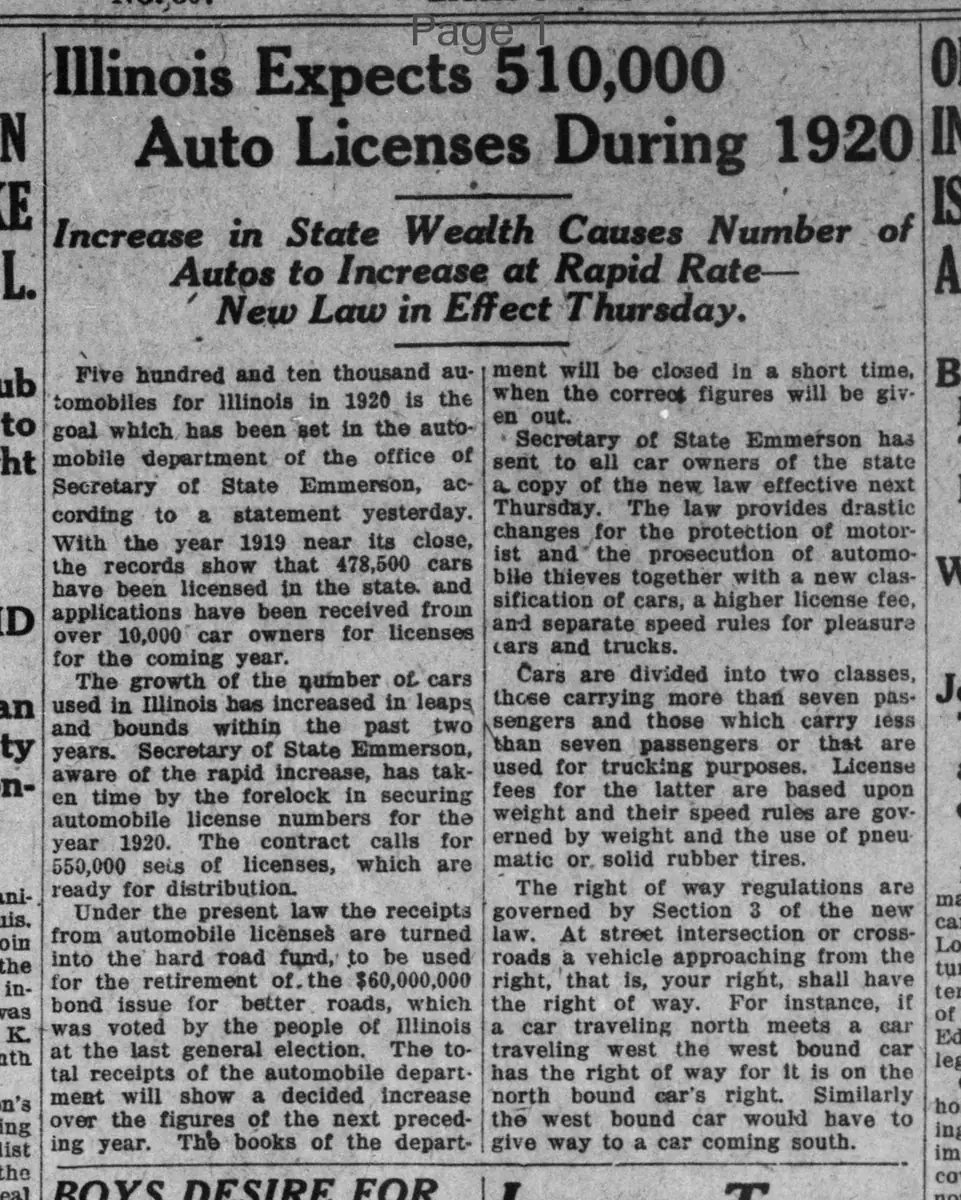
Increase in State Wealth Causes Number of Autos to Increase at Rapid Rate-
New Law in Effect Thursday.
Five hundred and ten thousand automobiles for Illinois in 1920 is the goal which has been set in the automobile department of the office of Secretary of State Emmerson, according to a statement yesterday.
With the year 1919 near its close, the records show that 478,500 cars have been licensed in the state, and applications have been received from over 10,000 car owners for licenses for the coming year.
The growth of the number of cars used in Illinois has increased in leaps and bounds within the past two years. Secretary of State Emmerson, aware of the rapid increase, has taken time by the forelock in securing automobile license numbers for the year 1920. The contract calls for 550,000 sets of licenses, which are ready for distribution.
Under the present law the receipts from automobile licenses are turned into the hard road fund, to be used for the retirement of the $60,000,000 bond issue for better roads, which was voted by the people of Illinois at the last general election. The total receipts of the automobile department will show a decided increase over the figures of the next preceding year. The books of the department will be closed in a short time when the correct figures will be given out.
Secretary of State Emmerson has sent to all car owners of the state a copy of the new law effective next Thursday. The law provides drastic changes for the protection of motorists and the prosecution of automobile thieves together with a new classification of cars, a higher license fee, and separate speed rules for pleasure cars and trucks.
Cars are divided into two classes, those carrying more than seven passengers and those which carry less than seven passengers or that are used for trucking purposes. License fees for the latter are based upon weight and their speed rules are governed by weight and the use of pneumatic or solid rubber tires.
The right of way regulations are governed by Section 3 of the new law. At street intersection or crossroads a vehicle approaching from the right, that is, your right, shall have the right of way. For instance, if a car traveling north meets a car traveling west the west bound car has the right of way for it is on the north bound car's right. Similarly the west bound car would have to give way to a car coming south.
What sub-type of article is it?
What keywords are associated?
What entities or persons were involved?
Where did it happen?
Domestic News Details
Primary Location
Illinois
Event Date
1920
Key Persons
Outcome
510,000 automobiles expected to be licensed in 1920; 550,000 license sets prepared; receipts to fund $60,000,000 road bond retirement; new law introduces car classifications, higher fees, speed rules, and right-of-way regulations.
Event Details
The automobile department anticipates 510,000 licenses for 1920 due to rapid increase in car ownership from 478,500 in 1919. Secretary Emmerson secured 550,000 license sets. License fees support hard road fund for bond issue. New law effective next Thursday classifies cars by passenger capacity and use, bases fees and speed on weight and tires, and sets right-of-way rules favoring vehicles from the right at intersections.