Thank you for visiting SNEWPapers!
Sign up free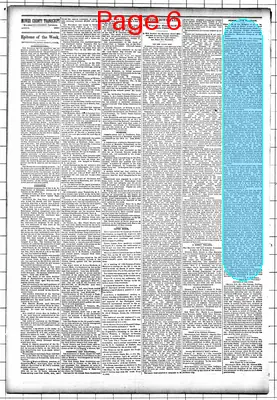
Mower County Transcript
Austin, Lansing, Mower County, Minnesota
What is this article about?
In a letter dated Feb. 28 from Scranton, Pa., T. V. Powderly of the Knights of Labor denounces the Brotherhood of Locomotive Engineers for past strike betrayals but advises Knights against retaliating by replacing striking engineers on the Chicago, Burlington & Quincy railroad, urging solidarity among workers.
Clipping

OCR Quality
Full Text
Plain Talk to the Knights of Labor by Their Chief—A Bitter Attack on Chief Arthur and the Brotherhood—Their Action in Previous Strikes Denounced, but the Knights Are Urged to Forego Retaliative Measures—Progress of the Strike.
PHILADELPHIA, Feb. 29.—The following letter is furnished the Associated Press:
"SCRANTON, Pa., Feb. 28.—A reporter comes to me this morning and asks what my opinion is concerning the strike of the engineers on the Chicago, Burlington & Quincy railway. The expression of opinion is required as to whether I favor the taking of the places of Brotherhood men by Knights of Labor. I have nothing to say concerning the matter of the strike on the road in question, for I do not know the particulars, but if the men are making an effort to do away with the European custom of grading men up and down, regardless of merit, then they are right for making the fight for equality. My opinion of the man who takes the place of another who is struggling for his rights is that he deserves the contempt and scorn of every man who loves justice. It is true that members of the Brotherhood have on repeated occasions taken the places of the Knights of Labor. It is true that away back, in the early days of the '70s Brotherhood men did the same thing with the machinists and blacksmiths at the command of their chief. It is true that the Brotherhood men stabbed the Knights of Labor in the back on the Southwest system, not only by taking their places, but by urging them to strike with the proffer of assistance if they would do so. It is true that the Knights were used as cat's-paws by the Brotherhood men in that struggle, and it is true that many engineers were burned in raking out chestnuts for others. It is true that Brotherhood men did take the places of Reading men in the strike on that road. The merits of the various cases herein mentioned have nothing to do with the principle of honor which is involved in all of them.
"It is to the eternal shame of the Brotherhood men that they stooped to such acts of meanness and treachery and unmanly conduct. The man who takes the place of another when that other is engaged in a struggle with a corporation is a scab, whether he be a member of the Knights of Labor or a member of the Brotherhood of Locomotive Engineers. When Charles Wilson ordered members of the Brotherhood to take the places of members of the Machinists and Blacksmiths' Union in 1877 and 1878 he did an unmanly, cowardly act. When Arthur allowed the members of the Brotherhood, over which he exercised such discipline, to tamper with the rights of the striking employes of the Missouri Pacific and Wabash system, two years ago, he, too, violated that principle of honor which should restrain a man when about to do wrong. It mattered not that the strike in question were not ordered by the chief officers of the Knights of Labor. If the men who are interested feel that they were right, and took up the fight as employees, regardless of what organization they belonged to, and on their own responsibility, they had the right to do so; and under the laws of the land members of the Brotherhood were not obliged to make cravens of themselves, as many of them did both on the Southwest system and in the Reading strike.
"The taking of the men's places was 'mean and dastardly.' If these actions were taken with the sanction of the chief of the Brotherhood, he, too, is mean and dastardly, but 'two wrongs never make a right,' and what is mean and dastardly in a member of the Brotherhood of Engineers can not become grand and noble in a member of the order of Knights of Labor. No Knight of Labor should belittle his manhood by stooping to such dirty work. If it is the habit of the Brotherhood men to do such work as the taking of strikers' places, in Heaven's name let them have a monopoly of it.
"Knights of Labor, if you take my advice you will stand back and allow this struggle to go on. Let the Brotherhood demonstrate its power to stand alone, without any 'entangling alliances' with those of other trades. Let the past be forgotten in this strike. No matter how bitter you may feel toward these men, remember that they have not stepped out of the rut of selfishness yet, and it is best to teach them what manhood means by keeping your hands off the Chicago, Burlington & Quincy strike. The spectacle presented by men of labor who belong to different organizations rushing at each other's throats whenever a strike takes place must be a gratifying thing for the employers of labor to look at. It must indeed give satisfaction to the corporations to know that neither Knights of Labor or Brotherhood men dare in future ask for better treatment with any assurance of receiving it. It must be a consoling thought to the monopolist to know that his power is not half so dangerous to the labor organizations as the possibility that another labor organization will espouse his cause through revenge. Labor will forever be bound hand and foot at the feet of capital as long as one working-man can be pitted against the other. No strike should be entered into until the court of last resort has been reached, until the last effort consistent with manhood has been made, until the heads of the opposing forces on both sides have been consulted and their verdict given; until the last bridge has been burned between them. Then if it was determined that the last thing possible had been done to avert trouble, every detachment of labor's army—horse, foot and artillery—should be wheeled into line in defending the rights of the men in the breach. I have never seen such a strike and never expect to until the narrow prejudices of the past are buried; until the principles of knighthood are properly understood. Then we will have no strikes.
"Knights of Labor, from Maine to California stand back. Keep your hands off. Let the law of retaliation be disregarded, and let the men of the Chicago, Burlington & Quincy railroad win this strike if they can.
"T. V. POWDERLY,
"General Master Workman.
What sub-type of article is it?
What themes does it cover?
What keywords are associated?
What entities or persons were involved?
Where did it happen?
Story Details
Key Persons
Location
Chicago, Burlington & Quincy Railway; Scranton, Pa.; Philadelphia
Event Date
Feb. 28; Feb. 29
Story Details
T. V. Powderly, General Master Workman of the Knights of Labor, writes a letter criticizing the Brotherhood of Locomotive Engineers for past betrayals during strikes, including taking Knights' places, but urges Knights not to retaliate by scabbing on the current CB&Q engineers' strike, advocating for unity and non-retaliation to teach manhood and avoid division among workers.