Thank you for visiting SNEWPapers!
Sign up free
Editorial
January 29, 1875
Sunbury American
Sunbury, Northumberland County, Pennsylvania
What is this article about?
This editorial defends General Sheridan's firm enforcement of law in Louisiana by drawing parallels to General Jackson's imposition of martial law in New Orleans after his 1815 victory, where Jackson defied a habeas corpus writ, was fined, but later had the fine remitted by Congress for public safety reasons. It urges Democrats not to criticize Sheridan, portraying both as heroes against disorder.
Clipping
OCR Quality
98%
Excellent
Full Text
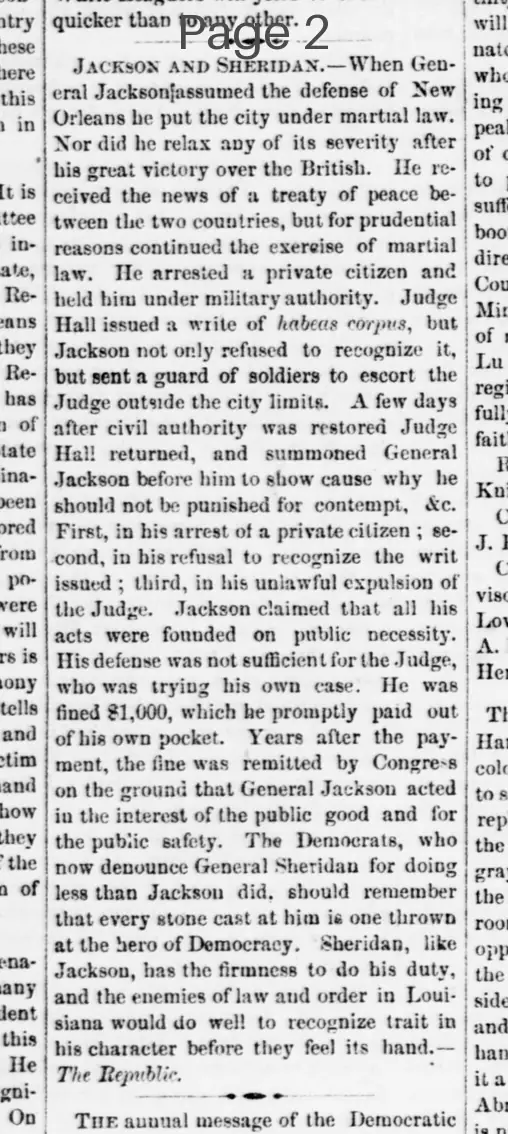
Jackson and Sheridan.—When General Jackson assumed the defense of New Orleans he put the city under martial law. Nor did he relax any of its severity after his great victory over the British. He received the news of a treaty of peace between the two countries, but for prudential reasons continued the exercise of martial law. He arrested a private citizen and held him under military authority. Judge Hall issued a writ of habeas corpus, but Jackson not only refused to recognize it, but sent a guard of soldiers to escort the Judge outside the city limits. A few days after civil authority was restored Judge Hall returned, and summoned General Jackson before him to show cause why he should not be punished for contempt, &c. First, in his arrest of a private citizen; second, in his refusal to recognize the writ issued; third, in his unlawful expulsion of the Judge. Jackson claimed that all his acts were founded on public necessity. His defense was not sufficient for the Judge, who was trying his own case. He was fined $1,000, which he promptly paid out of his own pocket. Years after the payment, the fine was remitted by Congress on the ground that General Jackson acted in the interest of the public good and for the public safety. The Democrats, who now denounce General Sheridan for doing less than Jackson did, should remember that every stone cast at him is one thrown at the hero of Democracy. Sheridan, like Jackson, has the firmness to do his duty, and the enemies of law and order in Louisiana would do well to recognize that trait in his character before they feel its hand.—The Republic.
What sub-type of article is it?
Military Affairs
Constitutional
Partisan Politics
What keywords are associated?
Martial Law
New Orleans
Habeas Corpus
General Jackson
General Sheridan
Louisiana
Democrats
Public Safety
What entities or persons were involved?
General Jackson
General Sheridan
Judge Hall
Democrats
Congress
British
Enemies Of Law And Order In Louisiana
Editorial Details
Primary Topic
Defense Of Sheridan's Actions Via Comparison To Jackson's Martial Law In New Orleans
Stance / Tone
Supportive Of Military Firmness Against Disorder, Critical Of Democratic Critics
Key Figures
General Jackson
General Sheridan
Judge Hall
Democrats
Congress
British
Enemies Of Law And Order In Louisiana
Key Arguments
Jackson Imposed And Maintained Martial Law In New Orleans Post Victory For Prudential Reasons
Jackson Arrested A Citizen And Defied Habeas Corpus Writ From Judge Hall
Jackson Expelled Judge Hall From The City Under Military Guard
Jackson Was Fined $1,000 For Contempt But Paid It Promptly
Congress Later Remitted The Fine Recognizing Public Necessity And Safety
Sheridan's Actions In Louisiana Are Less Severe Than Jackson's Yet Criticized By Democrats
Criticizing Sheridan Attacks The Democratic Hero Jackson
Both Leaders Show Firmness In Duty Against Lawlessness