Thank you for visiting SNEWPapers!
Sign up free
The Daily Union
Washington, District Of Columbia
What is this article about?
1848 article on Ohio legislative crisis: Whigs' unconstitutional gerrymandering splits counties, leading to disputed Hamilton County seats. Democrats hold majority with certificates, but Whigs block organization, threatening state functions. (187 chars)
Clipping
OCR Quality
Full Text
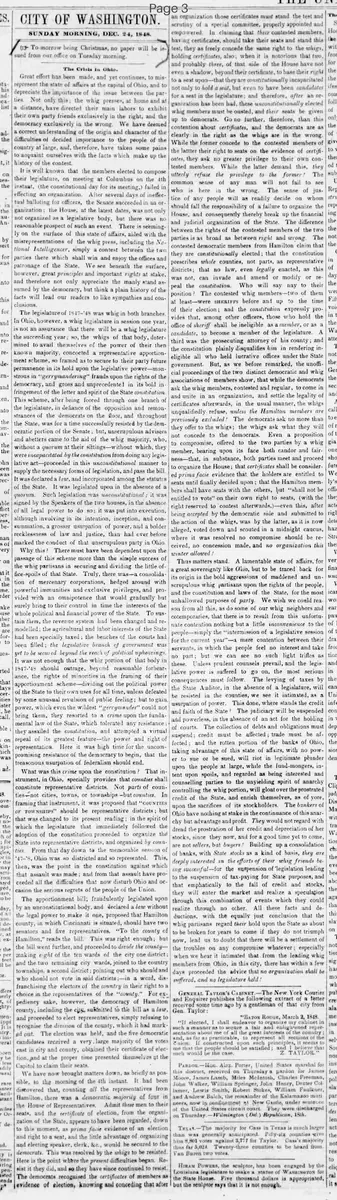
SUNDAY MORNING, DEC. 24, 1848.
To-morrow being Christmas, no paper will be issued from our office on Tuesday morning.
The Crisis in Ohio.
Great effort has been made, and yet continues, to misrepresent the state of affairs at the capital of Ohio, and to depreciate the importance of the issue between the parties. Not only this; the whig presses, at home and at a distance, have directed their main labors to exhibit their own party friends exclusively in the right, and the democracy exclusively in the wrong. We have deemed a correct understanding of the origin and character of the difficulties of decided importance to the people of the country at large, and, therefore, have taken some pains to acquaint ourselves with the facts which make up the history of the contest.
It is well known that the members elected to compose their legislature, on meeting at Columbus on the 4th instant, (the constitutional day for its meeting,) failed in effecting an organization. After several days of ineffectual balloting for officers, the Senate succeeded in an organization; the House, at the latest dates, was not only not organized as a legislative body, but there was no reasonable prospect of such an event. There is seemingly on the surface of this state of affairs, aided with the misrepresentations of the whig press, including the National Intelligencer, simply a contest between the two parties there which shall win and enjoy the offices and patronage of the State. We see beneath the surface, however, great principles and important rights at stake, and therefore not only appreciate the manly stand assumed by the democracy, but think a plain history of the facts will lead our readers to like sympathies and conclusions.
The legislature of 1847-'48 was whig in both branches. In Ohio, however, a whig legislature in session one year, is not an assurance that there will be a whig legislature the succeeding year; so, the whigs of that body, determined to avail themselves of the power of their then known majority, concocted a representative apportionment scheme, so framed as to secure to their party future permanence in its hold upon the legislative power—monstrous in "gerrymandering" frauds upon the rights of the democracy, and gross and unprecedented in its bold infringement of the letter and spirit of the State constitution.
This scheme, after being forced through one branch of the legislature, in defiance of the opposition and remonstrances of the democrats on the floor, and throughout the State, was for a time successfully resisted by the democratic portion of the Senate; but, unscrupulous advisers and abetters came to the aid of the whig majority, who, without a quorum at their sittings—without which, they were incapacitated by the constitution from doing any legislative act—proceeded in this unconstitutional manner to supply the necessary forms of legislation, and pass the bill. It was declared a law, and incorporated among the statutes of the State. It was legislated upon in the absence of a quorum. Such legislation was unconstitutional; it was signed by the Speakers of the two houses, in the absence of all legal power to do so; it was put into execution, although involving in its intention, inception, and consummation, a grosser usurpation of power, and a bolder recklessness of law and justice, than had ever before marked the conduct of that unscrupulous party in Ohio.
Why this? There must have been dependent upon the passage of this scheme more than the simple success of the whig partisans in securing and dividing the little office-spoils of that State. Truly, there was—a consolidation of mercenary corporations, hedged around with powerful immunities and exclusive privileges, and provided with an omnipotence that would gradually but surely bring to their control in time the interests of the whole political and financial power of the State. To sustain them, the revenue system had been changed and remodelled: the agricultural and labor interests of the State had been specially taxed: the benches of the courts had been filled; the legislative branch of government was yet to be secured beyond the reach of political upheavings.
It was not enough that the whig portion of that body in 1847-'48 should outrage, beyond reasonable forbearance, the rights of minorities in the framing of their apportionment scheme—dividing out the political power of the State to their own uses for all time, unless defeated by some unusual revulsion of public feeling; but to gain power, which even the wildest "gerrymander" could not bring them, they resorted to a crime upon the fundamental law of the State, which tolerated any resistance; they assailed the constitution, and attempted a virtual repeal of its greatest feature—the power and right of representation. Here it was high time for the uncompromising resistance of the democracy to begin, that the treasonous usurpation of federalism should end.
What was this crime upon the constitution? That instrument, in Ohio, specially provides that counties shall constitute representative districts. Not parts of counties—not cities, towns, or townships—but counties. In framing that instrument, it was proposed that "counties or townships" should be representative districts; but that was changed to its present reading; in the spirit of which the legislature that immediately followed the adoption of the constitution proceeded to organize the State into representative districts, and organized by counties. From that day down to the memorable session of '47-'48, Ohio was so districted and so represented. This, then, was the point in the constitution against which that assault was made; and from that assault have proceeded all the difficulties that now disturb Ohio and occasion the serious regrets of the people of the Union.
The apportionment bill; fraudulently legislated upon by an unconstitutional body, and declared a law without the legal power to make it one, proposed that Hamilton county, in which Cincinnati is situated, should have two senators and five representatives. "To the county of Hamilton," reads the bill. This was right enough; but the bill went further, and proceeded to divide the county—making eight of the ten wards of the city one district: and the two remaining city wards, joined to the country townships, a second district; pointing out who should and who should not vote in said districts;—in a word, disfranchising the electors of the country in their right to a choice in the representatives of the "county." For expediency sake, however, the democracy of Hamilton county, including the city, submitted to the bill as a law, and proceeded to elect representatives, simply refusing to recognise the division of the county, which it had marked out. The election was held, and the five democratic candidates received a very large majority of the votes cast in city and county, obtained their certificate of election, and at the proper time presented themselves at the Capitol to claim their seats.
We have now brought matters down, as briefly as possible, to the morning of the 4th instant. It had been discovered that, counting all the representatives from Hamilton, there was a democratic majority of four in the House of Representatives. Admit these men to their seats, and the certificate of election, from the organization of the State, appears to have been regarded, down to this moment, as prima facie evidence of an election and right to a seat, and the little advantage of organizing and electing speaker, clerk, &c., would be secured to the democrats. This was resolved by the whigs to be resisted.
Here is the point where the present difficulties began. Resist it they did, and so they have since continued to resist. The democrats recognised the certificates of members as evidence of election, knowing and conceding that after an organization those certificates must stand the test and scrutiny of a special committee, properly appointed and empowered. In claiming that their contested members, having certificates, should take their seats and stand this test, they as freely concede the same right to the whigs holding certificates, also; when it is notorious that two, and probably three, of that side of the House have not even a shadow, beyond their certificate, to base their right to a seat upon—that they are constitutionally incapacitated not only to hold a seat, but even to have been candidates for a seat in the legislature: and, therefore, after an organization has been had, these unconstitutionally elected whig members must be ousted, and their seats be given up to democrats. Go no further, therefore, than this contention about certificates, and the democrats are as clearly in the right as the whigs are in the wrong.
While the former concede to the contested members of the latter their right to seats on the evidence of certificates, they ask no greater privilege to their own contested members. While the latter demand this, they utterly refuse the privilege to the former! The common sense of any man will not fail to see who is here in the wrong. The sense of justice of any people will as readily decide on whom should fall the responsibility of a failure to organize the House, and consequently thereby break up the financial and judicial organization of the State. The difference between the rights of the contested members of the two parties is as broad as between right and wrong. The contested democratic members from Hamilton claim that they are constitutionally elected; that the constitution prescribes whole counties, not parts, as representative districts; that no law, even legally enacted, as this was not, can invade and amend or modify or repeal the constitution. Who will say nay to their position? The contested whig members—two of them at least—were sheriffs before and up to the time of their election; and the constitution expressly provides that, among other officers, those who hold the office of sheriff shall be ineligible as a member, or as a candidate, to become a member of the legislature. A third was the prosecuting attorney of his county; and the constitution plainly disqualifies him in rendering ineligible all who held lucrative offices under the State government. But, as we before remarked, the unofficial proceedings of the two distinct democratic and whig associations of members show, that while the democrats ask the whig members, contested and regular, to come in and unite in an organization, and settle the legality of certificates afterwards, in the usual manner, the whigs unqualifiedly refuse, unless the Hamilton members are previously excluded! The democrats ask no more than they offer to the whigs; the whigs ask what they will not concede to the democrats. Even a proposition to compromise, offered to the two parties by a whig member, bearing upon its face both candor and fairness—that, in substance, both parties meet and proceed to organize the House; that certificates shall be considered prima facie evidence that the holders are entitled to seats until finally decided upon; that the Hamilton members shall have seats with the others, but "shall not be entitled to vote" on their own right to seats, (with the right reserved to contest afterwards,)—even this, after being accepted by the democratic side and submitted to the action of the whigs, was by the latter, as it is now alleged, voted down and scouted in a midnight caucus, where it was resolved no compromise should be received, no concession made, and no organization this winter allowed!
Thus matters stand. A lamentable state of affairs, for a great sovereignty like Ohio, but to be traced back for its origin in the bold aggressions of maddened and unscrupulous whig partisans upon the rights of the people and the constitution and laws of the State, for the most unhallowed purposes of party. We wish we could reason from all this, as do some of our whig neighbors and cotemporaries, that there is to result from this unfortunate contention nothing but a little inconvenience to the people—simply the "intermission of a legislative session for the current year"—a mere contention between their servants, in which the people feel no interest and take no part; but we can see no such light trifles as these. Unless prudent counsels prevail, and the legislative power is suffered to go on, the most serious consequences must follow. The levying of taxes by the State Auditor, in the absence of a legislature, will be resisted in the counties, we see it intimated, as a usurpation of power. This done, where stands the credit and faith of the State? The judiciary will be suspended and powerless, in the absence of an act for the holding of courts. The collection of debts and obligations must suspend; credit must be affected; trade must be affected; and the rotten portion of the banks of Ohio, taking advantage of this state of affairs, with no power to sue or be sued, will riot in legitimate plunder upon the people at large, while the fund-mongers, intent upon spoils, and regarded as being interested and counselling parties to the unyielding spirit of anarchy controlling the whig portion, will gloat over the prostrated credit of the State, and enrich themselves, as of yore, upon the sacrifices of its stockholders. The bankers of Ohio have nothing at stake in the continuance of this anarchy but advantage and profit. They would not regard with dread the prostration of her credit and depreciation of her stocks, since they now, and for a good time yet to come, are not sellers, but buyers! Building up a consolidation of banks, with State stocks as a kind of basis, they are deeply interested in the efforts of their whig friends being successful—for the suspension of legislation leading to the suspension of tax-paying for State purposes, and that emphatically to the fall of credit and stocks. They will enter the market and realize a speculation through this combination of events which they could realize through no other. All these facts and deductions, with the equally just conclusion that the whig partisans regard their hold upon the State as about to be broken for years to come if they do not triumph now, lead us to doubt that there will be a settlement of the troubles on any compromise whatever; especially when we hear it intimated that from the leading whig members from Ohio, in this city, there has within a few days proceeded the advice that no organization shall be suffered, and no legislature held!
What sub-type of article is it?
What themes does it cover?
What keywords are associated?
Where did it happen?
Story Details
Location
Ohio, Columbus, Hamilton County, Cincinnati
Event Date
December 1848
Story Details
Whig legislature in 1847-48 passed unconstitutional apportionment bill gerrymandering districts by splitting counties, violating Ohio constitution. This caused contested Democratic elections in Hamilton County; Whigs refuse to seat certified Democratic members, leading to deadlock in organizing the House on December 4, 1848, risking state financial and judicial disruption.