Thank you for visiting SNEWPapers!
Sign up free
Foreign News
July 7, 1879
The New Orleans Daily Democrat
New Orleans, Orleans County, Louisiana
What is this article about?
Biographical account of Prince Napoleon Joseph Charles Paul Bonaparte, his life, political involvements, marriage to Princess Clotilde, their three children, family residence in Paris, and the children's education and habits as of 1878.
Clipping
OCR Quality
95%
Excellent
Full Text
THE NAPOLEONS.
Prince Jerome and His Boys—Their Habits and Dispositions.
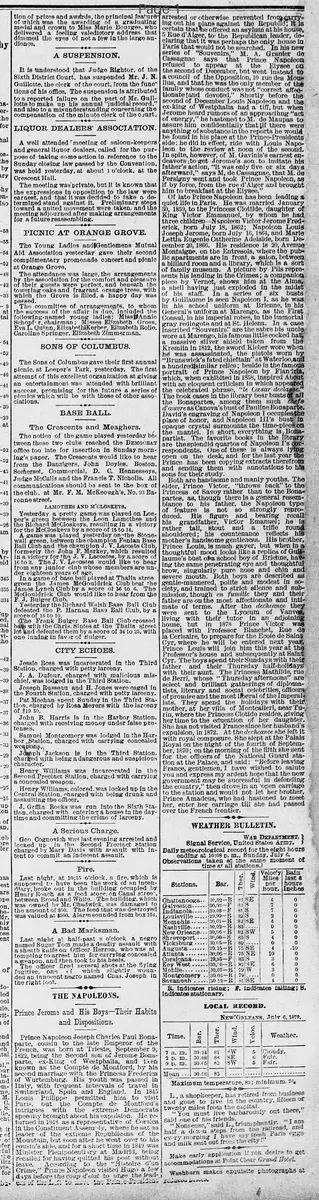
Prince Napoleon Joseph Charles Paul Bonaparte, cousin to the late Emperor of the French, was born at Trieste, September 9, 1822, being the second son of Jerome Bonaparte, ex-King of Westphalia, and then known as the Comte de Montfort, by his second marriage with the Princess Frederica of Wurtemberg. His youth was passed in Italy, with frequent intervals of travel in Switzerland, Spain and England. In 1845 Louis Philippe permitted him to visit Paris, but the Comte de Montfort's intrigues with the extreme Democrats speedily brought about his expulsion. He returned in 1848 as a representative of Corsica in the Constituent Assembly, where he sat as leader of the extreme Republicans of the Mountain, but soon after he went over to his cousin's side, and for a short time in 1849 was Minister Plenipotentiary at Madrid, being recalled for having quitted his post without leave. According to the "Histoire d'un Crime," Prince Napoleon visited Hugo a few days before the coup d'etat to urge the leaders of the Left to join Prince-President Bonaparte; it is certain that he offered an asylum at his house, 5 Rue d'Alger, to the Republican leader, declaring that it was perhaps the only house in Paris that would not be searched. In his new series of "Souvenirs,"
M. A. Granier de Cassagnac says that Prince Napoleon refused to appear at the Elysee on the second of December, but went instead to a council of the Opposition, 10 rue des Moulins, and that he was the only member of the family whose conduct was not "correct, affectionate (and devoted." Shortly before the second of December Louis Napoleon and the ex-king of Westphalia had a tiff, but when Jerome heard rumors of an approaching "act of energy," he hastened to M. de Maupas to assure him confidentially that if there were anything of substance in the reports he would be found in his place at the Prince-President's side; he did in effect ride with Louis Napoleon to the review at noon of the second. In spite, however, of M. Gavini's earnest endeavors to get Jerome's son to imitate his father's action, "it was only five or six days afterward," says M. de Cassagnac, that M. de Persigny went and took Prince Napoleon, as if by force, from the rue d'Alger and brought him to breakfast at the Elysee.
Of late Prince Napoleon has been leading a quiet life in Paris. He was married January 30, 1859, to the Princess Clotilde, daughter of King Victor Emmanuel, by whom he had three children—Napoleon Victor Jerome Frederick, born July 18, 1862; Napoleon Louis Joseph Jerome, born July 16, 1864, and Marie Letitia Eugenie Catherine Adelaide, born December 20, 1866. His residence is 20, Avenue Montaigne, on the entresols, where the public apartments are in front, a salon, between a billiard room and a library, which is a sort of family museum. A picture by Pils represents his landing in the Crimea; a companion piece by Vernet, shows him at the Alma, a shell having just exploded in the midst of his staff. In a series of six busts by Guillaume is seen Napoleon I., as he was in his school uniform at Brienne, in his General's uniform at Marengo, as the First Consul, in his imperial robes, in the immortal gray redingote and at St. Helena. In a case inscribed "Souvenirs" are the sabre his uncle wore at Marengo, his famous little cocked hat, a massive silver shield taken from the Kremlin in 1812, the sword Kleber wore when he was assassinated, the pistols worn by "Brunswick's fated chieftain" at Waterloo, and a hundred similar relics; beside is the famous portrait of Prince Napoleon by Flammarion, which, when exhibited in 1858, inspired About with an eloquent criticism in which appeared the celebrated phrase, "le Cesar declasse."
The book cases in the library bear busts of all the Bonapartes, among them such chefs d'oeuvre as Canova's bust of Pauline Bonaparte. David's engraving of Napoleon I. occupies the place of honor, and Napoleon III.'s bust in opaque crystal surmounts the time-piece on the mantel. In short, everything is Bonapartist. The favorite books in the library are the splendid quartos of Napoleon I.'s correspondence. One of these is always lying open on the desk, and for the last year the Prince has been copying extracts therefrom and sending them with annotations to his sons for their study.
Both are handsome and manly youths. The elder, Prince Victor, "throws back" to the Princess of Savoy rather than to the Bonapartes, as, though there is a general resemblance to his father, the Napoleon type of feature is not so strongly reproduced. His figure and bearing recall his grandfather, Victor Emanuel; he is rather tall, stout and a trifle round shouldered; his countenance reflects his mother's handsome gentleness. His brother, Prince Louis, is much gayer, but when in a thoughtful mood looks like a replica of Guillaume's bust of a school boy of Brienne, having the same penetrating eye and thoughtful brow, singularly pure nose and chin and severe mouth. Both boys are described as gentle-mannered, polite and modest in society, and trained to strict silence and submission, though en famille they and their father are on the most affectionate and intimate of terms. After the decheance they were sent to the Lyceum of Vanves, living with their tutor in an adjoining house, but in 1878 Prince Victor was placed with Professor Blanchet, Rue de la Cerisaie, to prepare for the Ecole de Saint Cyr, where he will be entered next year. Prince Louis will join him this year at the Professor's house and subsequently at Saint Cyr. The boys spend their Sundays with their father and their Thursday half-holidays with their aunt, the Princess Mathilde, rue de Berri, whose "Thursday afternoons" are select and brilliant gatherings of diplomatists, literary and social celebrities, officers of promise and the most liberal of the Imperialists. They spend the holidays with their mother, at her villa of Moncalieri, near Turin, where the Princess Clotilde resides, giving her time to the education of her daughter. She has not visited France since her husband's expulsion, in 1872. At the decheance she left it with royal composure. She slept at the Palais Royal on the night of the fourth of September, 1870; on the morning of the fifth she sent for the officers of the National Guard station at the Palace, and said: "Before leaving France, gentlemen, I have wished to salute you and express my ardent hope that the new government may be successful in defending the country," then drove in an open carriage to the station and would not let her brother, Prince Amadeus, who had hastened to meet her, enter her carriage till she had passed over the French frontier.
Prince Jerome and His Boys—Their Habits and Dispositions.
Prince Napoleon Joseph Charles Paul Bonaparte, cousin to the late Emperor of the French, was born at Trieste, September 9, 1822, being the second son of Jerome Bonaparte, ex-King of Westphalia, and then known as the Comte de Montfort, by his second marriage with the Princess Frederica of Wurtemberg. His youth was passed in Italy, with frequent intervals of travel in Switzerland, Spain and England. In 1845 Louis Philippe permitted him to visit Paris, but the Comte de Montfort's intrigues with the extreme Democrats speedily brought about his expulsion. He returned in 1848 as a representative of Corsica in the Constituent Assembly, where he sat as leader of the extreme Republicans of the Mountain, but soon after he went over to his cousin's side, and for a short time in 1849 was Minister Plenipotentiary at Madrid, being recalled for having quitted his post without leave. According to the "Histoire d'un Crime," Prince Napoleon visited Hugo a few days before the coup d'etat to urge the leaders of the Left to join Prince-President Bonaparte; it is certain that he offered an asylum at his house, 5 Rue d'Alger, to the Republican leader, declaring that it was perhaps the only house in Paris that would not be searched. In his new series of "Souvenirs,"
M. A. Granier de Cassagnac says that Prince Napoleon refused to appear at the Elysee on the second of December, but went instead to a council of the Opposition, 10 rue des Moulins, and that he was the only member of the family whose conduct was not "correct, affectionate (and devoted." Shortly before the second of December Louis Napoleon and the ex-king of Westphalia had a tiff, but when Jerome heard rumors of an approaching "act of energy," he hastened to M. de Maupas to assure him confidentially that if there were anything of substance in the reports he would be found in his place at the Prince-President's side; he did in effect ride with Louis Napoleon to the review at noon of the second. In spite, however, of M. Gavini's earnest endeavors to get Jerome's son to imitate his father's action, "it was only five or six days afterward," says M. de Cassagnac, that M. de Persigny went and took Prince Napoleon, as if by force, from the rue d'Alger and brought him to breakfast at the Elysee.
Of late Prince Napoleon has been leading a quiet life in Paris. He was married January 30, 1859, to the Princess Clotilde, daughter of King Victor Emmanuel, by whom he had three children—Napoleon Victor Jerome Frederick, born July 18, 1862; Napoleon Louis Joseph Jerome, born July 16, 1864, and Marie Letitia Eugenie Catherine Adelaide, born December 20, 1866. His residence is 20, Avenue Montaigne, on the entresols, where the public apartments are in front, a salon, between a billiard room and a library, which is a sort of family museum. A picture by Pils represents his landing in the Crimea; a companion piece by Vernet, shows him at the Alma, a shell having just exploded in the midst of his staff. In a series of six busts by Guillaume is seen Napoleon I., as he was in his school uniform at Brienne, in his General's uniform at Marengo, as the First Consul, in his imperial robes, in the immortal gray redingote and at St. Helena. In a case inscribed "Souvenirs" are the sabre his uncle wore at Marengo, his famous little cocked hat, a massive silver shield taken from the Kremlin in 1812, the sword Kleber wore when he was assassinated, the pistols worn by "Brunswick's fated chieftain" at Waterloo, and a hundred similar relics; beside is the famous portrait of Prince Napoleon by Flammarion, which, when exhibited in 1858, inspired About with an eloquent criticism in which appeared the celebrated phrase, "le Cesar declasse."
The book cases in the library bear busts of all the Bonapartes, among them such chefs d'oeuvre as Canova's bust of Pauline Bonaparte. David's engraving of Napoleon I. occupies the place of honor, and Napoleon III.'s bust in opaque crystal surmounts the time-piece on the mantel. In short, everything is Bonapartist. The favorite books in the library are the splendid quartos of Napoleon I.'s correspondence. One of these is always lying open on the desk, and for the last year the Prince has been copying extracts therefrom and sending them with annotations to his sons for their study.
Both are handsome and manly youths. The elder, Prince Victor, "throws back" to the Princess of Savoy rather than to the Bonapartes, as, though there is a general resemblance to his father, the Napoleon type of feature is not so strongly reproduced. His figure and bearing recall his grandfather, Victor Emanuel; he is rather tall, stout and a trifle round shouldered; his countenance reflects his mother's handsome gentleness. His brother, Prince Louis, is much gayer, but when in a thoughtful mood looks like a replica of Guillaume's bust of a school boy of Brienne, having the same penetrating eye and thoughtful brow, singularly pure nose and chin and severe mouth. Both boys are described as gentle-mannered, polite and modest in society, and trained to strict silence and submission, though en famille they and their father are on the most affectionate and intimate of terms. After the decheance they were sent to the Lyceum of Vanves, living with their tutor in an adjoining house, but in 1878 Prince Victor was placed with Professor Blanchet, Rue de la Cerisaie, to prepare for the Ecole de Saint Cyr, where he will be entered next year. Prince Louis will join him this year at the Professor's house and subsequently at Saint Cyr. The boys spend their Sundays with their father and their Thursday half-holidays with their aunt, the Princess Mathilde, rue de Berri, whose "Thursday afternoons" are select and brilliant gatherings of diplomatists, literary and social celebrities, officers of promise and the most liberal of the Imperialists. They spend the holidays with their mother, at her villa of Moncalieri, near Turin, where the Princess Clotilde resides, giving her time to the education of her daughter. She has not visited France since her husband's expulsion, in 1872. At the decheance she left it with royal composure. She slept at the Palais Royal on the night of the fourth of September, 1870; on the morning of the fifth she sent for the officers of the National Guard station at the Palace, and said: "Before leaving France, gentlemen, I have wished to salute you and express my ardent hope that the new government may be successful in defending the country," then drove in an open carriage to the station and would not let her brother, Prince Amadeus, who had hastened to meet her, enter her carriage till she had passed over the French frontier.
What sub-type of article is it?
Court News
Royal Event
What keywords are associated?
Bonaparte Family
Prince Napoleon
Prince Victor
Prince Louis
Princess Clotilde
Bonapartist Relics
Family Education
What entities or persons were involved?
Prince Napoleon Joseph Charles Paul Bonaparte
Jerome Bonaparte
Princess Clotilde
Napoleon Victor Jerome Frederick
Napoleon Louis Joseph Jerome
Marie Letitia Eugenie Catherine Adelaide
Victor Emmanuel
Princess Mathilde
Where did it happen?
Paris
Foreign News Details
Primary Location
Paris
Key Persons
Prince Napoleon Joseph Charles Paul Bonaparte
Jerome Bonaparte
Princess Clotilde
Napoleon Victor Jerome Frederick
Napoleon Louis Joseph Jerome
Marie Letitia Eugenie Catherine Adelaide
Victor Emmanuel
Princess Mathilde
Event Details
Biographical details on Prince Napoleon's life, political career, marriage, children, residence, and family habits; descriptions of sons' education and mother's departure from France in 1870.