Thank you for visiting SNEWPapers!
Sign up free
Story
July 6, 1911
The Citizen
Berea, Madison County, Kentucky
What is this article about?
Advice on managing orchards during summer drought in Kentucky via cultivation, cover crops, mulching, and disease spraying to ensure fruit production. By Prof. C.W. Matthews of Kentucky University.
Clipping
OCR Quality
98%
Excellent
Full Text
INTENSIVE FARMING
Summer Care of the Orchard.
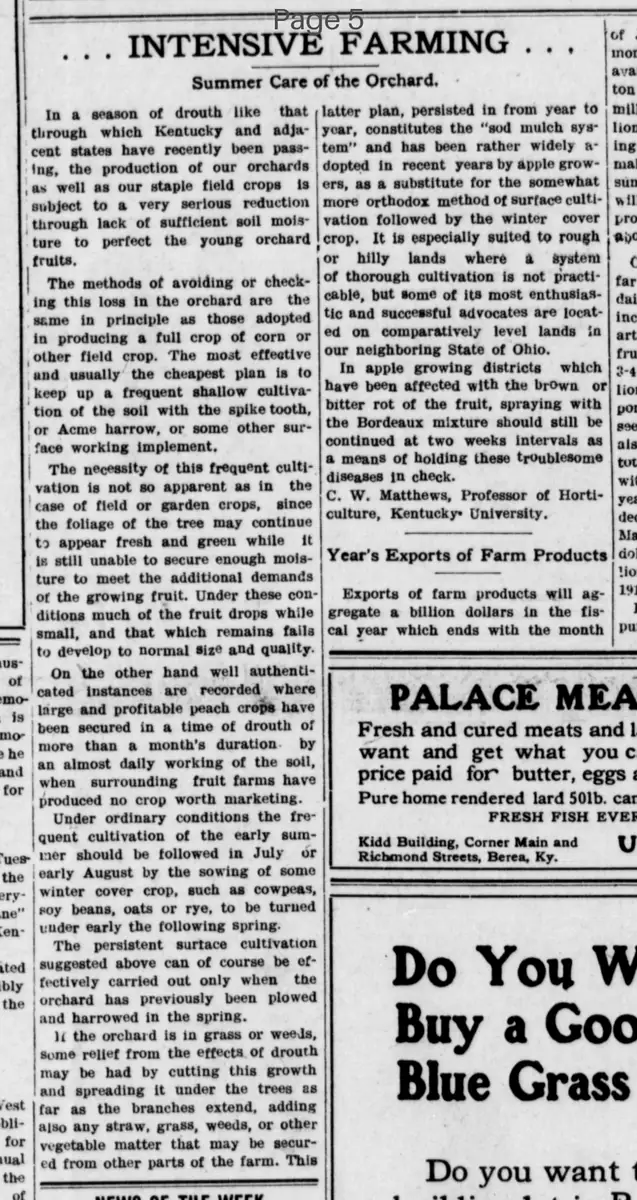
In a season of drouth like that through which Kentucky and adjacent states have recently been passing, the production of our orchards as well as our staple field crops is subject to a very serious reduction through lack of sufficient soil moisture to perfect the young orchard fruits. The methods of avoiding or checking this loss in the orchard are the same in principle as those adopted in producing a full crop of corn or other field crop. The most effective and usually the cheapest plan is to keep up a frequent shallow cultivation of the soil with the spike tooth, or Acme harrow, or some other surface working implement. The necessity of this frequent cultivation is not so apparent as in the case of field or garden crops, since the foliage of the tree may continue to appear fresh and green while it is still unable to secure enough moisture to meet the additional demands of the growing fruit. Under these conditions much of the fruit drops while small, and that which remains fails to develop to normal size and quality. On the other hand well authenticated instances are recorded where large and profitable peach crops have been secured in a time of drouth of more than a month's duration by an almost daily working of the soil, when surrounding fruit farms have produced no crop worth marketing. Under ordinary conditions the frequent cultivation of the early summer should be followed in July or early August by the sowing of some winter cover crop, such as cowpeas, soy beans, oats or rye, to be turned under early the following spring. The persistent surface cultivation suggested above can of course be effectively carried out only when the orchard has previously been plowed and harrowed in the spring. If the orchard is in grass or weeds, some relief from the effects of drouth may be had by cutting this growth and spreading it under the trees as far as the branches extend, adding also any straw, grass, weeds, or other vegetable matter that may be secured from other parts of the farm. This latter plan, persisted in from year to year, constitutes the "sod mulch system" and has been rather widely adopted in recent years by apple growers, as a substitute for the somewhat more orthodox method of surface cultivation followed by the winter cover crop. It is especially suited to rough or hilly lands where a system of thorough cultivation is not practicable, but some of its most enthusiastic and successful advocates are located on comparatively level lands in our neighboring State of Ohio. In apple growing districts which have been affected with the brown or bitter rot of the fruit, spraying with the Bordeaux mixture should still be continued at two weeks intervals as a means of holding these troublesome diseases in check.
C. W. Matthews, Professor of Horticulture, Kentucky University.
Summer Care of the Orchard.
In a season of drouth like that through which Kentucky and adjacent states have recently been passing, the production of our orchards as well as our staple field crops is subject to a very serious reduction through lack of sufficient soil moisture to perfect the young orchard fruits. The methods of avoiding or checking this loss in the orchard are the same in principle as those adopted in producing a full crop of corn or other field crop. The most effective and usually the cheapest plan is to keep up a frequent shallow cultivation of the soil with the spike tooth, or Acme harrow, or some other surface working implement. The necessity of this frequent cultivation is not so apparent as in the case of field or garden crops, since the foliage of the tree may continue to appear fresh and green while it is still unable to secure enough moisture to meet the additional demands of the growing fruit. Under these conditions much of the fruit drops while small, and that which remains fails to develop to normal size and quality. On the other hand well authenticated instances are recorded where large and profitable peach crops have been secured in a time of drouth of more than a month's duration by an almost daily working of the soil, when surrounding fruit farms have produced no crop worth marketing. Under ordinary conditions the frequent cultivation of the early summer should be followed in July or early August by the sowing of some winter cover crop, such as cowpeas, soy beans, oats or rye, to be turned under early the following spring. The persistent surface cultivation suggested above can of course be effectively carried out only when the orchard has previously been plowed and harrowed in the spring. If the orchard is in grass or weeds, some relief from the effects of drouth may be had by cutting this growth and spreading it under the trees as far as the branches extend, adding also any straw, grass, weeds, or other vegetable matter that may be secured from other parts of the farm. This latter plan, persisted in from year to year, constitutes the "sod mulch system" and has been rather widely adopted in recent years by apple growers, as a substitute for the somewhat more orthodox method of surface cultivation followed by the winter cover crop. It is especially suited to rough or hilly lands where a system of thorough cultivation is not practicable, but some of its most enthusiastic and successful advocates are located on comparatively level lands in our neighboring State of Ohio. In apple growing districts which have been affected with the brown or bitter rot of the fruit, spraying with the Bordeaux mixture should still be continued at two weeks intervals as a means of holding these troublesome diseases in check.
C. W. Matthews, Professor of Horticulture, Kentucky University.
What sub-type of article is it?
Agricultural Advice
Horticulture Guide
What keywords are associated?
Orchard Care
Drought
Soil Cultivation
Cover Crops
Mulching
Fruit Rot Spraying
What entities or persons were involved?
C. W. Matthews
Where did it happen?
Kentucky And Adjacent States
Story Details
Key Persons
C. W. Matthews
Location
Kentucky And Adjacent States
Event Date
Recent Drought Season
Story Details
In drought conditions, maintain orchard production by frequent shallow soil cultivation to retain moisture, preventing fruit drop and poor development. Follow with winter cover crops like cowpeas or soy beans. Alternatively, use sod mulch system by cutting grass and spreading under trees. Continue spraying with Bordeaux mixture for rot diseases.