Thank you for visiting SNEWPapers!
Sign up free
The Enquirer
Richmond, Henrico County, Virginia
What is this article about?
French Army of Spain bulletins report advances from Vitoria to Burgos, defeating Spanish insurgents and British-allied forces in multiple engagements, capturing prisoners, artillery, and supplies while suffering minimal losses in late October to mid-November battles around Bilbao, Valmaseda, and Burgos.
Clipping
OCR Quality
Full Text
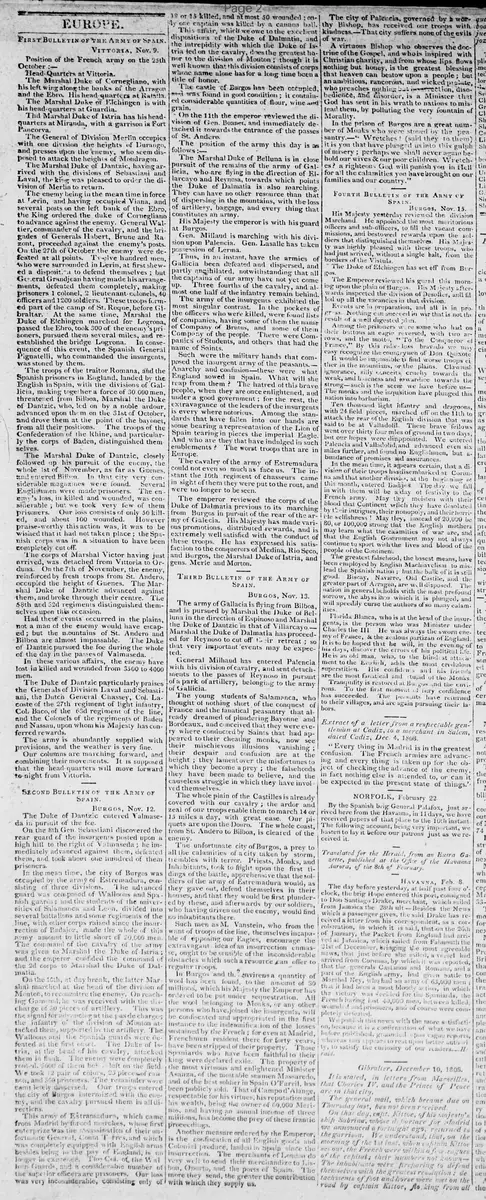
FIRST BULLETIN OF THE ARMY OF SPAIN.
VITORIA, NOV. 9.
Position of the French army on the 25th October:
Head-Quarters at Vittoria.
The Marshal Duke of Cornegliano, with his left wing along the banks of the Arragon and the Ebro. His head-quarters at Ralla.
The Marshal Duke of Elchingen is with his head-quarters at Guardia.
The Marshal Duke of Istria has his head-quarters at Miranda, with a garrison in Fort Pancorvo.
The General of Division Merlin occupies with one division the heights of Durango, and presses upon the enemy, who seem disposed to attack the heights of Mondragon.
The Marshal Duke of Dantzic, having arrived with the divisions of Sebastiani and Laval, the king was pleased to order the division of Merlin to return.
The enemy being in the mean time in force at Lerin, and having occupied Viana, and several posts on the left bank of the Ebro, the King ordered the duke of Cornegliano to advance against the enemy. General Walther, commander of the cavalry, and the brigades of Generals Habert, Brune and Razout, proceeded against the enemy's posts.
On the 27th of October the enemy were defeated at all points. Twelve hundred men, who were surrounded in Lerin, at first showed a disposition to defend themselves; but General Grandjean having made his arrangements, defeated them completely, making prisoners 1 colonel, 2 lieutenant-colonels, 40 officers and 1200 soldiers. These troops formed part of the camp of St. Roque, before Gibraltar. At the same time, Marshal the Duke of Elchingen marched for Logrono, passed the Ebro, took 300 of the enemy's prisoners, pursued them several miles, and re-established the bridge at Logrono. In consequence of this event, the Spanish General Pignatelli, who commanded the insurgents, was stoned by them.
The troops of the traitor Romana, and the Spanish prisoners in England, landed by the English in Spain, with the divisions of Galicia, making together a force of 30,000 men, threatened from Bilbao, Marshal the Duke of Dantzic, who, led on by a noble ardour, advanced upon them on the 31st of October, and drove them at the point of the bayonet, from all their positions. The troops of the Confederation of the Rhine, and particularly the corps of Baden, distinguished themselves.
The Marshal Duke of Dantzic, closely followed up his pursuit of the enemy, the whole 1st of November, as far as Guenes, and entered Bilbao. In that city very considerable magazines were found. Several Englishmen were made prisoners. The enemy's loss, in killed and wounded, was considerable; but we took very few of them prisoners. Our loss consists of only 50 killed, and about 100 wounded. However praise-worthy this action was, it was to be wished that it had not taken place; the Spanish corps was in a situation to have been completely cut off.
The corps of Marshal Victor having just arrived, was detached from Vittoria to Orduna. On the 7th of November, the enemy, reinforced by fresh troops from St. Andero, occupied the height of Guenes. The Marshal Duke of Dantzic advanced against them, and broke through their centre. The 58th and 82d regiments distinguished themselves upon this occasion.
Had these events occurred in the plains, not a man of the enemy would have escaped; but the mountains of St. Andero and Bilbao are almost impassable. The Duke of Dantzic pursued the foe during the whole of the day in the passes of Valmaseda.
In these various affairs, the enemy have lost in killed and wounded from 3500 to 4000 men.
The Duke of Dantzic particularly praises the Generals of Division Laval and Sebastiani, the Dutch General Chassey, Col. Lacoste of the 27th regiment of light infantry, Col. Baco, of the 63d regiment of the line, and the Colonels of the regiments of Baden and Nassau, upon whom his Majesty has conferred rewards.
The army is abundantly supplied with provisions, and the weather is very fine.
Our columns are marching forward, and combining their movements. It is supposed that the head-quarters will move forward to-night from Vittoria.
SECOND BULLETIN OF THE ARMY OF SPAIN.
Burgos, Nov. 12.
The Duke of Dantzic entered Valmaseda in pursuit of the foe.
On the 8th Gen. Sebastiani discovered the rear guard of the insurgents posted upon a high hill to the right of Valmaseda; he immediately advanced against them, defeated them, and took about one hundred of them prisoners.
In the mean time, the city of Burgos was occupied by the army of Estremadura, consisting of three divisions. The advanced guard was composed of Walloons and Spanish guards; and the students of the universities of Salamanca and Leon, divided into several battalions and some regiments of the line, with other corps raised since the insurrection of Badajoz, made the whole of this army amount to little short of 20,000 men.
The command of the cavalry of the army was given to Marshal the Duke of Istria: and the emperor confided the command of the 2d corps to Marshal the Duke of Dalmatia.
On the 10th, at day break, the latter Marshal marched at the head of the division of Mouton, to reconnoitre the enemy. On reaching Gamonal, he was received with the discharge of 50 pieces of artillery. This was the signal for advancing at the pas de charge; the infantry of the division of Mouton attacked them, supported by the artillery. The Walloons and the Spanish guards were defeated at the first onset. The Duke of Istria, at the head of his cavalry, attacked them in flank. The enemy were completely routed, some of them left on the field. We took 12 pair of colors, 23 pieces of cannon, and 500 prisoners. The remainder were completely dispersed. Our troops entered the city of Burgos intermingled with the enemy, and the cavalry pursued them in all directions.
This army of Estremadura, which came from Madrid by forced marches, whose first enterprize was the assassination of their unfortunate General, Count Turrene, and which was completely equipped with English arms besides being in the pay of England, is no longer in existence. The Col. of the Walloon Guards, and a considerable number of the superior officers are prisoners. Our loss was very inconsiderable, consisting only of 19 or 15 killed, and at most 50 wounded: only one captain was killed by a cannon ball.
This affair, which we owe to the excellent dispositions of the Duke of Dalmatia, and the intrepidity with which the Duke of Istria led on the cavalry, does the greatest honor to the division of Mouton; though it is well known that this division consists of corps whose name alone has for a long time been a title of honor.
The castle of Burgos has been occupied, and was found in good condition; it contained considerable quantities of flour, wine and grain.
On the 11th the emperor reviewed the division of Gen. Bonnet, and immediately detached it towards the entrance of the passes of St. Andero.
The position of the army this day is as follows:
The Marshal Duke of Belluna is in close pursuit of the remains of the army of Galicia, who are flying in the direction of Ellarcayo and Reynosa, towards which points the Duke of Dalmatia is also marching.
They can have no other resource than that of dispersing in the mountains, with the loss of artillery, baggage, and every thing that constitutes an army.
His Majesty the emperor is with his guard at Burgos.
Gen. Milhaud is marching with his division upon Palencia. Gen. Lasalle has taken possession of Lerma.
Thus, in an instant, have the armies of Galicia been defeated and dispersed, and partly annihilated, notwithstanding that all the captains of our army have not yet come up.
Three fourths of the cavalry, and almost one half of the infantry remain behind.
The army of the insurgents exhibited the most singular contrast. In the pockets of the officers who were killed, were found lists of companies, having some of them the name of Company of Brutus, and some of them Company of the people. There were Companies of Students, and others that had the name of Saints.
Such were the military bands that composed the insurgent army of the peasants. Anarchy and confusion—these were what England sowed in Spain. What will she reap from them? The hatred of this brave people, when they are once enlightened, and under a good government; for the rest, the extravagance of the leaders of the insurgents is every where notorious. Among the standards that have fallen into our hands are some bearing a representation of the Lion of Spain tearing in pieces the imperial Eagle.
And who are they that have indulged in such emblems? The worst troops that are in Europe.
The Cavalry of the army of Estremadura could not even so much as face us. The instant the 10th regiment of chasseurs came in sight of them they were put to the rout, and were no longer to be seen.
The emperor reviewed the corps of the Duke of Dalmatia previous to its marching from Burgos in pursuit of the rear of the army of Galicia. His Majesty has made various promotions, distributed rewards, and is extremely well satisfied with the conduct of these troops. He has expressed his satisfaction to the conquerors of Medina, Rio Seco, and Burgos, the Marshal Duke of Istria, and Gens. Merle and Mouton.
THIRD BULLETIN OF THE ARMY OF SPAIN.
Burgos, Nov. 13.
The army of Galicia is flying from Bilbao, and is pursued by Marshal the Duke of Belluna in the direction of Espinosa and Marshal the Duke of Dantzic in that of Villarcayo. Marshal the Duke of Dalmatia has proceeded for Reynosa to cut off their retreat; so that very important events may be expected.
General Milhaud has entered Palencia with his division of cavalry, and sent detachments to the passes of Reynosa in pursuit of a park of artillery, belonging to the army of Galicia.
The young students of Salamanca, who thought of nothing short of the conquest of France and the fanatical peasantry that already dreamed of plundering Bayonne and Bordeaux, and conceived that they were every where conducted by Saints that had appeared to their cheating monks, now see their mischievous illusions vanishing; their despair and confusion are at the height; they lament over the misfortunes to which they become a prey; the falsehoods they have been made to believe, and the causeless struggle in which they have involved themselves.
The whole plain of the Castiles is already covered with our cavalry; the ardor and zeal of our troops enable them to march 14 or 15 miles a day, with great ease. Our piquets are upon the Douro. The whole coast, from St. Andero to Bilbao, is cleared of the enemy.
The unfortunate city of Burgos, a prey to all the calamities of a city taken by storm, trembles with terror. Priests, Monks, and Inhabitants, took to flight upon the first tidings of the battle, apprehensive that the soldiers of the army of Estremadura would, as they gave out, defend themselves in their houses, and that they would be first plundered by these, and afterwards by our soldiers, who having driven out the enemy, would find no inhabitants there.
Such men as M. Urquijo, who from the want of troops of the line, themselves incapable of opposing our Eagles, encourage the extravagant idea of an insurrection en masse, ought to be sensible of the inconsiderable obstacles which such a resource can offer to regular troops.
In Burgos and the environs a quantity of wool has been found, to the amount of 30 millions, which his Majesty the Emperor has ordered to be put under sequestration. All the wool belonging to Monks, or any other persons who have joined the insurgents, will be confiscated and appropriated in the first instance to the indemnification of the losses sustained by the French: for even at Madrid, Frenchmen resident there for forty years, have been stripped of their property. Those Spaniards who have been faithful to their king were declared exiles. The property of the most virtuous and enlightened Minister Urquijo, of the most able seamen Massaredo, and of the best soldier in Spain O'Farril, has been publicly sold. That of Ceballos d'Alange, respectable for his virtues, his reputation and his wealth, being the owner of 60,000 Merinos, and having an annual income of three millions, has become the prey of these frantic proceedings.
Another measure ordered by the Emperor, is the confiscation of all English goods and Colonial produce, landed in Spain since the insurrection. The merchants of London do very well to send their merchandise to Lisbon, Oporto, and the ports of Spain. The more they send, the greater the contribution with which they supply us.
The city of Palencia, governed by a worthy Bishop, has received our troops with kindness. That city suffers none of the evils of war.
A virtuous Bishop who observes the doctrine of the Gospel, and who is inspired with Christian charity, and from whose lips flows nothing but honey, is the greatest blessing that heaven can bestow upon a people; but an ambitious, rancorous, and wicked prelate, who preaches nothing but insurrection, disobedience, and disorder, is a Minister that God has sent in his wrath to nations to mislead them, by polluting the very fountain of Morality.
In the prison of Burgos are a great number of Monks who were stoned by the peasantry. "Wretches! (said they to them) it is you that have plunged us into this gulph of misery; perhaps we shall never again behold our wives & our poor children. Wretches! a righteous God will punish you in Hell for all the calamities you have brought on our families and our country."
FOURTH BULLETIN OF THE ARMY OF SPAIN.
Burgos, Nov. 15.
His Majesty yesterday reviewed the division Marchand. He appointed the most meritorious officers and sub-officers, to fill the vacant commissions, and bestowed rewards upon the soldiers that distinguished themselves. His Majesty was highly pleased with these troops, who had just arrived, without a single halt, from the borders of the Vistula.
The Duke of Elchingen has set off from Burgos.
The Emperor reviewed his guard this morning upon the plain of Burgos. His Majesty afterwards inspected the division of Dessolles, and filled up all the vacancies in that division.
Events are in preparation, and all is in progress. Nothing can succeed in war that is not the result of a well digested plan.
Among the prisoners were some who had on their buttons an eagle reversed, with two arrows, and the motto, "To the Conqueror of France." By this ridiculous bravado we may easily recognize the countrymen of Don Quixote. It would be impossible to find worse troops either in the mountains, or the plains. Clownish ignorance, silly vain conceits, cruelty towards the weak, and baseness and cowardice towards the strong—such is the scene we have before us. The monks and the inquisition have plunged this nation into barbarism.
Ten thousand light infantry and dragoons, with 24 field pieces, marched off on the 11th to attack the rear of the English division that was said to be at Valladolid. These brave fellows went over thirty four miles of ground in two days, but our hopes were disappointed. We entered Palencia and Valladolid and advanced even six miles further, and found no Englishmen, but abundance of promises and assurances.
In the mean time, it appears certain, that a division of their troops has disembarked at Corunna and that another division at the beginning of this month, entered Badajoz. The day we fall in with them will be a day of festivity to the French army. May they moisten with their blood that Continent which they have desolated by their intrigues, their monopoly, and their horrible selfishness! May they, instead of 20,000 be 80, or 100,000 strong that the English mothers may learn what the calamities of war are, and that the English Government may not always continue to sport with the lives and blood of the people of the Continent.
The greatest falsehood, the basest means, have been employed by English Machiavelism to mislead the Spanish nation; but the bulk of it is still good. Biscay, Navarre, Old Castile, and the greater part of Arragon, are well disposed. The nation in general beholds with the most profound sorrow, the abyss into which it is plunged, and will speedily curse the authors of so many calamities.
Florida Blanca, who is at the head of the insurgents, is the person who was Minister under Charles the III. He was always the sworn enemy of France, & the zealous partizan of England. It is to be hoped that he will, in the evening of his days, discover the errors of his political life. He is an old man, who, to the blindest attachment to the English, adds the most credulous superstition. His confidants and his friends are the most fanatical and stupid of the Monks.
Tranquility is restored at Burgos and the environs. To the first moment of fury confidence has succeeded. The peasants have returned to their villages, and are again pursuing their labors.
What sub-type of article is it?
What keywords are associated?
What entities or persons were involved?
Where did it happen?
Foreign News Details
Primary Location
Vitoria, Burgos, Bilbao, Spain
Event Date
25th October To 15th November
Key Persons
Outcome
enemy losses: 3500-4000 killed/wounded in various affairs; 1200 prisoners at lerin, 300 at logrono, 100 at valmaseda, 500 at burgos; captured 12 colors, 23 cannon, magazines, wool; french losses minimal: 50 killed, 100 wounded near bilbao; 15-19 killed, 50 wounded at burgos; spanish armies of galicia and estremadura defeated and dispersed.
Event Details
French forces under Napoleon advanced from Vitoria, defeating Spanish insurgents at Lerin, Logrono, Bilbao, Valmaseda, and Burgos; pursued retreating armies of Galicia and Estremadura; occupied cities, seized supplies, and confiscated goods; Emperor reviewed troops and planned further movements while criticizing English influence and Spanish leadership.