Thank you for visiting SNEWPapers!
Sign up free
Republican Herald
Providence, Providence County, Rhode Island
What is this article about?
A letter to the Providence Herald defending the Indian Removal Bill (No. 2), arguing that Native Americans, particularly common Indians in tribes like the Cherokee, are miserable, impoverished, and eager to emigrate west, based on a U.S. House Committee report, despite opposition from chiefs and glowing accounts from missionaries.
Merged-components note: This is a continuation of the letter to the editor discussing the Indian Bill, spanning from page 1 to page 2. The second component was originally labeled domestic_news but fits as part of the letter.
Clippings
1 of 2
OCR Quality
Full Text
FOR THE HERALD.
THE INDIAN BILL, No. 2.
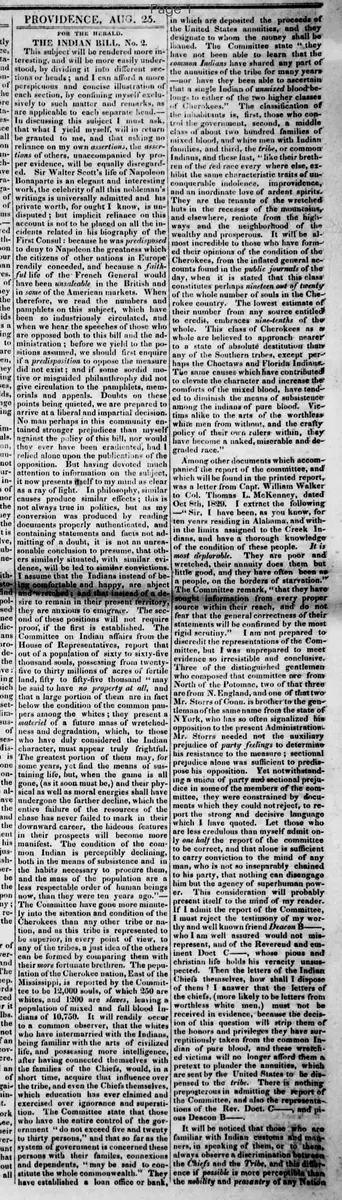
This subject will be rendered more interesting, and will be more easily understood, by dividing it into different sections or heads; and I can afford a more perspicuous and concise illustration of each section, by confining myself exclusively to such matter and remarks, as are applicable to each separate head.—In discussing this subject I must ask, that what I yield myself, will in return be granted to me, and that asking no reliance on my own assertions, the assertions of others, unaccompanied by proper evidence, will be equally disregarded. Sir Walter Scott's life of Napoleon Bonaparte is an elegant and interesting work, the celebrity of all this nobleman's writings is universally admitted and his private worth, for ought I know, is undisputed; but implicit reliance on this account is not to be placed on all the incidents related in his biography of the First Consul: because he was predisposed to deny to Napoleon the greatness which the citizens of other nations in Europe readily conceded, and because a faithful life of the French General would have been unsaleable in the British and in some of the American markets. When therefore, we read the numbers and pamphlets on this subject, which have been so industriously circulated, and when we hear the speeches of those who are opposed both to this bill and the administration; before we yield to the positions assumed, we should first enquire if a predisposition to oppose the measure did not exist; and if some sordid motive or misguided philanthropy did not give circulation to the pamphlets, memorials and appeals. Doubts on these points being quieted, we are prepared to arrive at a liberal and impartial decision.
No man perhaps in this community entertained stronger prejudices than myself against the policy of this bill, nor would they ever have been eradicated, had I relied alone upon the publications of the opposition. But having devoted much attention to information on the subject, it now presents itself to my mind as clear as a ray of light. In philosophy, similar causes produce similar effects; this is not always true in politics, but as my conversion was produced by reading documents properly authenticated, and containing statements and facts not admitting of a doubt, it is not an unreasonable conclusion to presume, that others similarly situated, with similar evidence, will be led to similar convictions.
I assume that the Indians instead of being comfortable and happy, are abject and wretched; and that instead of a desire to remain in their present territory, they are anxious to emigrate. The second of these positions will not require proof, if the first is established. The Committee on Indian affairs from the House of Representatives, report that out of a population of sixty to sixty-five thousand souls, possessing from twenty-five to thirty millions of acres of fertile land, fifty to fifty-five thousand "may be said to have no property at all, and that a large portion of them are in fact below the condition of the common paupers among the whites; they present a material of a future mass of wretchedness and degradation, which, to those who have duly considered the Indian character, must appear truly frightful." The greatest portion of them may, for some years, yet find the means of sustaining life, but, when the game is all gone, (as it soon must be,) and their physical as well as moral energies shall have undergone the farther decline, which the entire failure of the resources of the chase has never failed to mark in their downward career, the hideous features in their prospects will become more manifest. The condition of the common Indian is perceptibly declining, both in the means of subsistence and in the habits necessary to procure them, and the mass of the population are a less respectable order of human beings now, than they were ten years ago.—
The Committee have gone more minutely into the situation and condition of the Cherokees than any other tribe or nation, and as this tribe is represented to be superior, in every point of view, to any of the tribes, a just idea of the others can be formed by comparing them with their more fortunate brethren. The population of the Cherokee nation, East of the Mississippi, is reported by the Committee to be 12,000 souls, of which 250 are whites, and 1200 are slaves, leaving a population of mixed and full blood Indians of 10,750. It will readily occur to a common observer, that the whites who have intermarried with the Indians, being familiar with the arts of civilized life, and possessing more intelligence, after having connected themselves with the families of the Chiefs, would, in a short time, acquire that influence over the tribe, and even the Chiefs themselves, which education has ever claimed and exercised over ignorance and superstition. The Committee state that those who have the entire control of the government do not exceed five and twenty to thirty persons, and that so far as the system of government is concerned these persons with their families, connexions and dependents, "may be said to constitute the whole commonwealth." They have established a loan office or bank, in which are deposited the proceeds of the United States annuities, and they designate to whom the money shall be loaned. The Committee state "they have not been able to learn that the common Indians have shared any part of the annuities of the tribe for many years—nor have they been able to ascertain that a single Indian of unmixed blood belongs to either of the two higher classes of Cherokees." The classification of the inhabitants is, first, those who control the government, second, a middle class of about two hundred families of mixed blood, and white men with Indian families, and third, the tribe, or common Indians, and these last, "like their brethren of the red race every where else, exhibit the same characteristic traits of unconquerable indolence, improvidence, and an inordinate love of ardent spirits. They are the tenants of the wretched huts in the recesses of the mountains, and elsewhere, remote from the highways and the neighborhood of the wealthy and prosperous. It will be almost incredible to those who have formed their opinions of the condition of the Cherokees, from the inflated general accounts found in the public journals of the day, when it is stated that this class constitutes perhaps nineteen out of twenty of the whole number of souls in the Cherokee country. The lowest estimate of their number from any source entitled to credit, embraces nine-tenths of the whole. This class of Cherokees as a whole are believed to approach nearer to a state of absolute destitution than any of the Southern tribes, except perhaps the Choctaws and Florida Indians. The same causes which have contributed to elevate the character and increase the comforts of the mixed blood, have tended to diminish the means of subsistence among the Indians of pure blood. Victims alike to the arts of the worthless white men from without, and the crafty policy of their own rulers within, they have become a naked, miserable and degraded race."
Among other documents which accompanied the report of the committee, and which will be found in the printed report, was a letter from Capt. William Walker to Col. Thomas L. McKenney, dated Oct 8th, 1829. I extract the following—"Sir, I have been, as you know, for ten years residing in Alabama, and within the limits assigned to the Creek Indians, and have a thorough knowledge of the condition of these people. It is most deplorable. They are poor and wretched, their annuity does them but little good, and they have often been as a people, on the borders of starvation."
The Committee remark, "that they have sought information from every proper source within their reach, and do not fear that the general correctness of their statements will be confirmed by the most rigid scrutiny." I am not prepared to discredit the representations of the Committee, but I was unprepared to meet evidence so irresistible and conclusive. Three of the distinguished gentlemen who composed that committee are from North of the Potomac, two of that three are from N. England, and one of that two Mr. Storrs of Conn. is brother to the gentleman of the same name from the state of N. York, who has so often signalized his opposition to the present Administration. Mr. Storrs needed not the auxiliary prejudice of party feelings to determine his resistance to the measure; sectional prejudice alone was sufficient to predispose his opposition. Yet notwithstanding a union of party and sectional prejudice in some of the members of the committee, they were constrained by documents which they could not reject, to report the strong and decisive language which I have quoted. Let those who are less credulous than myself admit only one half the report of the committee to be correct, and that alone is sufficient to carry conviction to the mind of any man, who is not so inseparably chained to his party, that nothing can disengage him but the agency of superhuman power.
This consideration will probably present itself to the mind of my reader. If I admit the report of the Committee, I must reject the testimony of my worthy and well known friend Deacon B—, who I am well assured would not misrepresent, and of the Reverend and eminent Doct C—, whose pious and christian life holds his veracity unsuspected. Then the letters of the Indian Chiefs themselves, how shall I dispose of them? I answer that the letters of the chiefs, (more likely to be letters from worthless white men,) must not be received in evidence, because the decision of this question will strip them of the honors and privileges they have surreptitiously taken from the common Indian of pure blood, and these wretched victims will no longer afford them a pretext to plunder the annuities, which are sent by the United States to be dispensed to the tribe. There is nothing preposterous in admitting the report of the Committee, and also the representations of the Rev. Doct. C—, and pious Deacon B—.
It will be noticed that those who are familiar with Indian customs and manners, in speaking of them, or to them, always observe a discrimination between the Chiefs and the Tribe, and this difference if possible is more perceptible than the nobility and peasantry of any Nation.
in Europe. The representations of the pious gentlemen above are no doubt entirely true, in relation to the chiefs and half bloods whom they have seen, and when it is known that these few have taken the government into their own hands, control the funds and direct the board of trade, and that they live on the principal roads and avenues, which lead through the Indian country, and that it is from them, and not from the tribe, that the information concerning the nation was received, and that it is for the honor and interest of these few to withhold correct information concerning the tribe, it can no longer be a matter of surprise that we see such glowing descriptions of their wealth and comfort, their highly cultivated farms, and their advancement in education and morals: because those who afford these descriptions, have only been along the great roads, where all the wealth, comfort, education and morals of the whole nation is concentrated; and judging from what they see, and relying upon the testimony of crafty and interested white men and half blood Indians, their publications go forth to the world as a true representation of the whole country.
It will be observed there is no clashing in the representations made by the Committee, and those who have published numbers and periodicals on this subject. The Committee admit all the happiness, wealth, education and morals, which is said to be enjoyed by the Cherokees, but they point to the limited number who enjoy these blessings, and circumscribe the territory in which the enjoyments are confined, to a very narrow compass. Thus much in support of my argument that the Indians are not comfortable and happy, but are abject and miserable. The relation in which the tribe or common Indians of pure blood stand to their chiefs and the half bloods, could not require proof to convince an acute observer, how gladly they would escape the fangs of the aristocracy, which are fattening on their vitals, and must soon extinguish life, and with it their hapless race. Under these circumstances, what inducement offers for the tribe to remain? Possessing only a common usufructuary interest in the lands and forests over which they roam, relying for subsistence on the wild fruits, fishes, birds and game, which are common to all, and perceiving these supplies of nature rapidly to diminish, not even participants in the commodities which the annual supplies of our government have directed for their comfort, spurned by their chiefs, and oppressed by rigorous and unjust laws, in the existence of which they feel no interest, because in their formation they gave neither their counsel nor consent. What native full blood Indians then will not flee to the country beyond the Mississippi, where remote from the corrupting arts of the white man, they can have a government of their own: where the soil, the climate, the forest, the prairie, and the various pursuits of the chase offer them perpetual and unrestrained enjoyment.
Can we ask, or can more incontestable evidence be introduced of the desire the tribe have to cross the Mississippi, than the pains and penalties embodied in the laws and resolves of those who have usurped the government, why these restrictions and penalties? If the Indians are anxious to remain, corporal punishment and confiscation of their property will not make them more anxious.
In one of the Resolves passed by the Cherokee Legislature, in October, 1829, the penalty of enrolling for emigration, or inviting or attempting to induce others to emigrate, is 'confiscation of property, a fine not more than two thousand, nor less than one thousand dollars, and punishment not less than one hundred stripes.' If such a law should be passed in this State, could any one be made to believe that it was because the citizens were unwilling to leave the State? Would not the contrary conclusion be drawn, that the people intended and were anxious to go, but the authorities interposed to prevent it? The new government set up among the Cherokees has abolished the ancient usage of an equal division of the spoils and presents which accident or conquest threw in their way; the common Indians, although very ignorant, are nevertheless aware of its, and seek a new country, where former customs restored is of more magnitude to them, than to perish in sight of the graves of their ancestors.
The committee observe, 'If such measures shall be resorted to, as will satisfy the Indians generally, that the government means to treat them with kindness, and to secure to them a country, beyond the power of the white inhabitants to annoy them, the influence of their chiefs cannot longer prevent their emigration.' I would not be understood to say, that all the common Indians evince this desire to emigrate, for it must be believed that the Chiefs still retain influence over some of them; for among a caste so destitute as the tribe, many of them can be diverted from their purpose by the money or threats of their opulent masters. Those who had the power began to check emigration as early as 1817, and when Gen. Jackson was in the nation, making treaties, many of the tribe, fearing the danger of their Chiefs, dared not approach in the day time, but at night would creep on their hands and knees to Gen. Jackson's quarters and enroll their names for emigration. Proof corroborative of this fact may be found in a letter from Col. Crowell, the Indian Agent, to the Secretary of War, dated June 19, 1829. The letter is annexed to the printed Report of the Committee on Indian affairs. I extract the following--'They have recently passed laws to punish any of their people, who shall dare to signify a willingness to emigrate, and such is the influence of the Chiefs over some of their people, that many who would willingly remove, yes, I may say thousands, dare not let it be publicly known. They come to me secretly, and say, when I am ready to start and prepared to protect them they will go with me.'
Extract of a letter from General Coffee to the Secretary of War, dated Nov. 16, 1829.--'Just before I left the Creek nation a man by the name of John Danny, had been run from his town by the threats of old Ma-nor-wa, at a ball play. Ma-nor-wa told his men that Danny must be killed; that he talked of going away, and was trying to persuade his friends to go with him; that he should be killed and his property taken. This man has recently had the brother of Danny killed, under the plausible pretext of his being a witch.'
Extract of a letter from Mackey, the Choctaw Indian Interpreter, to the Secretary of War, dated Choctaw nation, Nov. 27, 1829. 'They would, the great mass of them, go if it was not that there are three half breed Chiefs, one to each district; they are opposed to anything like emigration, or anything for the good of the nation; they know they can live under the laws and become citizens of the State, but it is not so with all. They are very much in the spirit of moving to the West, and if they were encouraged by the government, a great many of them would go very soon.'
These extracts are from letters which are printed and accompanied the report of the committee. There are several other letters of the same character appended to the report, but it would occupy too much space to insert them. One more extract from a printed letter attached to the report, and I feel assured that I have proved that the Indians, instead of being anxious to remain, are desirous to remove. Extract of a letter to the Secretary of War, dated Fort Bainbridge, Creek Nation, April 12, 1829:
'Friend and Brother--A party of us that were willing to go, collected and took our encampment at this place. When we were leaving our houses, our people that were not going, exerted their utmost endeavors to prevent us from leaving this country; we placed but little confidence in their menaces, being confident that it would please our Father to learn that his children had taken hold on his talk. This so exasperated them, that they set no bounds to their resentment; and accordingly a party of desperadoes, headed by their Chief, old He-ne-he-mathla, who was one of the most inveterate enemies, that the United States had in the last war, attacked our camps, and after most barbarously beating two of our people, a man and a woman, they wantonly took off their ears, the said old He-ne-he-mathla exclaiming, that if the United States had promised them protection, he would see whether they would be protected or not. We earnestly beg that our great Father would send us immediate assistance, or otherwise we will be exposed to the fury of our countrymen, and may eventually be all massacred, as we are informed that they are again threatening of
Your Children,
CO-WE MATHLA. his x mark
POSE HARJOE.
x
HOLATEE THLOCOE, x
CHOCOTE YOHOLA,
x
CO-WE HARJOE,
x
Witness--John Hambly.'
If those Missionaries, who have been stationed in the neighborhood of the wealthy Cherokees, and those travellers who have only seen the well educated and intelligent half bloods, could have penetrated to the interior of the country, and gained access to the comfortless huts of the squalid native Indian, those glowing descriptions and highly colored pictures representing the Cherokee nation as far advanced in the usages of civilized life, would never have obtruded themselves before our National Legislature, to prepossess its acts, or influence its decisions.
DIOMED.
What sub-type of article is it?
What themes does it cover?
What keywords are associated?
What entities or persons were involved?
Letter to Editor Details
Author
Diomed
Recipient
For The Herald
Main Argument
the indian removal bill should be supported because native americans, especially common full-blood indians, are abject, wretched, and eager to emigrate west to escape oppressive chiefs and declining conditions, as evidenced by the u.s. house committee on indian affairs report and supporting documents, despite contrary claims from interested parties.
Notable Details