Thank you for visiting SNEWPapers!
Sign up free
Poem
August 31, 1862
Sunday Dispatch
New York, New York County, New York
What is this article about?
Henry Wadsworth Longfellow's poem 'Resignation' offers consolation to the bereaved, especially in wartime, by depicting death as a transition to a heavenly school where the departed, like the poet's daughter, grow in grace under Christ's rule, urging patience and unbroken bonds of love.
Clipping
OCR Quality
95%
Excellent
Full Text
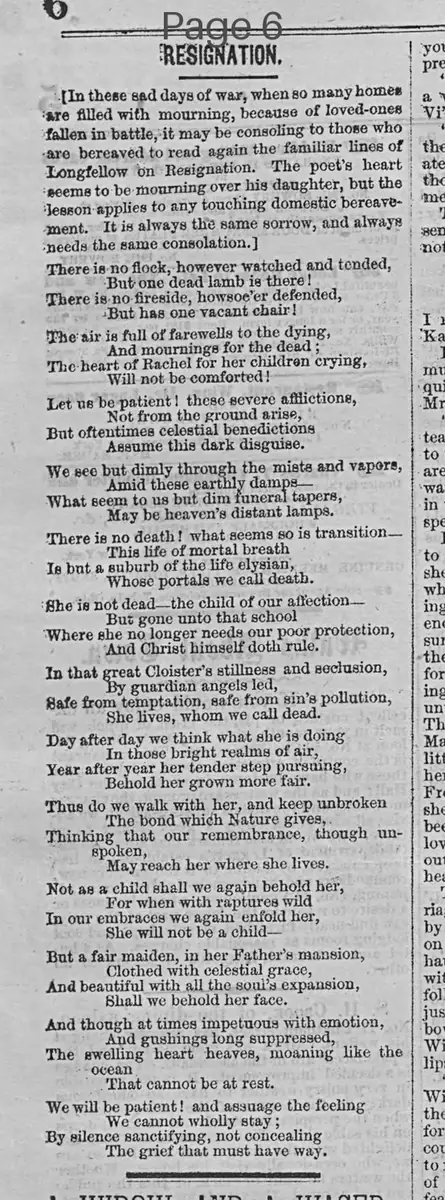
RESIGNATION.
[In these sad days of war, when so many homes are filled with mourning, because of loved-ones fallen in battle, it may be consoling to those who are bereaved to read again the familiar lines of Longfellow on Resignation. The poet's heart seems to be mourning over his daughter, but the lesson applies to any touching domestic bereavement. It is always the same sorrow, and always needs the same consolation.]
There is no flock, however watched and tended.
But one dead lamb is there!
There is no fireside, howsoe'er defended,
But has one vacant chair!
The air is full of farewells to the dying,
And mournings for the dead;
The heart of Rachel for her children crying,
Will not be comforted!
Let us be patient! these severe afflictions
Not from the ground arise,
But oftentimes celestial benedictions
Assume this dark disguise.
We see but dimly through the mists and vapors,
Amid these earthly damps
What seems to us but dim funeral tapers
May be heaven's distant lamps.
There is no death! what seems so is transition.
This life of mortal breath
Is but a suburb of the life elysian,
Whose portals we call death.
She is not dead—the child of our affection,—
But gone unto that school
Where she no longer needs our poor protection,
And Christ himself doth rule.
In that great Cloister's stillness and seclusion,
By guardian angels led,
Safe from temptation, safe from sin's pollution,
She lives, whom we call dead.
Day after day we think what she is doing
In those bright realms of air:
Year after year her tender step pursuing,
Behold her grown more fair.
Thus do we walk with her, and keep unbroken
The bond which nature gives,
Thinking that our remembrance, though unspoken,
May reach her where she lives.
Not as a child shall we again behold her,
For when with raptures wild
In our embraces we again enfold her,
She will not be a child;
But a fair maiden, in her Father's mansion,
Clothed with celestial grace,
And beautiful with all the soul's expansion,
Shall we behold her face.
And though at times impetuous with emotion
And gushing long suppressed,
The swelling heart heaven-moaning like the ocean,
That cannot be at rest, —
We will be patient, and assuage the feeling
We cannot wholly stay;
By silence sanctifying, not concealing,
The grief that must have way.
[In these sad days of war, when so many homes are filled with mourning, because of loved-ones fallen in battle, it may be consoling to those who are bereaved to read again the familiar lines of Longfellow on Resignation. The poet's heart seems to be mourning over his daughter, but the lesson applies to any touching domestic bereavement. It is always the same sorrow, and always needs the same consolation.]
There is no flock, however watched and tended.
But one dead lamb is there!
There is no fireside, howsoe'er defended,
But has one vacant chair!
The air is full of farewells to the dying,
And mournings for the dead;
The heart of Rachel for her children crying,
Will not be comforted!
Let us be patient! these severe afflictions
Not from the ground arise,
But oftentimes celestial benedictions
Assume this dark disguise.
We see but dimly through the mists and vapors,
Amid these earthly damps
What seems to us but dim funeral tapers
May be heaven's distant lamps.
There is no death! what seems so is transition.
This life of mortal breath
Is but a suburb of the life elysian,
Whose portals we call death.
She is not dead—the child of our affection,—
But gone unto that school
Where she no longer needs our poor protection,
And Christ himself doth rule.
In that great Cloister's stillness and seclusion,
By guardian angels led,
Safe from temptation, safe from sin's pollution,
She lives, whom we call dead.
Day after day we think what she is doing
In those bright realms of air:
Year after year her tender step pursuing,
Behold her grown more fair.
Thus do we walk with her, and keep unbroken
The bond which nature gives,
Thinking that our remembrance, though unspoken,
May reach her where she lives.
Not as a child shall we again behold her,
For when with raptures wild
In our embraces we again enfold her,
She will not be a child;
But a fair maiden, in her Father's mansion,
Clothed with celestial grace,
And beautiful with all the soul's expansion,
Shall we behold her face.
And though at times impetuous with emotion
And gushing long suppressed,
The swelling heart heaven-moaning like the ocean,
That cannot be at rest, —
We will be patient, and assuage the feeling
We cannot wholly stay;
By silence sanctifying, not concealing,
The grief that must have way.
What sub-type of article is it?
Elegy
What themes does it cover?
Death Mourning
Religious Faith
Moral Virtue
What keywords are associated?
Resignation
Bereavement
Death
Consolation
Longfellow
Mourning
Heaven
Patience
What entities or persons were involved?
Longfellow
Poem Details
Title
Resignation.
Author
Longfellow
Subject
Resignation In Bereavement
Form / Style
Rhymed Quatrains
Key Lines
There Is No Death! What Seems So Is Transition.
This Life Of Mortal Breath
Is But A Suburb Of The Life Elysian,
Whose Portals We Call Death.
She Is Not Dead—The Child Of Our Affection,—
But Gone Unto That School
Where She No Longer Needs Our Poor Protection,
And Christ Himself Doth Rule.