Thank you for visiting SNEWPapers!
Sign up free
Editorial
May 10, 1930
The Milwaukee Leader
Milwaukee, Milwaukee County, Wisconsin
What is this article about?
Scott Nearing argues that war economically benefits contractors, ruling classes, and businesses by generating profits, securing resources, and destroying surplus, as seen in Britain's post-WWI boom and subsequent slump. He contrasts this with exploitation of the masses and proposes a cooperative alternative.
Clipping
OCR Quality
98%
Excellent
Full Text
War Does Pay
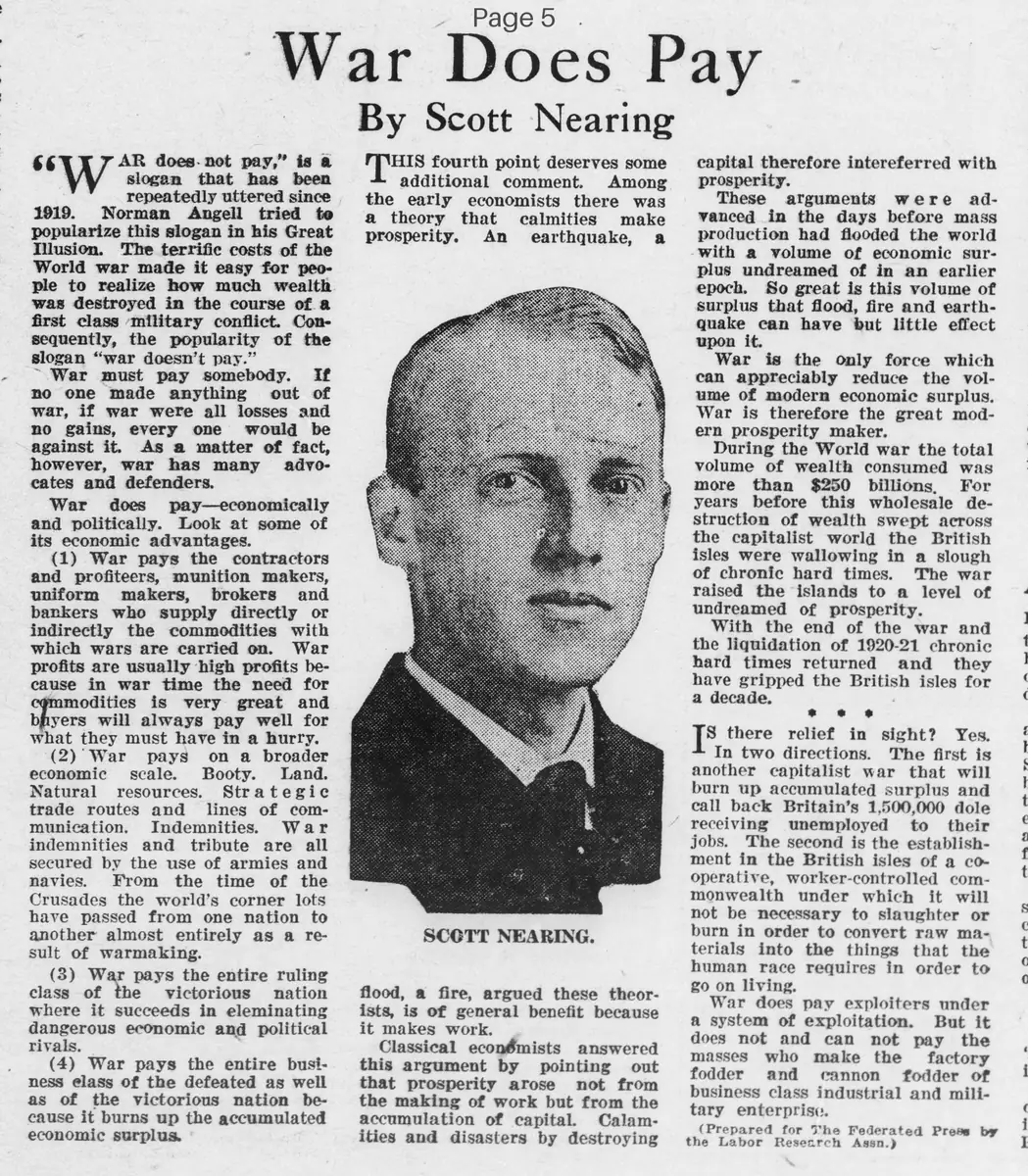
By Scott Nearing
"War does not pay," is a slogan that has been repeatedly uttered since 1919. Norman Angell tried to popularize this slogan in his Great Illusion.
The terrific costs of the World war made it easy for people to realize how much wealth was destroyed in the course of a first class military conflict. Consequently, the popularity of the slogan "war doesn't pay."
War must pay somebody. If no one made anything out of war, if war were all losses and no gains, every one would be against it. As a matter of fact, however, war has many advocates and defenders.
War does pay--economically and politically. Look at some of its economic advantages.
(1) War pays the contractors and profiteers, munition makers, uniform makers, brokers and bankers who supply directly or indirectly the commodities with which wars are carried on. War profits are usually high profits because in war time the need for commodities is very great and buyers will always pay well for what they must have in a hurry.
(2) War pays on a broader economic scale. Booty. Land. Natural resources. Strategic trade routes and lines of communication. Indemnities. War indemnities and tribute are all secured by the use of armies and navies.
From the time of the Crusades the world's corner lots have passed from one nation to another almost entirely as a result of warmaking.
(3) War pays the entire ruling class of the victorious nation where it succeeds in eliminating dangerous economic and political rivals.
(4) War pays the entire business class of the defeated as well as of the victorious nation because it burns up the accumulated economic surplus.
This fourth point deserves some additional comment.
Among the early economists there was a theory that calamities make prosperity. An earthquake, a flood, a fire, argued these theorists, is of general benefit because it makes work.
Classical economists answered this argument by pointing out that prosperity arose not from the making of work but from the accumulation of capital. Calamities and disasters by destroying capital therefore interfered with prosperity.
These arguments were advanced in the days before mass production had flooded the world with a volume of economic surplus undreamed of in an earlier epoch. So great is this volume of surplus that flood, fire and earthquake can have but little effect upon it.
War is the only force which can appreciably reduce the volume of modern economic surplus. War is therefore the great modern prosperity maker.
During the World war the total volume of wealth consumed was more than $250 billions. For years before this wholesale destruction of wealth swept across the capitalist world the British isles were wallowing in a slough of chronic hard times. The war raised the islands to a level of undreamed of prosperity.
With the end of the war and the liquidation of 1920-21 chronic hard times returned and they have gripped the British isles for a decade.
Is there relief in sight? Yes. In two directions.
The first is another capitalist war that will burn up accumulated surplus and call back Britain's 1,500,000 dole receiving unemployed to their jobs. The second is the establishment in the British isles of a co-operative, worker-controlled commonwealth under which it will not be necessary to slaughter or burn in order to convert raw materials into the things that the human race requires in order to go on living.
War does pay exploiters under a system of exploitation. But it does not and can not pay the masses who make the factory fodder and cannon fodder of business class industrial and military enterprise.
(Prepared for The Federated Press by the Labor Research Assn.)
By Scott Nearing
"War does not pay," is a slogan that has been repeatedly uttered since 1919. Norman Angell tried to popularize this slogan in his Great Illusion.
The terrific costs of the World war made it easy for people to realize how much wealth was destroyed in the course of a first class military conflict. Consequently, the popularity of the slogan "war doesn't pay."
War must pay somebody. If no one made anything out of war, if war were all losses and no gains, every one would be against it. As a matter of fact, however, war has many advocates and defenders.
War does pay--economically and politically. Look at some of its economic advantages.
(1) War pays the contractors and profiteers, munition makers, uniform makers, brokers and bankers who supply directly or indirectly the commodities with which wars are carried on. War profits are usually high profits because in war time the need for commodities is very great and buyers will always pay well for what they must have in a hurry.
(2) War pays on a broader economic scale. Booty. Land. Natural resources. Strategic trade routes and lines of communication. Indemnities. War indemnities and tribute are all secured by the use of armies and navies.
From the time of the Crusades the world's corner lots have passed from one nation to another almost entirely as a result of warmaking.
(3) War pays the entire ruling class of the victorious nation where it succeeds in eliminating dangerous economic and political rivals.
(4) War pays the entire business class of the defeated as well as of the victorious nation because it burns up the accumulated economic surplus.
This fourth point deserves some additional comment.
Among the early economists there was a theory that calamities make prosperity. An earthquake, a flood, a fire, argued these theorists, is of general benefit because it makes work.
Classical economists answered this argument by pointing out that prosperity arose not from the making of work but from the accumulation of capital. Calamities and disasters by destroying capital therefore interfered with prosperity.
These arguments were advanced in the days before mass production had flooded the world with a volume of economic surplus undreamed of in an earlier epoch. So great is this volume of surplus that flood, fire and earthquake can have but little effect upon it.
War is the only force which can appreciably reduce the volume of modern economic surplus. War is therefore the great modern prosperity maker.
During the World war the total volume of wealth consumed was more than $250 billions. For years before this wholesale destruction of wealth swept across the capitalist world the British isles were wallowing in a slough of chronic hard times. The war raised the islands to a level of undreamed of prosperity.
With the end of the war and the liquidation of 1920-21 chronic hard times returned and they have gripped the British isles for a decade.
Is there relief in sight? Yes. In two directions.
The first is another capitalist war that will burn up accumulated surplus and call back Britain's 1,500,000 dole receiving unemployed to their jobs. The second is the establishment in the British isles of a co-operative, worker-controlled commonwealth under which it will not be necessary to slaughter or burn in order to convert raw materials into the things that the human race requires in order to go on living.
War does pay exploiters under a system of exploitation. But it does not and can not pay the masses who make the factory fodder and cannon fodder of business class industrial and military enterprise.
(Prepared for The Federated Press by the Labor Research Assn.)
What sub-type of article is it?
Economic Policy
War Or Peace
Labor
What keywords are associated?
War Profits
Economic Surplus
Capitalism
Unemployment
British Economy
Worker Control
Munition Makers
World War
What entities or persons were involved?
Scott Nearing
Norman Angell
British Isles
Labor Research Assn.
Federated Press
Editorial Details
Primary Topic
Economic Benefits Of War For Exploiters And Ruling Classes
Stance / Tone
Critical Of War Under Capitalism, Advocating Worker Controlled Alternative
Key Figures
Scott Nearing
Norman Angell
British Isles
Labor Research Assn.
Federated Press
Key Arguments
War Pays Contractors, Profiteers, And Suppliers Through High Profits
War Secures Booty, Land, Resources, Trade Routes, And Indemnities
War Benefits Ruling Class By Eliminating Rivals
War Benefits Business Class By Destroying Economic Surplus
Calamities Like War Create Prosperity By Reducing Surplus In Mass Production Era
World War Destroyed $250 Billion In Wealth, Boosting Prosperity Temporarily
British Chronic Hard Times Ended By War But Returned Post War
Relief Via Another War Or Worker Controlled Commonwealth
War Pays Exploiters But Not The Masses