Thank you for visiting SNEWPapers!
Sign up free
Story
January 16, 1846
The Charlotte Journal
Charlotte, Mecklenburg County, North Carolina
What is this article about?
In May 1814, a small group of American militia in Rochester uses clever deceptions to repel a British fleet led by Sir James Yeo from landing, by feigning a larger force and military readiness through marches, flags of truce, and a single cannon.
Clipping
OCR Quality
95%
Excellent
Full Text
MISCELLANEOUS.
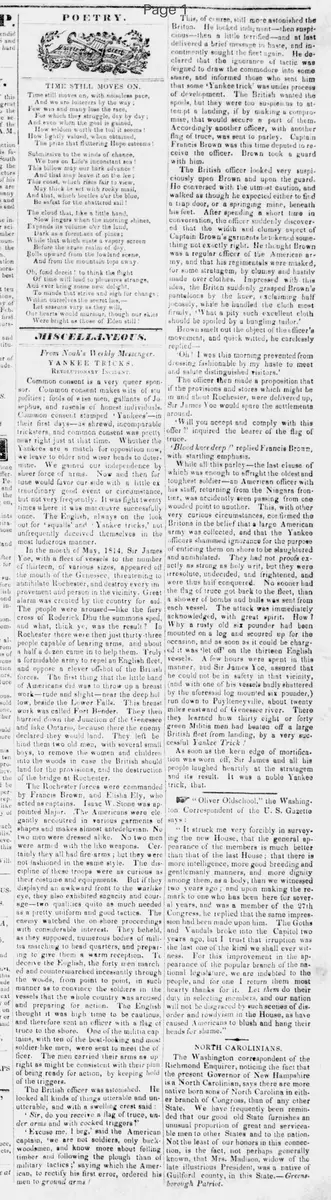
From Noah's Weekly Messenger.
YANKEE TRICKS.
Revolutionary Incident.
Common consent is a very queer sponsor.
Common consent makes wits of stupidities: fools of wise men, gallants of Josephus, and rascals of honest individuals.
Common consent stamped Yankees-in their first days-as shrewd, incomparable tricksters, and common consent was pretty near right just at that time. Whether the Yankees are a match for opposition now, we leave to older and wiser heads to determine. We gained our independence by sheer force of arms. Now and then fortune would favor our side with a little extraordinary good event or circumstance, but not very frequently. It was fight twenty times where it was manoeuvre successfully once. The English, always on the look out for 'squalls' and 'Yankee tricks,' not unfrequently deceived themselves in the most ludicrous manner.
In the month of May, 1814. Sir James Yeo, with a fleet of vessels to the number of thirteen, of various sizes, appeared off the mouth of the Genesee, threatening to annihilate Rochester, and destroy every improvement and person in the vicinity. Great alarm was created by the country for aid. The people were aroused-like the fiery cross of Roderick Dhu the summons sped, and what, think ye, was the result? In Rochester there were then just thirty-three people capable of bearing arms, and about a half a dozen came in to help them. Truly a formidable army to repel an English fleet, and oppose a clever off-shot of the British forces. The first thing that the little band of Americans did was to throw up a breast work-rude and slight-near the deep hollow, beside the Lower Falls. This breast work was called Fort Bender. They then hurried down the Junction of the Genesee and lake Ontario, because there the enemy declared they would land. They left behind them two old men, with several small boys, to remove the women and children into the woods in case the British should land for the provisions, and the destruction of the bridge at Rochester.
The Rochester forces were commanded by Francis Brown, and Elisha Ely, who acted as captains. Isaac W. Stone was appointed Major. The Americans were elegantly accoutred in various garments of shapes and makes almost antediluvian. No two men were dressed alike. No two men were armed with the like weapons. Certainly they all had fire-arms; but they were not fashioned in the same style. The discipline of these troops were as curious as their costume and equipments. But if they displayed an awkward front to the warlike eye, they also exhibited sagacity and courage-two qualities quite as much needed as a pretty uniform and good tactics. The enemy watched the on shore proceedings with considerable interest. They beheld, as they supposed, numerous bodies of militia marching to head quarters, and preparing to give them a warm reception. To deceive the English, the forty men marched and countermarched incessantly through the woods, from point to point, in such manner as to convince the soldiers in the vessels that the whole country was aroused and preparing for action. The English thought it was high time to be cautious, and therefore sent an officer with a flag of truce to the shore. One of the militia captains, with ten of the best-looking and most soldierlike men, were sent to meet the officer. The men carried their arms as upright as might be consistent with their plan of being ready for action, by keeping hold of the triggers.
The British officer was astonished. He looked all kinds of things utterable and unutterable, and with a swelling crest said: 'Sir, do you receive a flag of truce, under arms and with cocked triggers?'
'Excuse me, I beg,' said the American captain, 'we are not soldiers, only buckwoodsmen, and know more about felling timber and following the plough than of military tactics;' saying which the American, to rectify his first error, ordered his men to ground arms!
This, of course, still more astonished the Briton. He looked indignant-then suspicious-then a little terrified and at last delivered a brief message in haste, and incontinently sought the fleet again. He declared that the ignorance of tactics was feigned to draw the commodore into some snare, and informed those who sent him that some 'Yankee trick' was under process of development. The British wanted the spoils, but they were too suspicious to attempt a landing, if by making a compromise, that would secure a part of them. Accordingly another officer, with another flag of truce, was sent to parley. Captain Francis Brown was this time deputed to receive the officer. Brown took a guard with him.
The British officer looked very suspiciously upon Brown and upon the guard. He conversed with the utmost caution, and walked as though he expected either to find a trap door, or a springing mine, beneath his feet. After spending a short time in conversation, the officer suddenly discovered that the width and clumsy aspect of Captain Brown's garments betokened something not exactly right. He thought Brown was a regular officer of the American army, and that his regimentals were masked, for some stratagem, by clumsy and hastily made over clothes. Impressed with this idea, the Briton suddenly grasped Brown's pantaloon by the knee, exclaiming half jocosely, while he handled the cloth most firmly, 'What a pity such excellent cloth should be spoiled by a bungling tailor.'
Brown smelt out the object of the officer's movement, and quick witted, he carelessly replied-
'Oh! I was this morning prevented from dressing fashionable by my haste to meet and salute distinguished visitors.'
The officer then made a proposition that if the provisions and stores which might be in and about Rochester, were delivered up, Sir James Yeo would spare the settlements around.
'Will you accept and comply with this offer?' inquired the bearer of the flag of truce.
'Blood knee-deep' replied Francis Brown, with startling emphasis.
While all this parley-the last clause of which was enough to affright the oldest and toughest soldier-an American officer with his staff, returning from the Niagara frontier, was accidentally seen passing from one wooded point to another. This, with other very curious circumstances, confirmed the Britons in the belief that a large American army was collected, and that the Yankee officers shammed ignorance for the purpose of enticing them on shore to be slaughtered and annihilated. They had not proofs exactly as strong as holy writ, but they were irresolute, undecided, and frightened, and were thus half conquered. No sooner had the flag of truce got back to the fleet, than a shower of bombs and balls was sent from each vessel. The attack was immediately acknowledged, with great spirit. How? Why a rusty old six pounder had been mounted on a log and scoured up for the occasion, and as soon as it could be charged it was 'let off' on the thirteen English vessels. A few hours were spent in this manner, and Sir James Yeo, assured that he could not be in safety in that vicinity, (and with one of his vessels badly shattered by the aforesaid log mounted six pounder,) run down to Pultneyville, about twenty miles eastward of Genesee river. There they learned how thirty eight or forty green Militia men had beaten off a large British fleet from landing, by a very successful Yankee Trick!
As soon as the keen edge of mortification was worn off, Sir James and all his people laughed heartily at the stratagem and its result. It was a noble Yankee trick, that.
From Noah's Weekly Messenger.
YANKEE TRICKS.
Revolutionary Incident.
Common consent is a very queer sponsor.
Common consent makes wits of stupidities: fools of wise men, gallants of Josephus, and rascals of honest individuals.
Common consent stamped Yankees-in their first days-as shrewd, incomparable tricksters, and common consent was pretty near right just at that time. Whether the Yankees are a match for opposition now, we leave to older and wiser heads to determine. We gained our independence by sheer force of arms. Now and then fortune would favor our side with a little extraordinary good event or circumstance, but not very frequently. It was fight twenty times where it was manoeuvre successfully once. The English, always on the look out for 'squalls' and 'Yankee tricks,' not unfrequently deceived themselves in the most ludicrous manner.
In the month of May, 1814. Sir James Yeo, with a fleet of vessels to the number of thirteen, of various sizes, appeared off the mouth of the Genesee, threatening to annihilate Rochester, and destroy every improvement and person in the vicinity. Great alarm was created by the country for aid. The people were aroused-like the fiery cross of Roderick Dhu the summons sped, and what, think ye, was the result? In Rochester there were then just thirty-three people capable of bearing arms, and about a half a dozen came in to help them. Truly a formidable army to repel an English fleet, and oppose a clever off-shot of the British forces. The first thing that the little band of Americans did was to throw up a breast work-rude and slight-near the deep hollow, beside the Lower Falls. This breast work was called Fort Bender. They then hurried down the Junction of the Genesee and lake Ontario, because there the enemy declared they would land. They left behind them two old men, with several small boys, to remove the women and children into the woods in case the British should land for the provisions, and the destruction of the bridge at Rochester.
The Rochester forces were commanded by Francis Brown, and Elisha Ely, who acted as captains. Isaac W. Stone was appointed Major. The Americans were elegantly accoutred in various garments of shapes and makes almost antediluvian. No two men were dressed alike. No two men were armed with the like weapons. Certainly they all had fire-arms; but they were not fashioned in the same style. The discipline of these troops were as curious as their costume and equipments. But if they displayed an awkward front to the warlike eye, they also exhibited sagacity and courage-two qualities quite as much needed as a pretty uniform and good tactics. The enemy watched the on shore proceedings with considerable interest. They beheld, as they supposed, numerous bodies of militia marching to head quarters, and preparing to give them a warm reception. To deceive the English, the forty men marched and countermarched incessantly through the woods, from point to point, in such manner as to convince the soldiers in the vessels that the whole country was aroused and preparing for action. The English thought it was high time to be cautious, and therefore sent an officer with a flag of truce to the shore. One of the militia captains, with ten of the best-looking and most soldierlike men, were sent to meet the officer. The men carried their arms as upright as might be consistent with their plan of being ready for action, by keeping hold of the triggers.
The British officer was astonished. He looked all kinds of things utterable and unutterable, and with a swelling crest said: 'Sir, do you receive a flag of truce, under arms and with cocked triggers?'
'Excuse me, I beg,' said the American captain, 'we are not soldiers, only buckwoodsmen, and know more about felling timber and following the plough than of military tactics;' saying which the American, to rectify his first error, ordered his men to ground arms!
This, of course, still more astonished the Briton. He looked indignant-then suspicious-then a little terrified and at last delivered a brief message in haste, and incontinently sought the fleet again. He declared that the ignorance of tactics was feigned to draw the commodore into some snare, and informed those who sent him that some 'Yankee trick' was under process of development. The British wanted the spoils, but they were too suspicious to attempt a landing, if by making a compromise, that would secure a part of them. Accordingly another officer, with another flag of truce, was sent to parley. Captain Francis Brown was this time deputed to receive the officer. Brown took a guard with him.
The British officer looked very suspiciously upon Brown and upon the guard. He conversed with the utmost caution, and walked as though he expected either to find a trap door, or a springing mine, beneath his feet. After spending a short time in conversation, the officer suddenly discovered that the width and clumsy aspect of Captain Brown's garments betokened something not exactly right. He thought Brown was a regular officer of the American army, and that his regimentals were masked, for some stratagem, by clumsy and hastily made over clothes. Impressed with this idea, the Briton suddenly grasped Brown's pantaloon by the knee, exclaiming half jocosely, while he handled the cloth most firmly, 'What a pity such excellent cloth should be spoiled by a bungling tailor.'
Brown smelt out the object of the officer's movement, and quick witted, he carelessly replied-
'Oh! I was this morning prevented from dressing fashionable by my haste to meet and salute distinguished visitors.'
The officer then made a proposition that if the provisions and stores which might be in and about Rochester, were delivered up, Sir James Yeo would spare the settlements around.
'Will you accept and comply with this offer?' inquired the bearer of the flag of truce.
'Blood knee-deep' replied Francis Brown, with startling emphasis.
While all this parley-the last clause of which was enough to affright the oldest and toughest soldier-an American officer with his staff, returning from the Niagara frontier, was accidentally seen passing from one wooded point to another. This, with other very curious circumstances, confirmed the Britons in the belief that a large American army was collected, and that the Yankee officers shammed ignorance for the purpose of enticing them on shore to be slaughtered and annihilated. They had not proofs exactly as strong as holy writ, but they were irresolute, undecided, and frightened, and were thus half conquered. No sooner had the flag of truce got back to the fleet, than a shower of bombs and balls was sent from each vessel. The attack was immediately acknowledged, with great spirit. How? Why a rusty old six pounder had been mounted on a log and scoured up for the occasion, and as soon as it could be charged it was 'let off' on the thirteen English vessels. A few hours were spent in this manner, and Sir James Yeo, assured that he could not be in safety in that vicinity, (and with one of his vessels badly shattered by the aforesaid log mounted six pounder,) run down to Pultneyville, about twenty miles eastward of Genesee river. There they learned how thirty eight or forty green Militia men had beaten off a large British fleet from landing, by a very successful Yankee Trick!
As soon as the keen edge of mortification was worn off, Sir James and all his people laughed heartily at the stratagem and its result. It was a noble Yankee trick, that.
What sub-type of article is it?
Deception Fraud
Historical Event
Military Action
What themes does it cover?
Deception
Bravery Heroism
Triumph
What keywords are associated?
Yankee Tricks
British Fleet
Rochester Defense
Flag Of Truce
Militia Deception
War Of 1812
What entities or persons were involved?
Sir James Yeo
Francis Brown
Elisha Ely
Isaac W. Stone
Where did it happen?
Rochester, Mouth Of The Genesee, Lake Ontario, Pultneyville
Story Details
Key Persons
Sir James Yeo
Francis Brown
Elisha Ely
Isaac W. Stone
Location
Rochester, Mouth Of The Genesee, Lake Ontario, Pultneyville
Event Date
Month Of May, 1814
Story Details
A small American militia force in Rochester deceives a British fleet into believing a large army awaits by marching through woods, feigning ignorance during flags of truce, and firing a single cannon, successfully repelling the invasion without landing.