Thank you for visiting SNEWPapers!
Sign up free
Editorial
September 2, 1949
Newport Navalog
Newport, Newport County, Rhode Island
What is this article about?
The editorial reveres the Unknown Soldier as a symbol of noble wartime sacrifice and contrasts this with the needless, selfish deaths of young sailors in accidents, emphasizing that true purpose comes from living and dying for worthy causes like country or God.
Clipping
OCR Quality
95%
Excellent
Full Text
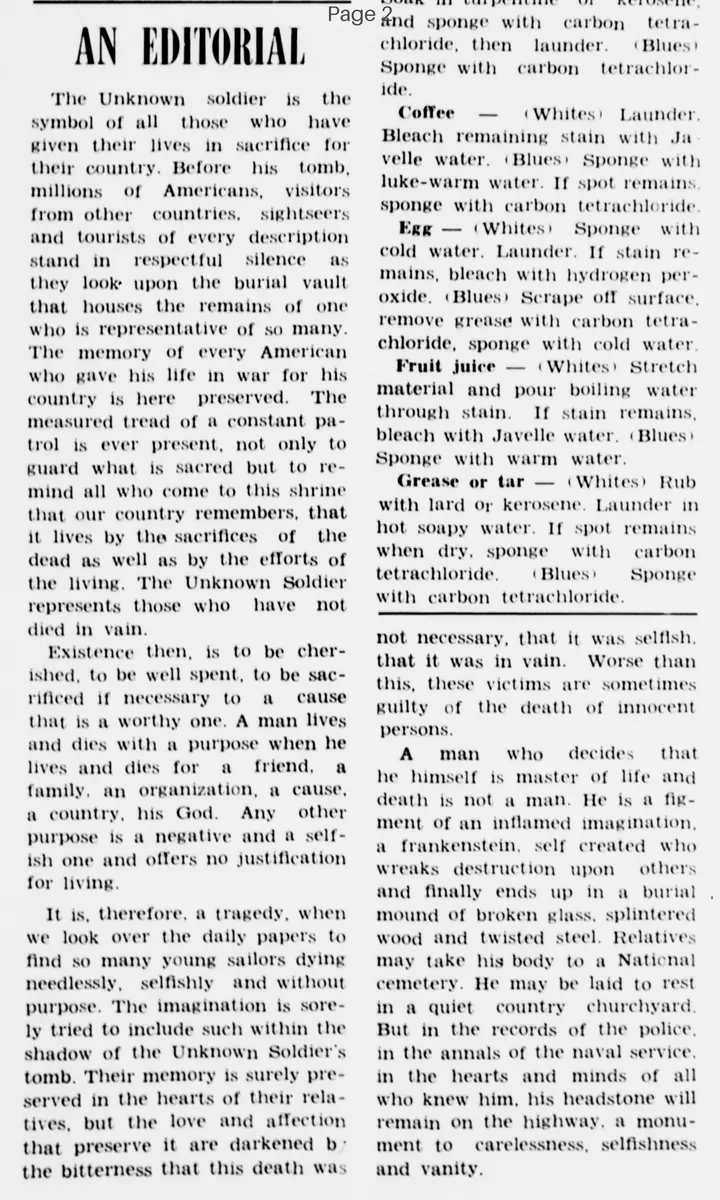
AN EDITORIAL
The Unknown Soldier is the symbol of all those who have given their lives in sacrifice for their country. Before his tomb, millions of Americans, visitors from other countries, sightseers and tourists of every description stand in respectful silence as they look upon the burial vault that houses the remains of one who is representative of so many.
The memory of every American who gave his life in war for his country is here preserved. The measured tread of a constant patrol is ever present, not only to guard what is sacred but to remind all who come to this shrine that our country remembers, that it lives by the sacrifices of the dead as well as by the efforts of the living. The Unknown Soldier represents those who have not died in vain.
Existence then, is to be cherished, to be well spent, to be sacrificed if necessary to a cause that is a worthy one. A man lives and dies with a purpose when he lives and dies for a friend, a family, an organization, a cause, a country, his God. Any other purpose is a negative and a selfish one and offers no justification for living.
It is, therefore, a tragedy when we look over the daily papers to find so many young sailors dying needlessly, selfishly and without purpose. The imagination is sorely tried to include such within the shadow of the Unknown Soldier's tomb. Their memory is surely preserved in the hearts of their relatives, but the love and affection that preserve it are darkened by the bitterness that this death was not necessary, that it was selfish, that it was in vain. Worse than this, these victims are sometimes guilty of the death of innocent persons.
A man who decides that he himself is master of life and death is not a man. He is a figment of an inflamed imagination, a frankenstein, self created who wreaks destruction upon others and finally ends up in a burial mound of broken glass, splintered wood and twisted steel. Relatives may take his body to a National cemetery. He may be laid to rest in a quiet country churchyard.
But in the records of the police, in the annals of the naval service, in the hearts and minds of all who knew him, his headstone will remain on the highway, a monument to carelessness, selfishness and vanity.
The Unknown Soldier is the symbol of all those who have given their lives in sacrifice for their country. Before his tomb, millions of Americans, visitors from other countries, sightseers and tourists of every description stand in respectful silence as they look upon the burial vault that houses the remains of one who is representative of so many.
The memory of every American who gave his life in war for his country is here preserved. The measured tread of a constant patrol is ever present, not only to guard what is sacred but to remind all who come to this shrine that our country remembers, that it lives by the sacrifices of the dead as well as by the efforts of the living. The Unknown Soldier represents those who have not died in vain.
Existence then, is to be cherished, to be well spent, to be sacrificed if necessary to a cause that is a worthy one. A man lives and dies with a purpose when he lives and dies for a friend, a family, an organization, a cause, a country, his God. Any other purpose is a negative and a selfish one and offers no justification for living.
It is, therefore, a tragedy when we look over the daily papers to find so many young sailors dying needlessly, selfishly and without purpose. The imagination is sorely tried to include such within the shadow of the Unknown Soldier's tomb. Their memory is surely preserved in the hearts of their relatives, but the love and affection that preserve it are darkened by the bitterness that this death was not necessary, that it was selfish, that it was in vain. Worse than this, these victims are sometimes guilty of the death of innocent persons.
A man who decides that he himself is master of life and death is not a man. He is a figment of an inflamed imagination, a frankenstein, self created who wreaks destruction upon others and finally ends up in a burial mound of broken glass, splintered wood and twisted steel. Relatives may take his body to a National cemetery. He may be laid to rest in a quiet country churchyard.
But in the records of the police, in the annals of the naval service, in the hearts and minds of all who knew him, his headstone will remain on the highway, a monument to carelessness, selfishness and vanity.
What sub-type of article is it?
Moral Or Religious
Military Affairs
Social Reform
What keywords are associated?
Unknown Soldier
Wartime Sacrifice
Needless Deaths
Young Sailors
Purposeful Living
Selfishness
Naval Service
What entities or persons were involved?
Unknown Soldier
Young Sailors
Americans
Naval Service
Editorial Details
Primary Topic
Honoring Noble Sacrifice Versus Condemning Needless Deaths
Stance / Tone
Reverent And Condemnatory
Key Figures
Unknown Soldier
Young Sailors
Americans
Naval Service
Key Arguments
The Unknown Soldier Symbolizes Noble Wartime Sacrifices.
The Nation Remembers And Honors Those Who Died For Their Country.
Life Should Be Lived And Sacrificed For Worthy Purposes Like Family, Country, Or God.
Needless Deaths Of Young Sailors Are Tragic And Selfish, Unlike True Sacrifices.
Such Reckless Individuals Cause Harm To Others And Die Without Purpose.
Their Legacy Is One Of Carelessness, Not Honor.