Thank you for visiting SNEWPapers!
Sign up free
Vermont Watchman And State Journal
Montpelier, Washington County, Vermont
What is this article about?
A private letter from General Zachary Taylor, dated November 9, 1846, from Monterey, Mexico, published in a US newspaper, recounts the US Army's advance and capture of Monterey in September 1846, defends the capitulation terms to avoid casualties, highlights supply shortages, and advises against further advances without massive reinforcements, favoring occupation and blockade strategy.
Clipping
OCR Quality
Full Text
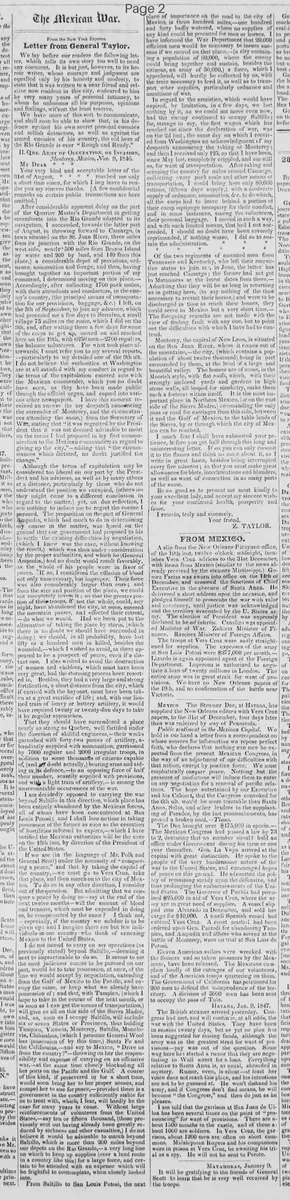
We lay before our readers the following letter, which tells its own story too well to need any comment. It is but just, however, to its heroic writer, whose courage and judgment are equalled only by his honesty and modesty, to state that it was written to a near friend and relative now resident in this city, endeared to him by very many years of personal intimacy, to whom he unbosoms all his purposes, opinions and feelings, without the least reserve.
We have more of this sort to communicate, and shall soon be able to show that, in his defence against his own secret personal enemies and selfish detractors, as well as against the armed enemies of his country, the old hero of the Rio Grande is ever "Rough and Ready."
H. Qrs. Army Of Occupation, or Invasion,
Monterey, Mexico, Nov. 9, 1846.
My Dear
Your very kind and acceptable letter of the 31st of August, reached me only a short time since, for which I beg leave to render you my sincere thanks. [A few confidential remarks on certain public transactions are here omitted.]
After considerable apparent delay on the part of the Quarter Master's Department in getting steamboats into the Rio Grande adapted to its navigation, I succeeded, towards the latter part of August, in throwing forward to Camargo, (a town situated on the St. Juan River, three miles from its junction with the Rio Grande, on the west side, nearly 500 miles from Brazos Island by water and 200 by land, and 140 from this place,) a considerable depot of provisions, ordnance, ammunition and forage, and then, having brought together an important portion of my command, I determined moving on this place.—Accordingly, after collecting 1700 pack mules, with their attendants and conductors, in the enemy's country, (the principal means of transportation for our provisions, baggage, &c.) I left, on the 5th of September, to join my advance, which had preceded me a few days to Serralvo, a small village 75 miles on the route, which I did on the 9th, and, after waiting there a few days for some of the corps to get up, moved on and reached here on the 19th, with 6250 men—2700 regulars, the balance volunteers. For what took place afterwards, I must refer you to my several reports,—particularly to my detailed one of the 9th ult.
I do not believe the authorities at Washington are at all satisfied with my conduct in regard to the terms of the capitulation entered into with the Mexican commander, which you no doubt have seen, as they have been made public through the official organ, and copied into various other newspapers. I have this moment received an answer (to my despatch announcing the surrender of Monterey, and the circumstances attending the same.) from the Secretary of War, stating that "it was regretted by the President that it was not deemed advisable to insist on the terms I had proposed in my first communication to the Mexican commander; in regard to giving up the city,"—adding that "the circumstances which dictated, no doubt justified the change."
Although the terms of capitulation may be considered too liberal on our part by the President and his advisers, as well as by many others at a distance, particularly by those who do not understand the position we occupied, (otherwise they might come to a different conclusion in regard to the matter.) yet, on due reflection, I see nothing to induce me to regret the course I pursued. The proposition on the part of General Ampudia, which had much to do in determining my course in the matter, was based on the ground that our government had proposed to his to settle the existing difficulties by negotiation, (which I knew was the case, without knowing the result,) which was then under consideration by the proper authorities, and which he (General Ampudia,) had no doubt would result favorably, as the whole of his people were in favor of peace. If so, I considered the effusion of blood not only unnecessary, but improper. Their force was also considerably larger than ours; and from the size and position of the place, we could not completely invest it; so that the greater portion of their troops, if not the whole, could, any night, have abandoned the city, at once, entered the mountain passes, and effected their retreat,—do what we would. Had we been put to the alternative of taking the place by storm, (which there is no doubt we should have succeeded in doing.) we should, in all probability, have lost fifty or a hundred men in killed, besides the wounded,—which I wished to avoid, as there appeared to be a prospect of peace, even if a distant one. I also wished to avoid the destruction of women and children, which must have been very great, had the storming process been resorted to. Besides, they had a very large and strong fortification, a short distance from the city, which if carried with the bayonet, must have been taken at a great sacrifice of life; and, with our limited train of heavy or battery artillery, it would have required twenty or twenty-five days to take it by regular approaches.
That they should have surrendered a place nearly as strong as Quebec, well fortified under the direction of skillful engineers,—their works garnished with forty-two pieces of artillery, abundantly supplied with ammunition, garrisoned by 7000 regular and 2000 irregular troops, in addition to some thousands of citizens capable of, (and no doubt actually,) bearing arms and aiding in its defence,—to an opposing force of half their number, scantily supplied with provisions, and with a light train of artillery,—is among the unaccountable occurrences of the war.
I am decidedly opposed to carrying the war beyond Saltillo in this direction, which place has been entirely abandoned by the Mexican forces, all of whom have been concentrated at San Louis Potosi; and I shall lose no time in taking possession of the former as soon as the cessation of hostilities referred to expires,—which I have notified the Mexican authorities will be the case on the 13th inst. by direction of the President of the United States.
If we are (in the language of Mr. Polk and General Scott) under the necessity of "conquering a peace," and that by taking the capital of the country,—we must go to Vera Cruz, take that place, and then march on to the city of Mexico. "To do so in any other direction, I consider out of the question. But admitting that we conquer a peace by doing so—say at the end of the next twelve months—will the amount of blood and treasure, which must be expended in doing so, be compensated by the same? I think not,—especially, if the country we subdue is to be given up: and I imagine there are but few individuals in our country who think of annexing Mexico to the United States.
I do not intend to carry on my operations (as previously stated) beyond Saltillo,—deeming it next to impracticable to do so. It seems to me the most judicious course to be pursued on our part, would be to take possession, at once, of the line we would accept by negotiation, extending from the Gulf of Mexico to the Pacific, and occupy the same, or keep what we already have possession of; and that, with Tampico, (which I hope to take in the course of the next month, or as soon as I can get the means of transportation,) will give us all on this side of the Sierra Madre, and, as soon as I occupy Saltillo, will include six or seven States or Provinces, thus holding Tampico, Victoria, Monterey, Saltillo, Monclova, Chihuahua, (which I presume General Wool has possession of by this time,) Santa Fe and the Californias,—and say to Mexico, "Drive us from the country!"—throwing on her the responsibility and expense of carrying on an offensive war,—at the same time closely blockading all her ports on the Pacific and the Gulf. A course of this kind, if persevered in for a short time, would soon bring her to her proper senses, and compel her to sue for peace,—provided there is a government in the country sufficiently stable for us to treat with, which, I fear, will hardly be the case for many years to come. Without large reinforcements of volunteers from the United States,—Say ten or fifteen thousand, (those previously sent out having already been greatly reduced by sickness and other casualties,) I do not believe it would be advisable to march beyond Saltillo, which is more than 200 miles beyond our depots on the Rio Grande,—a very long line on which to keep up supplies (over a land route in a country like this) for a large force, and certain to be attended with an expense which will be frightful to contemplate, when closely looked into.
From Saltillo to San Louis Potosi, the next place of importance on the road to the city of Mexico, is three hundred miles,—one hundred and forty badly watered, where no supplies of any kind could be procured for men or horses. I have informed the War Department that 20,000 efficient men would be necessary to insure success if we moved on that place,—(a city containing a population of 60,000, where the enemy could bring together and sustain, besides the citizens, an army of 50,000,) a force, which I apprehend, will hardly be collected by us, with the train necessary to feed it, as well as to transport other supplies, particularly ordnance and munitions of war.
In regard to the armistice, which would have expired, by limitation, in a few days, we lost nothing by it, as we could not move even now, had the enemy continued to occupy Saltillo: for, strange to say, the first wagon which has reached me since the declaration of war, was on the 2d inst. the same day on which I received from Washington an acknowledgment of my despatch announcing the taking of Monterey and then I received only 125, so that I have been, since May last, completely crippled, and am still so, for want of transportation. 'After raking and scraping the country for miles around Camargo, collecting every pack mule and other means of transportation, I could bring here only 30,000 rations, (fifteen days supply,) with a moderate supply of ordnance, ammunition, &c. to do which, all the corps had to leave behind a portion of their camp equipage necessary for their comfort, and in some instances, among the volunteers, their personal baggage. 'I moved in such a way, and with such limited means, that had I not succeeded, I should no doubt have been severely reprimanded, if nothing worse. I did so to sustain the administration.
Of the two regiments of mounted men from Tennessee and Kentucky, who left their respective states to join me, in June, the latter has just reached Camargo; the former had not got to Matamoras at the latest dates from there.—Admitting that they will be as long in returning as in getting here, (to say nothing of the time necessary to recruit their horses,) and were to be discharged in time to reach their homes, they could serve in Mexico but a very short time.—The foregoing remarks are not made with the view of finding fault with any one, but to point out the difficulties with which I have had to contend.
Monterey, the capital of New Leon, is situated on the San Juan River, where it comes out of the mountains,—the city, (which contains a population of about twelve thousand) being in part surrounded by them, at the head of a large and beautiful valley. The houses are of stone, in the Moorish style, with flat roofs, which, with their strongly inclosed yards and gardens in high stone walls, all looped for musketry, make them each a fortress within itself. It is the most important place in Northern Mexico, (or on the east side of the Sierra Madre.) commanding the only pass or road for carriages from this side, between it and the Gulf of Mexico, to the table lands of the Sierra, by or through which the city of Mexico can be reached.
I much fear I shall have exhausted your patience, before you get half through this long and uninteresting letter. If so, you can only commit it to the flames and think no more about it, as I write in great haste, besides being interrupted every five minutes; so that you must make great allowances for blots, interlineations and blunders, as well as want of connection in so many parts of the same.
Be so good as to present me most kindly to your excellent lady, and accept my sincere wishes for your continued health, prosperity and fame.
I remain, truly and sincerely,
Your friend,
Z. TAYLOR.
What sub-type of article is it?
What keywords are associated?
What entities or persons were involved?
Where did it happen?
Domestic News Details
Primary Location
Monterey, Mexico
Event Date
Nov. 9, 1846
Key Persons
Outcome
surrender of monterey without storming, avoiding estimated 50-100 killed and wounded; potential great destruction of women and children averted; mexican forces abandoned saltillo, concentrated at san louis potosi.
Event Details
General Taylor's letter details logistical preparations and advance from Camargo starting September 5, 1846, reaching Monterey on September 19 with 6250 men; rationale for accepting capitulation terms from General Ampudia to avoid unnecessary bloodshed given Mexican numerical superiority, incomplete investment, and prospect of peace negotiations; opposition to advancing beyond Saltillo without 10-15 thousand reinforcements due to supply line difficulties over 200+ miles; recommendation to occupy line from Gulf to Pacific, blockade ports, and force Mexico to offensive; description of Monterey's strategic importance and fortifications.