Thank you for visiting SNEWPapers!
Sign up free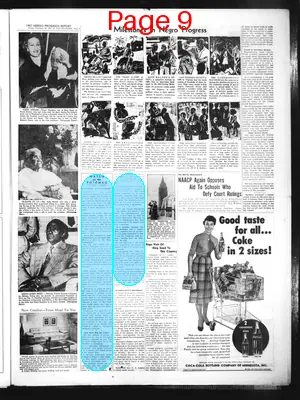
Editorial
February 22, 1957
St. Paul Recorder
Saint Paul, Ramsey County, Minnesota
What is this article about?
Analysis of potential passage of mild civil rights bill in 1957 Congress, crediting Sen. Johnson's early scheduling to aid Knowland and avoid obstruction label; details Eisenhower's program and Eastland's tactics.
Clipping
OCR Quality
98%
Excellent
Full Text
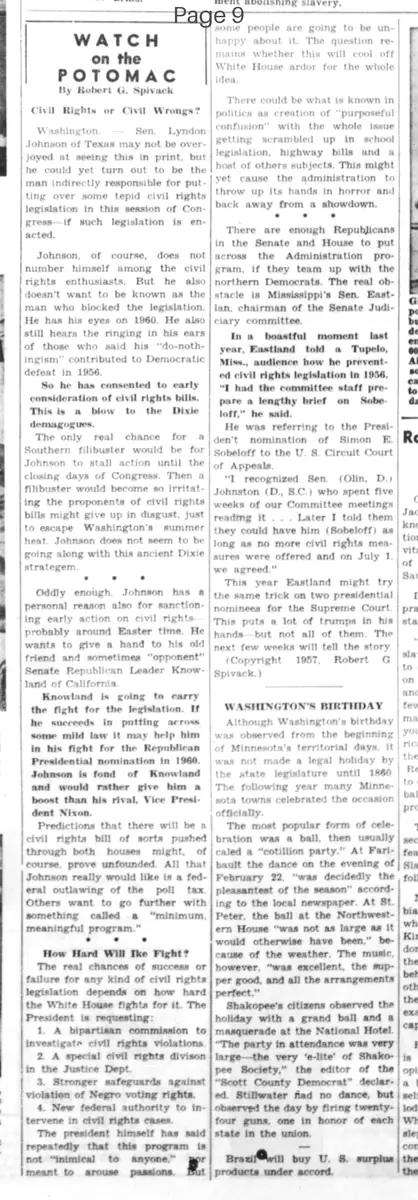
WATCH on the POTOMAC
By Robert G. Spivack
Civil Rights or Civil Wrongs?
Washington Sen. Lyndon Johnson of Texas may not be overjoyed at seeing this in print, but he could yet turn out to be the man indirectly responsible for putting over some tepid civil rights legislation in this session of Congress if such legislation is enacted.
Johnson, of course, does not number himself among the civil rights enthusiasts. But he also doesn't want to be known as the man who blocked the legislation. He has his eyes on 1960. He also still hears the ringing in his ears of those who said his "do-nothingism" contributed to Democratic defeat in 1956.
So he has consented to early consideration of civil rights bills. This is a blow to the Dixie demagogues.
The only real chance for a Southern filibuster would be for Johnson to stall action until the closing days of Congress. Then a filibuster would become so irritating the proponents of civil rights bills might give up in disgust, just to escape Washington's summer heat. Johnson does not seem to be going along with this ancient Dixie stratagem.
Oddly enough Johnson has a personal reason also for sanctioning early action on civil rights probably around Easter time. He wants to give a hand to his old friend and sometimes "opponent" Senate Republican Leader Knowland of California.
Knowland is going to carry the fight for the legislation. If he succeeds in putting across some mild law it may help him in his fight for the Republican Presidential nomination in 1960.
Johnson is fond of Knowland and would rather give him a boost than his rival, Vice President Nixon.
Predictions that there will be a civil rights bill of sorts pushed through both houses might, of course, prove unfounded. All that Johnson really would like is a federal outlawing of the poll tax.
Others want to go further with something called a "minimum meaningful program."
How Hard Will Ike Fight?
The real chances of success or failure for any kind of civil rights legislation depends on how hard the White House fights for it. The President is requesting:
1. A bipartisan commission to investigate civil rights violations
2. A special civil rights division in the Justice Dept.
3. Stronger safeguards against violation of Negro voting rights.
4. New federal authority to intervene in civil rights cases.
The President himself has said repeatedly that this program is not "inimical to anyone." nor meant to arouse passions.
But some people are going to be unhappy about it. The question remains whether this will cool off White House ardor for the whole idea.
There could be what is known in politics as creation of "purposeful confusion" with the whole issue getting scrambled up in school legislation, highway bills and a host of other subjects. This might yet cause the administration to throw up its hands in horror and back away from a showdown.
There are enough Republicans in the Senate and House to put across the Administration program, if they team up with the northern Democrats. The real obstacle is Mississippi's Sen. Eastland, chairman of the Senate Judiciary committee.
In a boastful moment last year, Eastland told a Tupelo, Miss., audience how he prevented civil rights legislation in 1956.
"I had the committee staff prepare a lengthy brief on Sobeloff," he said.
He was referring to the President's nomination of Simon E. Sobeloff to the U. S. Circuit Court of Appeals.
"I recognized Sen. (Olin D.) Johnston (D., S.C.) who spent five weeks of our Committee meetings reading it . . . Later I told them they could have him (Sobeloff) as long as no more civil rights measures were offered and on July 1 we agreed."
This year Eastland might try the same trick on two presidential nominees for the Supreme Court. This puts a lot of trumps in his hands but not all of them. The next few weeks will tell the story.
(Copyright 1957, Robert G. Spivack.)
By Robert G. Spivack
Civil Rights or Civil Wrongs?
Washington Sen. Lyndon Johnson of Texas may not be overjoyed at seeing this in print, but he could yet turn out to be the man indirectly responsible for putting over some tepid civil rights legislation in this session of Congress if such legislation is enacted.
Johnson, of course, does not number himself among the civil rights enthusiasts. But he also doesn't want to be known as the man who blocked the legislation. He has his eyes on 1960. He also still hears the ringing in his ears of those who said his "do-nothingism" contributed to Democratic defeat in 1956.
So he has consented to early consideration of civil rights bills. This is a blow to the Dixie demagogues.
The only real chance for a Southern filibuster would be for Johnson to stall action until the closing days of Congress. Then a filibuster would become so irritating the proponents of civil rights bills might give up in disgust, just to escape Washington's summer heat. Johnson does not seem to be going along with this ancient Dixie stratagem.
Oddly enough Johnson has a personal reason also for sanctioning early action on civil rights probably around Easter time. He wants to give a hand to his old friend and sometimes "opponent" Senate Republican Leader Knowland of California.
Knowland is going to carry the fight for the legislation. If he succeeds in putting across some mild law it may help him in his fight for the Republican Presidential nomination in 1960.
Johnson is fond of Knowland and would rather give him a boost than his rival, Vice President Nixon.
Predictions that there will be a civil rights bill of sorts pushed through both houses might, of course, prove unfounded. All that Johnson really would like is a federal outlawing of the poll tax.
Others want to go further with something called a "minimum meaningful program."
How Hard Will Ike Fight?
The real chances of success or failure for any kind of civil rights legislation depends on how hard the White House fights for it. The President is requesting:
1. A bipartisan commission to investigate civil rights violations
2. A special civil rights division in the Justice Dept.
3. Stronger safeguards against violation of Negro voting rights.
4. New federal authority to intervene in civil rights cases.
The President himself has said repeatedly that this program is not "inimical to anyone." nor meant to arouse passions.
But some people are going to be unhappy about it. The question remains whether this will cool off White House ardor for the whole idea.
There could be what is known in politics as creation of "purposeful confusion" with the whole issue getting scrambled up in school legislation, highway bills and a host of other subjects. This might yet cause the administration to throw up its hands in horror and back away from a showdown.
There are enough Republicans in the Senate and House to put across the Administration program, if they team up with the northern Democrats. The real obstacle is Mississippi's Sen. Eastland, chairman of the Senate Judiciary committee.
In a boastful moment last year, Eastland told a Tupelo, Miss., audience how he prevented civil rights legislation in 1956.
"I had the committee staff prepare a lengthy brief on Sobeloff," he said.
He was referring to the President's nomination of Simon E. Sobeloff to the U. S. Circuit Court of Appeals.
"I recognized Sen. (Olin D.) Johnston (D., S.C.) who spent five weeks of our Committee meetings reading it . . . Later I told them they could have him (Sobeloff) as long as no more civil rights measures were offered and on July 1 we agreed."
This year Eastland might try the same trick on two presidential nominees for the Supreme Court. This puts a lot of trumps in his hands but not all of them. The next few weeks will tell the story.
(Copyright 1957, Robert G. Spivack.)
What sub-type of article is it?
Constitutional
Partisan Politics
Social Reform
What keywords are associated?
Civil Rights Legislation
Congressional Filibuster
Southern Democrats
Presidential Nominations
Voting Rights
Judiciary Committee
What entities or persons were involved?
Lyndon Johnson
William Knowland
Dwight Eisenhower
James Eastland
Richard Nixon
Simon E. Sobeloff
Olin D. Johnston
Editorial Details
Primary Topic
Prospects For Civil Rights Legislation In 1957 Congress
Stance / Tone
Analytical Support For Mild Civil Rights Measures
Key Figures
Lyndon Johnson
William Knowland
Dwight Eisenhower
James Eastland
Richard Nixon
Simon E. Sobeloff
Olin D. Johnston
Key Arguments
Johnson Consents To Early Consideration Of Civil Rights Bills To Avoid Blocking Image Ahead Of 1960
Early Action Thwarts Southern Filibuster Strategy
Johnson Aids Knowland's Presidential Bid By Allowing Civil Rights Success
President Requests Bipartisan Commission, Justice Dept. Division, Voting Rights Safeguards, Federal Intervention Authority
Eastland May Obstruct Via Judicial Nominations As In 1956
Northern Democrats And Republicans Could Pass Administration Program