Thank you for visiting SNEWPapers!
Sign up free
Norfolk Gazette And Publick Ledger
Norfolk, Virginia
What is this article about?
Duke of Wellington's dispatch from Waterloo reports the Allied victory over Napoleon's forces on June 18, 1815, after engagements from June 15. Details battles at Quatre Bras and Waterloo, Prussian support, enemy rout with 150 cannons captured, and heavy British losses including key officers.
Merged-components note: Continuation of Lord Wellington's dispatch from the London Gazette, split across pages/columns.
Clippings
1 of 2
OCR Quality
Full Text
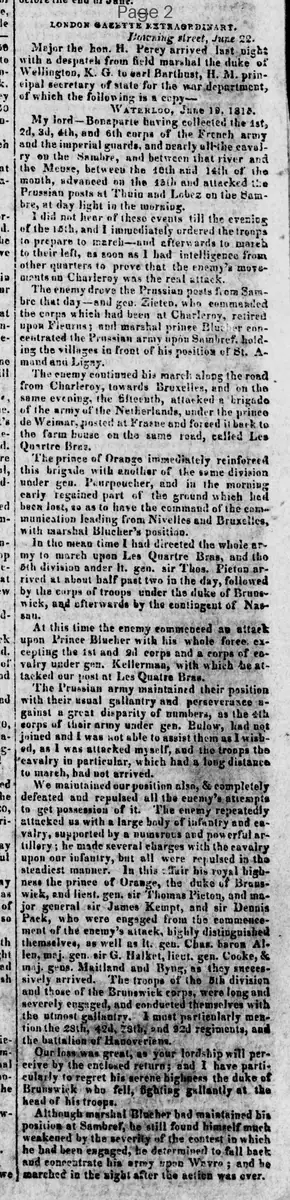
Downing street, June 22.
Major the hon. H. Percy arrived last night with a despatch from field marshal the duke of Wellington, K. G. to earl Bathurst, H. M. principal secretary of state for the war department, of which the following is a copy—
WATERLOO, June 19, 1815.
My lord— Bonaparte having collected the 1st, 2d, 3d, 4th, and 6th corps of the French army and the imperial guards, and nearly all the cavalry on the Sambre, and between that river and the Meuse, between the 10th and 15th of the month, advanced on the 15th and attacked the Prussian posts at Thuin and Lobes on the Sambre, at day light in the morning.
I did not hear of these events till the evening of the 15th, and I immediately ordered the troops to prepare to march—and afterwards to march to their left, as soon as I had intelligence from other quarters to prove that the enemy's movement on Charleroi was the real attack.
The enemy drove the Prussian posts from Sambre that day—and gen. Zieten, who commanded the corps which had been at Charleroi, retired upon Fleurus; and marshal prince Blucher concentrated the Prussian army upon Sambres, holding the villages in front of his position of St. Amand and Ligny.
The enemy continued his march along the road from Charleroi, towards Bruxelles, and on the same evening, the 16th, attacked a brigade of the army of the Netherlands, under the prince de Weimar, posted at Frasne and forced it back to the farm house on the same road, called Les Quatre Bras.
The prince of Orange immediately reinforced this brigade with another of the same division under gen. Perponcher, and in the morning early regained part of the ground which had been lost, to as to have the command of the communication leading from Nivelles and Bruxelles, with marshal Blucher's position.
—In the mean time I had directed the whole army to march upon Les Quatre Bras, and the 5th division under Lt. gen. sir Thos. Picton arrived at about half past two in the day. followed by the corps of troops under the duke of Brunswick, and afterwards by the contingent of Nassau.
At this time the enemy commenced an attack upon Prince Blucher with his whole force. excepting the 1st and 2d corps and a corps of cavalry under gen. Kellerman, with which he attacked our post at Les Quatre Bras.
The Prussian army maintained their position with their usual gallantry and perseverance against a great disparity of numbers, as the 4th corps of their army under gen. Bulow, had not joined and I was not able to assist them as I wished, as I was attacked myself, and the troops the cavalry in particular, which had a long distance to march, had not arrived.
We maintained our position also. & completely defeated and repulsed all the enemy's attempts to get possession of it. The enemy repeatedly attacked us with a large body of infantry and cavalry, supported by a numerous and powerful artillery; he made several charges with the cavalry upon our infantry, but all were repulsed in the steadiest manner. In this affair his royal highness the prince of Orange, the duke of Brunswick, and lieut. gen, sir Thomas Picton, and major general sir James Kempt, and sir Dennis Pack, who were engaged from the commencement of the enemy's attack, highly distinguished themselves, as well as lt. gen. Chas. baron Alten, maj. gen. sir G. Halket, lieut. gen. Cooke, & maj. Gens. Maitland and Byng, as they successively arrived. The troops of the 5th division and those of the Brunswick corps, were long and severely engaged, and conducted themselves with the utmost gallantry. I must particularly mention the 28th, 42d, 33d, and 92d regiments, and the battalion of Hanoverians.
Our loss was great, as your lordship will perceive by the enclosed return; and I have particularly to regret his serene highness the duke of Brunswick who fell, fighting gallantly at the head of his troops.
Although marshal Blucher had maintained his position at Sambres, he still found himself much weakened by the severity of the contest in which he had been engaged, he determined to fall back and concentrate his army upon Wavre ; and he marched in the night after the action was over.
This movement of the marshal's rendered necessary a corresponding one on my part; and I retired from the farm of Quatre Bras upon Genappe and thence upon Waterloo the next morning the 17th at 10 o'clock.
The enemy made no effort to pursue marshal Blucher. On the contrary, a patrol which I sent to Sambre in the morning found all quiet, and the enemy's videttes fell back as the patrol advanced. Neither did he attempt to molest our march to the rear, although made in the middle of the day, except by following with a large body of cavalry, brought from his right, the cavalry under the earl of Uxbridge.
This gave lord Uxbridge an opportunity of charging them with the 1st life guards, upon their debouches from the village of Genappe, upon which occasion his lordship has declared himself to be well satisfied with that regiment.
The position which I took up in front of Waterloo, crossed the high road from Charleroi and Nivelle, and had its right thrown back to a ravine near Merke Braine, which was occupied, and its left extended to a height above the hamlet La Haye Sainte, which was likewise occupied. In front of the right centre and near the Nivelle road, we occupied the house and garden of Hougoumont, which covered the return of that flank; and in front of the left centre, we occupied the farm of La Haye Sainte. By our left we communicated with marshal prince Blucher, at Wavre, through Ohain; and the marshal had promised me, that in case we should be attacked, he would support me with one or more corps, as might be necessary.
The enemy collected his army with the exception of the third corps, which had been sent to observe marshal Blucher, on a range of heights within our front, in the course of the 17th and yesterday morning; and at about ten o'clock he commenced a furious attack upon our post at Hougoumont—I had occupied that post with a detachment of gen. Byng's brigade of guards which was in a position in its rear; and it was for some time under the command of Lt. col. Macdonell, and afterwards col. Home, and I am happy to add it was maintained through the day with the utmost gallantry by these brave troops notwithstanding the repeated efforts of large bodies of the enemy to obtain possession of it.
This attack upon the right of our centre was accompanied by a very heavy cannonade upon our whole line, which was destined to support the repeated attacks of cavalry and infantry occasionally mixed, but sometimes separate, which were made upon it. In one of these the enemy carried the farm house of La Haye Sainte, as the detachment of light battalion of the legion which occupied it had expended all its ammunition, and the enemy occupied the only communication there was with them.
The enemy repeatedly charged our infantry with his cavalry, but these attacks were uniformly unsuccessful, and they afforded opportunities to our cavalry to charge, in one of which Lord D. Somerset's brigade, consisting of the life guards, royal horse guards, and 1st dragoon guards, highly distinguished themselves, as did that of maj. gen. sir W. Ponsonby, having taken many prisoners and an eagle.
These attacks were repeated till about 7 in the evening when the enemy made a desperate effort with the cavalry and infantry, supported by the fire of artillery, to force our left centre near the farm of La Haye Sainte, which, after a severe contest was defeated, and having observed that the troops retired from this attack in great confusion, and that the march of general Bulow's corps by Frischemont upon Planchenoit and La Belle Alliance, had begun to take effect, and as I could perceive the fire of his cannon, and as marshal prince Blucher had joined in person with a corps of our army to the left of our line by Ohain, I determined to attack the enemy, and immediately advanced the whole line of infantry, supported by the cavalry and artillery.
The attack succeeded in every point—the enemy was forced from his positions on the heights and fled in the utmost confusion, leaving behind him, as far as I could judge, 150 pieces of cannon, with their ammunition, which fell into our hands. I continued the pursuit till long after dark, and then discontinued it only on account of the fatigue of our troops, who had been engaged during 10 hours, and because I found myself on the same road with marshal Blucher, who assured me of his intention to follow the enemy throughout the night: he has sent me word this morning that he had taken 60 pieces of cannon belonging to the imperial guard, and several carriages, baggage, &c. belonging to Bonaparte, in Genappe.
I propose to move this morning upon Nivelles, and not to discontinue my operations.
Your lordship will observe, that such a desperate action could not be fought, and such advantages could not be gained without great loss, and I am sorry to add that ours has been immense.
In Lt. gen. sir Thos. Picton, his majesty has sustained the loss of an officer who has frequently distinguished himself in his service, and he fell gloriously leading his division to a charge with bayonets, by which one of the most serious attacks made by the enemy on our position was defeated. The earl of Uxbridge, after having successfully got through this arduous day, received a wound by almost the last shot fired, which will, I am afraid, deprive his majesty for some time of his services.
His royal highness the prince of Orange, distinguished himself by his gallantry and conduct, till he received a wound from a musket ball through the shoulder, which obliged him to quit the field.
It gives me the greatest satisfaction to assure your lordship that the army, never, upon any occasion, conducted itself better. The division of guards under lieut. gen. Cooke, who is severely wounded, maj. gen. Maitland and maj. gen. Byng, set an example which was followed by all; and there is no officer, or description of troops, that did not behave well.
I must however particularly mention for his royal highness's approbation, Lt. gen. sir H. Clinton, maj. gen. Adam, Lt. gen. sir Charles Colville (severely wounded), maj. gen. sir Colin Halket (severely wounded), col. Ompteda, col. Mitchell, commanding a brigade of the 4th division; maj. gen. Kempt, sir James Kempt and sir Denis Pack, maj. gen. Lambert, maj. gen. lord H. Somerset, maj. gen. sir W. Ponsonby, maj. gen. sir C. Grant, and maj. gen. sir H. Vivian; maj. gen. sir O. Vandeleur; maj. gen. count Dornberg. I am also particularly indebted to gen. lord Hill, for his assistance upon this as upon all former occasions.
The artillery and engineer departments were conducted much to my satisfaction by col. sir G. Wood and col. Smith; and I had every reason to be satisfied with the conduct of the adjt. gen. major general Barnes, who was wounded, and of the quarter master gen. col. De Lancey, who was killed by a cannon shot in the middle of the action—this officer is a serious loss to his majesty's service, and to me at this moment.
I was likewise much indebted to the assistance of lieut. col. lord Fitzroy Somerset, who was severely wounded, and of the officers composing my personal staff, who have suffered severely in the action. Lt. col. the hon. sir Alex. Gordon, who has died of his wounds, was a most promising officer, and is a serious loss to his majesty's service.
Gen. Kraseur, of the Nassau service, likewise conducted himself much to my satisfaction, as did gen. Trip, commanding the heavy brigade of cavalry, and gen. Vanhope, commanding a brigade of infantry of the king of the Netherlands.
Gen. Pozzo di Borgo, gen. Baron Vincent, gen. Müffling and gen. Alava, were in the field during the action, and rendered me every assistance in their power. Baron Vincent is wounded, but I hope not severely, and gen. Pozzo di Borgo received a contusion.
I should not do justice to my feelings or to marshal Blucher and the Prussian army, if I did not attribute the successful result of this arduous day to the cordial and timely assistance I received from them.
The operation of gen. Bulow upon the enemy's flank, was a most decisive one—and even if I had not found myself in a situation to make an attack, which produced the final result, it would have forced the enemy to retire, if his attacks should have failed, and would have prevented him from taking advantage of them, if they should unfortunately have succeeded.
I send with this dispatch, two eagles, taken by the troops in this action, which maj. Percy will have the honor of laying at the feet of his royal highness.
I beg leave to recommend him to your lordship's protection. I have the honor, &c.
Signed WELLINGTON
P. S. Since writing the above, I have received a report, that maj. gen. sir Wm. Ponsonby is killed, and in announcing this intelligence to your lordship, I have to add the expression of my grief, for the fate of an officer who had already rendered very brilliant and important services, and was an ornament to his profession.
2d P. S. I have not yet got the returns of killed and wounded, but I enclose a list of officers killed and wounded in the 2 days, as far as the same can be made out without the returns, and I am very happy to add, that col. De Lancey is not dead, and that strong hopes of his recovery are entertained.
British Killed and Wounded.
KILLED.
Duke of Brunswick Oels
Lt Gen sir Thomas Picton
Lt Gen sir H. Ponsonby
Col du Plat, K G L
Col Ompteda, do
Col Morrice, 95th regt
Col sir W. Ellis, 23d
Lt col Macara, 42d
Lt col Cameron, 42d
Lt col sir Alex. Gordon, K C B A D C to the Duke of Wellington
Lt col Canning
Lt col Currie, Lord Hill's staff
Major the hon. Frederick Howard, 10th hussars.
Major George Cain, royal artillery
Major Norman Ramsay, ditto
Major Cairnes, ditto
Major Chambers, 50th regiment
Brigade major Crofton, 5th division
B. major Roswell, 2d light regiment
Capt Bolton, royal artillery
Capt Crawford, guards
Capt the hon. Curzon, A D C to his R H the Prince of Orange
Capt Chambers, A D C to lieut gen Picton
Capt Charles Ellis, 95th regiment
Capt Robertson, 92d regiment
Capt Kennedy, 73d regiment
Capt Shaunan, 2d light batt K G L
Capt Halgoonan, 1st ditto
Capt Henry Marshall, 1st ditto
Capt Groben, ditto
Capt Cumming, 10th hussars
Capt Grant, 1st guards
Lieut C. Manners, royal artillery
Lieut Lister, 95th regiment
Ensign lord Hay, A D C to gen Maitland
Ensign Brown, 1st guards.
WOUNDED.
Gen his royal highness the Prince of Orange, G C B severely
Lieut gen the Earl of Uxbridge, G C B right leg amputated
Lieut gen sir Charles Alten, K C B severely
Lieut gen Cooke, right arm amputated
Lt gen sir J. Barnes, K C B adj gen severely
Lt gen sir J. Kempt, K C B slightly
Lt gen sir Colin Halkett, K C B severely
Lt gen Adams, severely
Lt gen sir W. Dornberg, K C B severely
Col sir J. Elley, K C B slightly
Col Harris, 73d regiment
Col Du Cane, 20th hussars, slightly
Col the hon. Frederick Ponsonby, severely
Col sir W. De Lancey, severely
Lt col lord Fitzroy Somerset, right leg amp'd.
Lt col Hay, 10th light dragoons, severely
Lt col Vieleurcq, 30th
Lt col Abercrombie, A Q M G slightly
Lt col Hamilton 50th regiment
Lt col Norcott, 95th severely
Lt col Cameron, 95th severely
Lt col Wyndham, 1st foot guards, severely
Lt col Bowater, 3d foot guards, slightly
Lt col Mackdonell, coldstream, slightly
Lt col Dashwood, 2d guards, severely
Lt col sir B. Hill, royal horse guards, severely
Lt col Hill
Lt col Schroeder, 5th line battalion
Lt col Adam, 1st guards, severely
Lt col Miller, 1st Guards, do
Lt col sir George Henry Berkeley, A A G
Major Macjean, 92d
Maj Beckwith, 95th, severely
Maj Jessop, assistant quarter master gen
Maj Briche, 1st light batt K G L right arm amputated
Maj Parkinson, 73d severely
Maj Parker, R H artillery, leg amputated
Maj Robert Hall, royal artillery, severely
Maj Hamilton, aide-de-camp to gen sir E. Barnes
Maj Lindsay, 92d regiment, severely
Maj Watton, do do
B M Emen, dangerously
Lt Wilkins, 90th regiment, severely
Maj Miller, do do
Capt Smith, do do
Capt Tyler, aide de camp to sir T. Picton, do
Capt Dance, 2d light dragoons
Capt Johnson, 95th
Capt Cameron, do
Capts Darney, Napier, A McDonald, and Webber, royal artillery, severely
Capt Dumaresq aide de camp to gen sir J. Byng severely
Capt Whinyates, royal artillery
Capt Barnes, brigade major, royal artillery, severely
Capt the hon. --- Erskine, D A A G left arm amputated
Capt A Duigen, aide de camp to lieut gen Picton, severely
Lieuts Foster, Crome, Robe, Smith and Strangway, royal artillery, severely
Lieut Roney, royal artillery, arm amputated
Lieut Bloomfield do slightly
Lieut Bruton do severely
Lieut Forbes do do
Lieut D. Crawford do slightly
Lieut Havelock, aide de camp to gen sir C. Alten
Lieut Pringle, royal engineers, slightly
Lieut Hamilton, 92d regiment, slightly
Lieut Heise, 1st veteran battalion
Lieuts Gardiner, Johnson, Mottry, Simmons, J. Gardiner, Fitzmaurice, Shenley, Wright, 95th regiment, severely.
What sub-type of article is it?
What keywords are associated?
What entities or persons were involved?
Where did it happen?
Foreign News Details
Primary Location
Waterloo
Event Date
15th To 18th June 1815
Key Persons
Outcome
allied forces defeated and repulsed napoleon's army at quatre bras on june 16 and waterloo on june 18; enemy fled in confusion, leaving 150 pieces of cannon; prussians captured 60 more; immense british losses including duke of brunswick and sir thomas picton killed, earl of uxbridge and prince of orange wounded; detailed list of officers killed and wounded provided.
Event Details
Napoleon advanced from Sambre on June 15, attacking Prussian posts; Allies engaged at Quatre Bras on June 16, maintaining position despite heavy fighting; retired to Waterloo on June 17; on June 18, fierce battle at Waterloo with attacks on Hougoumont and La Haye Sainte; Prussian corps under Bulow flanked enemy; Wellington advanced, routing French forces after 10 hours of combat.