Thank you for visiting SNEWPapers!
Sign up free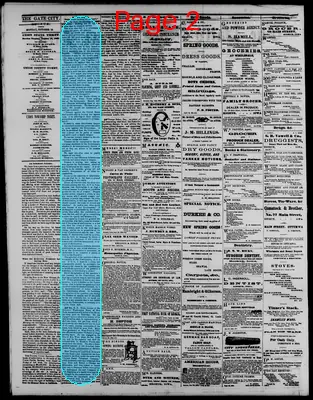
Editorial
October 12, 1863
The Daily Gate City
Keokuk, Lee County, Iowa
What is this article about?
An editorial argues that moral duties underpin political obligations, defines treason per the Constitution, condemns rebellion against the U.S. government, and defends abolitionist agitation of slavery as not criminal, upholding freedom of speech and press. Includes brief news on Maj. E. B. Hunt's death and a new telegraph line.
Clipping

OCR Quality
95%
Excellent
Full Text
Caesar's Breastplate.
I will lay down the following universal proposition: Nothing can be right in politics that is wrong in morals.
This is so clear that it is unnecessary to argue the point; all admit it. There are duties and obligations we owe to civil government, that we cannot throw off, but must meet them; and all true citizens will do so most cheerfully.
Nothing is more plain than the fact that all persons in any given civil compact or republic, are in duty bound to observe its laws, and obey its authority. This is especially true in the American Republic. "Submit yourselves to every ordinance of man for the Lord's sake." "Put them in mind to obey magistrates" "Honor the King" (the President.)
Treason.
It appears that the very foundation principles of our Government are to be tested in this terrible struggle. All true and loyal citizens should be fully prepared to meet the issue, whatever that may be. If it comes only in argumentative treason or rebellion, meet it with logical power; but if it comes in the shape of armed rebellion, meet it with armed authority, and never cease till rebellion has laid down its arms.
Either some persons are very ignorant of what treason is, as defined by the Constitution, or else woefully misrepresent it, or contemptuously disregard it.
Treason is of two kinds—direct or indirect. First, direct: Those making war on the Government. Second, indirect: Persons befriending those at war with the Government. The first are principals; the second are accessories, or particeps criminis.
"Treason against the United States shall consist only in levying war against them, or in adhering to their enemies, giving them aid and comfort."—[Constitution.]
It seems to some that treason cannot be committed unless that person has taken up arms against the Government. It will be perceived from the Constitution, that a person can be guilty of treason and never touch a deadly weapon.
No one can commit treason in the second sense unless war exists. Treason can be committed in the second sense anywhere in the Government, whether in an insurrectionary district or not, as they can adhere to its enemies anywhere.
No cause can ever exist to justify treason of any kind. There is a vast difference between true criticism and either abuse or treason.
Treason is levying war, taking up arms against the Government, whatever may be assigned as the reason. It is adhering to its enemies, giving aid and comfort, independent of all other circumstances.
No act in the execution or administration can ever be, in the least, a ground for adhering to the rebels Hence, all this hue and cry about abolitionists causing this war, is of no force.
Suppose that abolitionism is as high a crime as treason, it could be no justifiable ground for the act of treason. Because another person commits a crime, is that any reason why I should commit one? Because a person may commit the crime of abolitionism, is that any reason that I should commit the crime of treason and rebellion? At such a rate, what would ever become of any Government? If abolitionism is punishable by the Constitution, then inflict the punishment, enforce the law, and not go to committing another sin equally bad because of it.
Our argument is upon the ground that abolitionism is as bad a crime as treason; but if the crime of abolitionism is a less one, then the crime of treason, on its own account, must be the more aggravating; and so on, in proportion as the crime of abolitionism may be less. And finally, if abolitionism could be no crime, then we have no language by which to describe the blackness of the crime of treason and rebellion inaugurated on account of abolitionism.
But the Constitution nowhere describes abolitionism as any crime whatever; so far as the Constitution is concerned, an abolitionist is as innocent a person as lives in the Republic.
The agitation of the question of slavery is contrary to the Constitution, or it is not. If it is, it must be a crime, and consequently should be punished; but where is the clause in the Constitution, in which the agitation of the question is forbidden, or described as a crime?
But if the agitation of the question is not contrary to the Constitution, who then has a right to stop or interfere with it? If the agitation of that or any other question, is not forbidden in the Constitution, then to forbid the agitation of such questions must be unconstitutional, for it is unconstitutional to forbid whatever the Constitution allows. In forbidding the agitation of the question, you abridge the freedom of speech, and of the press, for we are evidently free to speak and write on any question that is not forbidden in the Constitution, or contrary to it.
—[Cin. Chris. Adv.
Maj. E. B. Hunt, brother of Ex-Governor Washington Hunt, of New York, was accidentally killed at the Brooklyn navy yard on Thursday. He was engaged upon a submarine battery of his own invention, and, in experimenting, a shell was burst, the gas from which so overpowered him that he fell into the hold of the vessel, causing concussion of the brain, from which he soon died. Major Hunt graduated at West Point in 1845, and afterwards became Professor of Engineering there. He was engaged on the forts at Key West when the war broke out, and by his sagacity and skill the valuable forts in Southern Florida were saved from the rebels. He was a distinguished member of the American Association for the Advancement of Science.
New Telegraph Line From Dubuque To The East.
An Association has been formed in the East, under the name of the United States Telegraph Company, which is already erecting a telegraph from New York and Boston to Chicago and Milwaukie, and they intend to extend their line to Dubuque before next spring. We understand the new Company will send dispatches at a much lower rate than is charged by the present lines. If it will only reduce the exorbitant rates which are extorted from the press, the new Company will confer blessings upon both publishers and people.
I will lay down the following universal proposition: Nothing can be right in politics that is wrong in morals.
This is so clear that it is unnecessary to argue the point; all admit it. There are duties and obligations we owe to civil government, that we cannot throw off, but must meet them; and all true citizens will do so most cheerfully.
Nothing is more plain than the fact that all persons in any given civil compact or republic, are in duty bound to observe its laws, and obey its authority. This is especially true in the American Republic. "Submit yourselves to every ordinance of man for the Lord's sake." "Put them in mind to obey magistrates" "Honor the King" (the President.)
Treason.
It appears that the very foundation principles of our Government are to be tested in this terrible struggle. All true and loyal citizens should be fully prepared to meet the issue, whatever that may be. If it comes only in argumentative treason or rebellion, meet it with logical power; but if it comes in the shape of armed rebellion, meet it with armed authority, and never cease till rebellion has laid down its arms.
Either some persons are very ignorant of what treason is, as defined by the Constitution, or else woefully misrepresent it, or contemptuously disregard it.
Treason is of two kinds—direct or indirect. First, direct: Those making war on the Government. Second, indirect: Persons befriending those at war with the Government. The first are principals; the second are accessories, or particeps criminis.
"Treason against the United States shall consist only in levying war against them, or in adhering to their enemies, giving them aid and comfort."—[Constitution.]
It seems to some that treason cannot be committed unless that person has taken up arms against the Government. It will be perceived from the Constitution, that a person can be guilty of treason and never touch a deadly weapon.
No one can commit treason in the second sense unless war exists. Treason can be committed in the second sense anywhere in the Government, whether in an insurrectionary district or not, as they can adhere to its enemies anywhere.
No cause can ever exist to justify treason of any kind. There is a vast difference between true criticism and either abuse or treason.
Treason is levying war, taking up arms against the Government, whatever may be assigned as the reason. It is adhering to its enemies, giving aid and comfort, independent of all other circumstances.
No act in the execution or administration can ever be, in the least, a ground for adhering to the rebels Hence, all this hue and cry about abolitionists causing this war, is of no force.
Suppose that abolitionism is as high a crime as treason, it could be no justifiable ground for the act of treason. Because another person commits a crime, is that any reason why I should commit one? Because a person may commit the crime of abolitionism, is that any reason that I should commit the crime of treason and rebellion? At such a rate, what would ever become of any Government? If abolitionism is punishable by the Constitution, then inflict the punishment, enforce the law, and not go to committing another sin equally bad because of it.
Our argument is upon the ground that abolitionism is as bad a crime as treason; but if the crime of abolitionism is a less one, then the crime of treason, on its own account, must be the more aggravating; and so on, in proportion as the crime of abolitionism may be less. And finally, if abolitionism could be no crime, then we have no language by which to describe the blackness of the crime of treason and rebellion inaugurated on account of abolitionism.
But the Constitution nowhere describes abolitionism as any crime whatever; so far as the Constitution is concerned, an abolitionist is as innocent a person as lives in the Republic.
The agitation of the question of slavery is contrary to the Constitution, or it is not. If it is, it must be a crime, and consequently should be punished; but where is the clause in the Constitution, in which the agitation of the question is forbidden, or described as a crime?
But if the agitation of the question is not contrary to the Constitution, who then has a right to stop or interfere with it? If the agitation of that or any other question, is not forbidden in the Constitution, then to forbid the agitation of such questions must be unconstitutional, for it is unconstitutional to forbid whatever the Constitution allows. In forbidding the agitation of the question, you abridge the freedom of speech, and of the press, for we are evidently free to speak and write on any question that is not forbidden in the Constitution, or contrary to it.
—[Cin. Chris. Adv.
Maj. E. B. Hunt, brother of Ex-Governor Washington Hunt, of New York, was accidentally killed at the Brooklyn navy yard on Thursday. He was engaged upon a submarine battery of his own invention, and, in experimenting, a shell was burst, the gas from which so overpowered him that he fell into the hold of the vessel, causing concussion of the brain, from which he soon died. Major Hunt graduated at West Point in 1845, and afterwards became Professor of Engineering there. He was engaged on the forts at Key West when the war broke out, and by his sagacity and skill the valuable forts in Southern Florida were saved from the rebels. He was a distinguished member of the American Association for the Advancement of Science.
New Telegraph Line From Dubuque To The East.
An Association has been formed in the East, under the name of the United States Telegraph Company, which is already erecting a telegraph from New York and Boston to Chicago and Milwaukie, and they intend to extend their line to Dubuque before next spring. We understand the new Company will send dispatches at a much lower rate than is charged by the present lines. If it will only reduce the exorbitant rates which are extorted from the press, the new Company will confer blessings upon both publishers and people.
What sub-type of article is it?
Constitutional
Slavery Abolition
Moral Or Religious
What keywords are associated?
Treason
Abolitionism
Constitution
Slavery Agitation
Freedom Of Speech
Loyalty
Rebellion
What entities or persons were involved?
Constitution
Abolitionists
Rebels
Editorial Details
Primary Topic
Treason Definition And Relation To Abolitionism
Stance / Tone
Strongly Pro Loyalty And Anti Treason, Defending Abolitionist Speech
Key Figures
Constitution
Abolitionists
Rebels
Key Arguments
Nothing Right In Politics Is Wrong In Morals.
Citizens Must Obey Government Laws.
Treason Is Levying War Or Aiding Enemies Per Constitution.
Abolitionism Is Not A Crime Under Constitution.
Agitation Of Slavery Question Does Not Justify Treason.
Forbidding Slavery Discussion Abridges Free Speech And Press.