Thank you for visiting SNEWPapers!
Sign up free
Springfield Weekly Republican
Springfield, Hampden County, Massachusetts
What is this article about?
1872 weekly news roundup: Progress in liberal Republican campaign against Grant amid corruption scandals; Greeley's acclaimed western speeches; Massachusetts political nominations; European updates; U.S. social issues, weather disasters, agricultural events, and religious news. (214 characters)
Clipping
OCR Quality
Full Text
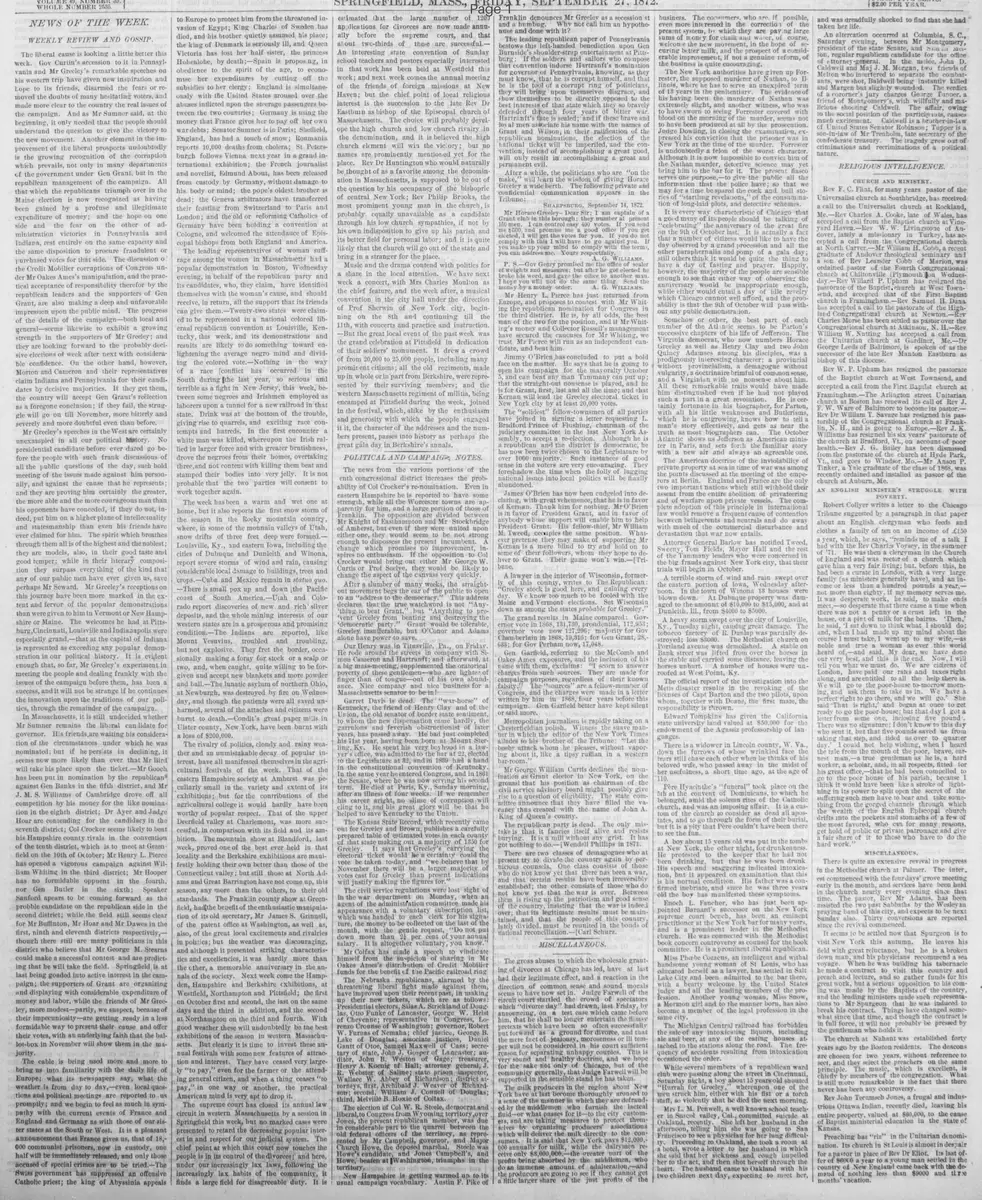
WEEKLY REVIEW AND GOSSIP.
The liberal cause is looking a little better this week. Gov. Curtin's accession to it in Pennsylvania and Mr. Greeley's remarkable speeches on his western trip have given new inspiration and hope to its friends, disarmed the fears or removed the doubts of many hesitating voters, and made more clear to the country the real issues of the campaign. And as Mr. Sumner said, at the beginning, it only needed that the people should understand the question to give the victory to the new movement. Another element in the improvement of the liberal prospects undoubtedly is the growing recognition of the corruption which prevails, not only in many departments of the government under Gen. Grant, but in the republican management of the campaign. All that which the republicans triumph over in the Maine election is now recognized as having been gained by a profuse and illegitimate expenditure of money; and the hope on one side and the fear on the other of administration victories in Pennsylvania and Indiana, rest entirely on the same capacity and the same disposition to procure fraudulent or purchased votes for that side. The discussion of the Credit Mobilier corruptions of Congress under Mr. Oakes Ames's manipulation, and the practical acceptance of responsibility therefor by the republican leaders and the supporters of Gen. Grant, are also making a deep and unfavorable impression upon the public mind. The progress of the details of the campaign—both local and general—seems likewise to exhibit a growing strength in the supporters of Mr. Greeley; and they are looking forward to the probably decisive elections of week after next with considerable confidence. On the other hand, however, Morton and Cameron and their representatives claim Indiana and Pennsylvania for their candidates by decisive majorities. If they get them, the country will accept Gen. Grant's reëlection as a foregone conclusion; if they fail, the struggle will go on till November, more bitterly and severely and more doubtful even than before.
Mr. Greeley's speeches in the West are certainly unexampled in all our political history. No presidential candidate before ever dared go before the people with such frank discussions of all the public questions of the day, such bold meeting of the issues made against him personally, and against the cause that he represents; and they are proving him certainly the greater, the more able and the more courageous man than his opponents have conceded, if they do not, indeed, put him on a higher plane of intellectuality and statesmanship than even his friends have ever claimed for him. The spirit which breathes through them all is of the highest and the noblest; they are models, also, in their good taste and good temper; while in their literary composition they surpass everything of the kind that any of our public men have ever given us, save perhaps Mr. Seward. Mr. Greeley's receptions on this journey have been more marked in the extent and fervor of the popular demonstrations than were given to him in Vermont or New Hampshire or Maine. The welcomes he had at Pittsburg, Cincinnati, Louisville and Indianapolis were especially grand,—that at the capital of Indiana is represented as exceeding any popular demonstration in our political history. It is evident enough that, so far, Mr. Greeley's experiment in meeting the people and dealing frankly with the issues of the campaign before them, has been a success, and it will not be strange if he continues the innovation upon the traditions of our politics, through the remainder of the campaign.
In Massachusetts, it is still undecided whether Mr. Sumner remains the liberal candidate for governor. His friends are waiting his consideration of the circumstances under which he was nominated; but if he persists in declining, it seems now more likely than ever that Mr. Bird will take his place upon the ticket.—Mr. Gooch has been put in nomination by the republicans against Gen. Banks in the fifth district, and Mr. J. M. S. Williams of Cambridge drove off all competition by his money for the like nomination in the eighth district; Dr. Ayer and Judge Hoar are contending for the candidacy in the seventh district; Col. Crocker seems likely to beat his Hampshire county rivals in the convention of the tenth district, which is to meet at Greenfield on the 10th of October; Mr. Henry L. Pierce has opened a vigorous campaign against William Whiting in the third district; Mr. Hooper has no formidable opponent in the fourth, nor Gen. Butler in the sixth; Speaker Sanford appears to be coming forward as the probable candidate on the republican side in the second district; while the field still seems clear for Mr. Buffinton, Mr. Hoar and Mr. Dawes in the first, ninth and eleventh districts respectively,—though there still are many politicians in this district who believe that Mr. George M. Stearns could make a successful contest and are predicting that he will take the field. Springfield is at last being goaded into active interest in the campaign; the supporters of Grant are organizing and displaying with considerable expenditure of money and labor, while the friends of Mr. Greeley, more modest—partly, we suspect, because of their impecuniosity—are getting ready in a less formidable way to present their cause and offer their votes, with an underlying faith that the ballot-box in November will show them in the majority.
The cable is being used more and more to bring us into familiarity with the daily life of Europe; what its newspapers say, what the weather is from day to day,—even local questions and political meetings are reported to us promptly; and we begin to feel as much in sympathy with the current events of France and England and Germany as with those of our sister states at the South or West. It is a pleasant announcement that France gives us, that of 18,000 communist prisoners, now in custody, one half will be immediately released, and only those accused of special crimes are to be tried.—The Swiss government has suppressed an offensive Catholic priest; the king of Abyssinia appeals to Europe to protect him from the threatened invasion of Egypt; King Charles of Sweden has died, and his brother quietly assumed his place; the king of Denmark is seriously ill, and Queen Victoria has lost her half sister, the princess Hohenlohe, by death;—Spain is proposing, in obedience to the spirit of the age, to economise her expenditures by cutting off the subsidies to her clergy; England is simultaneously with the United States aroused over the abuses inflicted upon the steerage passengers between the two countries; Germany is using the money that France gives her to pay off her own war debts; Senator Sumner is in Paris; Sheffield, England, has had a touch of snow; Roumania reports 10,000 deaths from cholera; St. Petersburg follows Vienna next year in a grand international exhibition; the French journalist and novelist, Edmund About, has been released from custody by Germany, without damage to his body or mind; the pope's oldest brother is dead; the Geneva arbitrators have transferred their feasting from Switzerland to Paris and London; and the old or reforming Catholics of Germany have been holding a convention at Cologne, and welcomed the attendance of Episcopal bishops from both England and America.
The leading representatives of woman suffrage among the women in Massachusetts had a popular demonstration in Boston, Wednesday evening, in behalf of the republican party and its candidates, who, they claim, have identified themselves with the woman's cause, and should receive, in return, all the support that its friends can give them.—Twenty-two states were claimed to be represented in a national colored liberal republican convention at Louisville, Kentucky, this week, and its demonstrations and results are likely to do something toward enlightening the average negro mind and dividing the colored vote.—Nothing in the way of a race conflict has occurred in the South during the last year, so serious and terrible as a fight in New Jersey, this week, between some negroes and Irishmen employed as laborers upon a tunnel for a new railroad in that state. Drink was at the bottom of the trouble, giving rise to quarrels, and exciting race contempts and hatreds. In the first encounter a white man was killed, whereupon the Irish rallied in larger force and with greater brutishness, drove the negroes from their homes, overtaking three, and not content with killing them beat and stamped their bodies into very jelly. It is not probable that the two parties will consent to work together again.
The week has been a warm and wet one at home, but it also reports the first snow storm of the season in the Rocky mountain country, where, in some of the mountain valleys of Utah, snow drifts of three feet deep were formed.—Louisville, Ky., and eastern Iowa, including the cities of Dubuque and Dunleith and Winona, report severe storms of wind and rain, causing considerable local damage to buildings, trees and crops.—Cuba and Mexico remain in statu quo.—There is small pox up and down the Pacific coast of South America.—Utah and Colorado report discoveries of new and rich silver deposits, and the whole mining interests of our western states are in a prosperous and promising condition.—The Indians are reported, like Mount Vesuvius, troubled and troubling, but not explosive. They fret the border, occasionally making a foray for stock or a scalp or two, and, when caught, quite willing to be forgiven and accept new blankets and more powder and ball.—The lunatic asylum of northern Ohio, at Newburgh, was destroyed by fire on Wednesday, and though the patients were all saved unharmed, several of the attaches and citizens were burnt to death.—Condit's great paper mills in Ulster county, New York, have been burnt with a loss of $200,000.
The rivalry of politics, cloudy and rainy weather and an unmistakable decay of popular interest, have all manifested themselves in the agricultural festivals of the week. That of the eastern Hampshire society at Amherst was peculiarly small in the variety and extent of its exhibitions; but for the contributions of the agricultural college it would hardly have been worthy of popular respect. That of the upper Deerfield valley at Charlemont, was more successful, in comparison with its field and its ambition. The mountain show at Blandford, last week, proved one of the best ever held in that locality and the Berkshire exhibitions are manifestly holding their own better than those of the Connecticut valley: but still those at North Adams and Great Barrington have not come up, this season, any more than the others, to their old standards. The Franklin county show at Greenfield, had the benefit of the enthusiastic manipulation of its old secretary, Mr. James S. Grinnell, of the patent office at Washington, as well as, also, of the great local excitements and rivalries in politics; but the weather was discouraging, and although it presented striking characteristics and excellencies, it was hardly more than the other, a memorable anniversary in the annals of the society. Next week come the Hampden, Hampshire and Berkshire exhibitions, at Westfield, Northampton and Pittsfield; the first on October first and second, the last on the same days and the second at Northampton on the third and fourth. With good weather these will undoubtedly be the best exhibitions of the season in western Massachusetts. But clearly it is time to invest these annual festivals with some new features of attraction and interest. They have ceased very largely "to pay," even for the farmer or the attending general citizen, and when a thing ceases "to pay," in one way or another, the practical American mind is very apt to drop it.
The supreme court has closed its annual law circuit in western Massachusetts by a session in Springfield this week, but no marked cases were presented to retard the decreasing popular interest in and respect for our judicial system. The chief point at which this court now touches the people is in its control of the divorces; and here, under our increasingly lax laws, following the increasingly lax habits of the community, it finds a large field for disagreeable duty. It is estimated that the large number of 120 applications for divorces are now made annually before the supreme court, and that about two-thirds of these are successful.—An interesting state convention of Sunday school teachers and pastors especially interested in that work has been held at Westfield this week; and next week comes the annual meeting of the friends of foreign missions at New Haven; but the chief point of local religious interest is the succession to the late Rev. Dr. Eastburn as bishop of the Episcopal church of Massachusetts. The choice will probably develop the high church and low church rivalry in the denomination, and it is believed the high church element will win the victory; but no names are prominently mentioned yet for the place. Rev. Dr. Huntington who would naturally be thought of as a favorite among the denomination in Massachusetts, is supposed to be out of the question by his occupancy of the bishopric of central New York; Rev. Phillips Brooks, the most prominent young man in the church, is probably equally unavailable as a candidate through his low church sympathies, if not by his own indisposition to give up his parish and its better field for personal labor: and it is quite likely that the church will go out of the state and bring in a stranger for the place.
Music and the drama contend with politics for a share in the local attention. We have next week a concert, with Mrs. Charles Moulton as the chief feature, and the week after, a musical convention in the city hall under the direction of Prof. Sherwin of New York city, beginning on the 8th and continuing till the 11th, with concerts and practice and instruction.—But the great local event of the past week was the grand celebration at Pittsfield in dedication of their soldiers' monument. It drew a crowd of from 20,000 to 25,000 people, including many prominent citizens; all the old regiments, made up in whole or in part from Berkshire, were represented by their surviving members; and the western Massachusetts regiment of militia, being encamped at Pittsfield during the week, joined in the festival, which, alike by the enthusiasm and generosity with which the people engaged in it, the character of the addresses and the numbers present, passes into history as perhaps the great gala day in Berkshire's annals.
POLITICAL AND CAMPAIGN NOTES.
The news from the various portions of the tenth congressional district increases the probability of Col. Crocker's re-nomination. Even in eastern Hampshire he is reported to have some strength, while all the Worcester towns are apparently for him, and a large portion of those of Franklin. The opposition are divided between Mr. Knight of Easthampton and Mr. Stockbridge of Amherst, but even if they were united upon either one, they would seem to be not strong enough to dispossess the present incumbent. A change which promises no improvement, inspires no enthusiasm. If the opposition to Col. Crocker would bring out either Mr. George W. Curtis or Prof. Seelye, they would be likely to change the aspect of the canvass very quickly.
After a slumber of many weeks, the straight-out movement begs the ear of the public to open to an "address to the democracy." This address declares that the true watchword is not "Anything to beat Grant," but "Anything to prevent Greeley from beating and destroying the democratic party." Grant would be tolerable, Greeley insufferable, but O'Conor and Adams alone have power to save.
Our Henry was in Titusville, Pa., on Friday. He rode around the streets in company with Simon Cameron and Hartranft; and afterward, at a big mass-meeting, supplemented the oratorical poverty of these gentlemen—who are lighter of finger than of tongue—out of his own abundance. Nice company and nice business for a Massachusetts senator to be in!
Garret Davis is dead. The "war-horse" of Kentucky, the friend of Henry Clay and of the Union, the old senator of border state sentiment, to whom the new dispensation came hardly, the garrulous and feverish obstructionist of later years, has passed away. He had just completed his 71st year, having been born at Mount Sterling, Ky. He spent his very boyhood in a lawyer's office, was admitted to the bar at 22, elected to the Legislature at 23, and in 1839 had a hand in the constitutional convention of Kentucky. In the same year he entered Congress, and in 1861 the Senate, where he was now serving his second term. He died at Paris, Ky., Sunday morning, after an illness of four weeks. If we remember his career aright, no slime of corruption will cling to it, and his great glory will be that he helped to save Kentucky to the Union.
The Kansas State Record, which recently came out for Greeley and Brown, publishes a carefully prepared table of estimated votes in each county of that state making out a majority of 1850 for Greeley. It says that Greeley's carrying the electoral ticket would be a certainty could the vote be taken to-day, and "we believe that by November there will be a larger majority of votes cast for Greeley than present indications will justify making the figures for."
The civil service regulations were lost sight of in the war department on Monday, when an agent of the administration committee made his appearance with a voluntary subscription list, which was handed to each clerk for his signature, the money to be collected on the last of the month, with the gentle request, "Do not put down more than 2 per cent of your annual salary. It is altogether voluntary, you know."
Mr. Colfax has made a speech to vindicate himself from the suspicion of sharing in Mr. Oakes Ames's distribution of Credit Mobilier funds for the benefit of the Pacific railroad ring.
The Nebraska republicans, alarmed by the threatening liberal fight made against them, have improved upon their recent past, in making up their new tickets, which are as follows: Presidential electors, Silas A. Strickland of Douglas, Otto Funke of Lancaster, George W. Heist of Cheyenne; representative in Congress, Lorenzo Crounse of Washington; governor, Robert W. Furnas of Nemaha; chief justice, George B. Lake of Douglas; associate justices, Daniel Gantt of Otoe, Samuel Maxwell of Cass; secretary of state, John J. Gosper of Lancaster; auditor, John B. Weston of Gage; treasurer, Henry A. Koenig of Hall; attorney general, J. R. Webster of Saline; state prison inspector, Wallace W. Abbey of Richardson; district attorneys, first, Archibald J. Weaver of Richardson; second, William J. Connell of Douglas; third, Melville B. Hoxie of Colfax.
The election of Col. W. R. Steele, democrat and liberal, to Congress from Wyoming territory, over Jones, the present republican member, was due in considerable part to the quarrel between the old federal officers of the territory, as represented by Mr. Campbell, governor, and Major Church Howe, the deposed marshal. Steele was Howe's candidate, and Jones Campbell's, and Howe, beaten at Washington, triumphs in the territory.
New Hampshire is getting warmed up to its usual campaign vocabulary. Austin F. Pike of Franklin denounces Mr. Greeley as a secessionist and a humbug. Why not call him a hypotenuse and done with it?
The leading republican paper of Pennsylvania bestows thus left-handed benediction upon Gen. Burnside's shoulder-strap entertainment at Pittsburg: If the soldiers and sailors who compose that convention indorse Hartranft's nomination for governor of Pennsylvania, knowing, as they must know, that he is corrupt himself, and that he is the tool of a corrupt ring of politicians, they will bring upon themselves disgrace, and show themselves to be directly opposed to the best interests of that state which they so bravely defended through four years of bitter war. Hartranft's fate is sealed; and if these brave and loyal men associate his name with the names of Grant and Wilson, in their ratification of the republican nominations, the election of the national ticket will be imperiled, and the convention, instead of accomplishing a great good, will only result in accomplishing a great and permanent evil.
After a while, the politicians who are "on the make," will learn the wisdom of giving Horace Greeley a wide berth. The following private and confidential communication appears in the Tribune:
SHARPSBURG, September 14, 1872.
Mr. Horace Greeley—Dear Sir: I am captain of a Grant club in this borough; they number at present 150 men. I can control easy 400 votes. If you send me $500, and promise me a good office if you get elected, I will get the votes for you. If you do not comply with this I will have to go against you. If you make up your mind to comply with the terms, you can address me. Yours respectfully,
A. G. WILLIAMS.
P. S.—Gov. Geary promised me the office of sealer of weights and measures; but after he got elected he broke his word, and gave the office to another man. I hope you will not do the same thing. Send the money by a money order.
A. G. WILLIAMS.
Mr. Henry L. Pierce has just returned from Europe, and proposes to contest with Mr. Whiting the republican nomination for Congress in the third district. He is, by all odds, the best man of the two for the position, and if Mr. Whiting's money and Collector Russell's management have secured the caucuses for Mr. Whiting, we trust Mr. Pierce will run as an independent candidate, and beat him.
Jimmy O'Brien has concluded to put a bold face on the matter. He says that he is going to open his campaign for the mayoralty October 5, and can beat any man Tammany can put up; that the straight-out nonsense is played, and he is for Grant, first, last and all the time; and that Kernan will lead the Greeley electoral ticket in New York city by at least 20,000 votes.
The "solidest" fellow-townsmen of all parties have joined in signing a letter requesting L. Bradford Prince of Flushing, chairman of the judiciary committee in the last New York Assembly, to accept a re-election. Although he is a republican and the district is democratic, he has now been twice chosen to the Legislature by over 1000 majority. Such instances of good sense in the voters are very encouraging. They foreshadow the time when the folly of lugging national issues into local politics will be finally abandoned.
James O'Brien has now been cudgeled into declaring, with great vehemence, that he is in favor of Kernan. Thank him for nothing. Mr. O'Brien is in favor of President Grant, and in favor of anybody whose support will enable him to help President Grant. His fellow-thief, Mr. William M. Tweed, occupies the same position. Whatever pretense they may make of supporting Mr. Kernan is a mere blind to try and hold on to some of their followers, whom they hope to deliver to Grant. Their game won't win.—[Tribune.
A lawyer in the interior of Wisconsin, formerly of this county, writes to The Republican: "Greeley stock is good here, and gaining every day. We know too much to be fooled with the Maine and Vermont elections. Set Wisconsin down as among the states probable for Greeley."
The grand results in Maine compared: Governor vote in 1868, 131,780, presidential, 112,953; governor vote now 127,296; majority for Gov. Chamberlain in 1868, 19,316; for Gen. Grant, 28,083; for Gov. Perham now, 17,048.
Gen. Garfield, referring to the McComb and Oakes Ames exposures, and the inclusion of his name with them, exclaims: "I scorn to answer charges from such sources. They are made for campaign purposes, regardless of their known falsity." The "sources" are a fellow-member of Congress, and the charges were made in a letter written by him in 1868, four years before this campaign. Gen. Garfield better have kept silent or said more.
Metropolitan journalism is rapidly taking on a Chesterfieldian polish. Witness the suave manner in which the editor of the New York Times alludes to his brother of the Tribune: "Let the booby attack whom he pleases, without vaporing about it, like a tipsy ruffian in a western bar-room."
Mr. George William Curtis declines the nomination as Grant elector in New York, on the ground that his position as chairman of the civil service advisory board might possibly give rise to a question of eligibility. The state committee announce that they have filled the vacancy thus created with the name of John A. King of Queen's county.
The republican party is dead. The only mistake is that it fancies itself alive and resists burying. It is a mill without any grist. It has got nothing to do.—[Wendell Phillips in 1871.
There are two classes of demagogues who at present try to divide the country again by pernicious counsels. One class consists of those who do not know yet that there has been a war, and that certain results have been irreversibly established; the other consists of those who do not know yet that the war is over. Between them is rising up the patriotism and good sense of the country, insisting that the war is indeed over; that its legitimate results must be maintained, and that the people of this country, lately divided, must be reunited in the bonds of national reconciliation.—[Carl Schurz.
MISCELLANEOUS.
The gross abuses to which the wholesale granting of divorces at Chicago has led, have at last had their legitimate effect, and a reaction in the direction of common sense and sound morals seems to have now set in. Judge Farwell of the circuit court startled the crowd of spectators which "divorce day" had drawn, last Friday, by announcing, on a test case which came before him, that he shall no longer entertain the flimsy pretexts which have been so often successfully put forward as a ground for divorce, and that the mere fact of jealousy, moroseness or ill temper will not be considered in his court sufficient reason for separating unhappy couples. This is very sound and healthy doctrine, and we hope for the sake not only of Chicago, but of the community generally, that Judge Farwell will be supported in the sensible stand he has taken.
The milk producers in the region about New York have at last become thoroughly aroused to a sense of the manner in which they are defrauded by the middlemen who furnish the lacteal fluid—or what passes for it—to the city customers, and are taking measures to protect themselves by organizing producers' associations which will deliver the milk directly to the consumers. It is said that New York pays $12,000,000 annually for milk, while the dairymen receive only $8,000,000.—the greater part of the profits being absorbed by the middlemen, who do an immense amount of adulteration,—and the producers are going to see if they cannot get a little larger share of the just profits of the business. The consumers, who are, if possible even more interested in the correction of the present system, by which they are paying large sums of money for chalk and water, of course, welcome the new movement, in the hope of securing better milk, and the prospect of a considerable improvement, if not a genuine reform, of the business is quite encouraging.
The New York authorities have given up Forrester, the supposed murderer of Nathan, to Illinois, where he has to serve an unexpired term of 13 years in the penitentiary. The evidence of his having been the murderer of Nathan was extremely slight, and another witness, who was to have sworn to seeing Forrester covered with blood on the morning of the murder, seems not to have been produced at all by the prosecution. Judge Dowling, in closing the examination, expressed his conviction that the prisoner was in New York at the time of the murder. Forrester is undoubtedly a felon of the worst character. Although it is now impossible to convict him of the Nathan murder, detective science may yet bring him to the bar for it. The present fiasco serves one purpose,—to give the public all the information that the police have; so that we may for a time be spared the cock and bull stories of "startling revelations," of the consummation of long-laid plots, and detective schemes.
It is every way characteristic of Chicago that a good many of its people should be talking of "celebrating" the anniversary of the great fire on the 9th of October last. It is actually a fact that a number of citizens would like to have the day observed by a grand procession and all the other paraphernalia and pomp of a gala day; still others think it would be quite the thing to have a day of fasting and prayer. Happily, however, the majority of the people are sensible enough to see that either way of observing the anniversary would be inappropriate enough, while either would entail a day of idle revelry which Chicago cannot well afford, and the probability is that the 9th of October will pass without any public demonstration.
Somehow or other, the best part of each number of the Atlantic seems to be Parton's successive chapters of his life of Jefferson. The Virginia democrat, who now numbers Horace Greeley as well as Henry Clay and two John Quincy Adamses among his disciples, was a prodigiously interesting character: a provincial without provincialism, a demagogue without vulgarity, a doctrinaire brimful of common sense, and a Virginian with no nonsense about him. All these remarkable traits would have made him distinguished even if he had not played such a part in a great revolution. He is certainly fortunate in his biographer, for Parton, with all his little weaknesses and Butlerisms, which he is outgrowing, knows how to tell a man's story effectively, and gets as near the truth as most biographers can. The October Atlantic shows us Jefferson as American minister in Paris, and sets forth the familiar story with a new air and always an agreeable one.
The American doctrine of the inviolability of private property at sea in time of war was among the points discussed at the meeting of the emperors at Berlin. England and France are the only two important nations which still withhold their assent from the entire abolition of privateering and of warfare upon private vessels. The complete adoption of this principle in international law would remove a frequent cause of contention between belligerents and neutrals and do away with much of the commercial disturbance and devastation that war now entails.
Attorney General Barlow has notified Tweed, Sweeny, Tom Fields, Mayor Hall and the rest of the Tammany leaders who were concerned in the big frauds against New York city, that their trials will begin in October.
A terrible storm of wind and rain swept over the eastern portion of Iowa, Wednesday afternoon. In the town of Winona 13 houses were blown down. At Dubuque property was damaged to the amount of $10,000 to $15,000, and at Dunleith, Ill., from $4000 to $5000.
A heavy storm swept over the city of Louisville, Ky., Tuesday night, causing great damage. The tobacco factory of R. Dunlap was partially destroyed: loss $3000. The Methodist church on Portland avenue was demolished. A stable on Bank street was lifted from over the horses in the stable and carried some distance, leaving the horses unhurt. A number of houses were unroofed at West Point, Ky.
The official report of the investigation into the Metis disaster results in the revoking of the licenses of Capt. Barton and the two pilots, upon whom, together with Doane, the first mate, the responsibility is thrown.
Edward Tompkins has given the California state university land valued at $50,000 for the endowment of the Agassiz professorship of languages.
There is a widower in Lincoln county, W. Va., down the furrows of whose wrinkled face the tears still chase each other when he thinks of his beloved wife, who passed away in the midst of her usefulness, a short time ago, at the age of 110.
Père Hyacinthe's "funeral" took place on the 5th at the convent of Dominicans, to which he belonged, amid the solemn rites of the Catholic church, and was an imposing affair. It is a custom of the church to consider as dead all apostates, and to go through the form of their burial, but it is a pity that Père couldn't have been there to see the fun.
A boy about 15 years old was put in the tombs at New York, the other night, for drunkenness. He protested to the keeper that he had not been drinking, but that he was born drunk. His speech and staggering indicated intoxication, but it appeared on examination that this is his normal condition. His father was a confirmed inebriate, and since he was three years old the boy has manifested these symptoms.
Enoch L. Fancher, who has just been appointed Barnard's successor on the New York supreme court bench, has been an eminent practitioner at the New York bar for many years, and is a prominent leader in the Methodist church. He was connected with the Methodist book concern controversy as counsel for the book committee. He is a prominent liberal republican.
Miss Phoebe Cozzens, an intelligent and withal handsome young woman of St. Louis, who has educated herself as a lawyer, has settled in Salt Lake City and been admitted to the bar there, with a hearty welcome by the United States judge and all the leading members of the profession. Another young woman, Miss Snow, a Mormon girl and to the manner born, has also become a member of the legal profession in the same city.
The Michigan Central railroad has forbidden the sale of any intoxicating liquors, including ale and beer, at any of the eating houses attached to the stations along the road. The frequency of accidents resulting from intoxication occasioned the order.
While several members of a republican ward club were passing along the street in Cincinnati, Saturday night, a boy about 15 years old shouted "Hurrah for Greeley," whereupon one of the men struck him, either with his fist or a torch staff, so violently that he died the next morning.
Mrs. I. M. Penwell, a well known school teacher in Suisun valley, Cal., committed suicide at Oakland, recently. She left her husband in the afternoon, telling him she was going to San Francisco to see a physician for her lung difficulty. Proceeding to Oakland, she took a room at a hotel, wrote a letter to her husband in which she said that her sickness and cough impelled her to the act, and then shot herself through the heart. The husband came to Oakland with his two children next day, expecting to meet her, and was dreadfully shocked to find that she had taken her life.
An altercation occurred at Columbia, S. C., Saturday evening, between Mr. Montgomery, president of the state Senate, and Sam Melton, regular republican candidate for the office of attorney-general. In the melée, John D. Caldwell and Maj. J. M. Morgan, two friends of Melton who interfered to separate the combatants, were shot. Caldwell being instantly killed and Morgan but slightly wounded. The verdict of a coroner's jury charges George Tapner, a friend of Montgomery's, with willfully and maliciously shooting Caldwell. The affair, owing to the social position of the participants, causes much excitement. Caldwell is a brother-in-law of United States Senator Robinson: Tapner is a son-in-law of Mr. Trenholm, late secretary of the confederate treasury. The tragedy grew out of criminations and recriminations of a political nature.
RELIGIOUS INTELLIGENCE.
CHURCH AND MINISTRY.
Rev. F. C. Flint, for many years pastor of the Universalist church at Southbridge, has received a call to the Universalist church at Rockland, Me.—Rev. Charles A. Cooke, late of Wales, has accepted a call from the Baptist church at Vineyard Haven.—Rev. W. W. Livingstone of Andover, lately a missionary in Turkey, has accepted a call from the Congregational church at North Carver.—Mr. William H. Cobb, a recent graduate of Andover theological seminary and a son of Rev. Leander Cobb of Marion, was ordained pastor of the Fourth Congregational church at Chiltonville (Plymouth) on Wednesday.—Rev. Willard P. Upham has resigned the pastorate of the Baptist church at West Pownal, and accepted that of the First Baptist church in Framingham.—Rev. Samuel H. Dana has accepted a call to the pastorate of the Highland Congregational church at Newton.—Rev. Charles Morse has been settled as pastor over the Congregational church at Atkinson, N. H.—Rev. William W. Nutting has accepted a call from the Unitarian church at Gardiner, Me.—Dr. George Leeds of Baltimore, is spoken of as the successor of the late Rev. Manton Eastburn as bishop of this diocese.
Rev. W. P. Upham has resigned the pastorate of the Baptist church at West Townsend, and accepted a call from the First Baptist church at Framingham.—The Arlington street Unitarian church at Boston has renewed its call of Rev. J. F. W. Ware of Baltimore to become its pastor.—Rev. Dr. William T. Savage has resigned his pastorate of the Congregational church at Franklin, N. H., and is going to Europe.—Rev. J. K. Williams has resigned his six years' pastorate of the church at Bradford, Vt., on account of poor health.—Rev. J. G. Bailey has been dismissed from the pastorate of the church at Hyde Park, Vt., and goes to Windsor, Mo.—Mr. Anson P. Tinker, a Yale graduate of the class of 1868, was recently ordained and installed as pastor of the church at Auburn, Me.
AN ENGLISH MINISTER'S STRUGGLE WITH POVERTY.
Robert Collyer writes a letter to the Chicago Tribune suggested by a paragraph in that paper about an English clergyman who feeds and clothes a family of ten on an income of £150 a year, which, he says, "reminds me of a talk I had with the Rev. Charles Voysey, in the summer of '71. He was then a clergyman in the Church of England and was rector of a church which gave him a very fair living; but, before this, he had been a curate in London, with a very large family (as ministers generally have), and an income of less than a hundred pounds a year,—not more than eighty, if my memory serves me. It was desperate work, he said, to make ends meet,—so desperate that there came a time when there was not a penny or a crust left in the house, or a pint of milk for the bairns. 'Then,' he said, I sat down to think what I should do; and, when I had made up my mind about the course I must take, I went up to my wife,—as noble and true a woman as ever this world heard of,—and said, My dear, we have done our very best, and this is the end. Now, I will tell you what we must do. We are citizens of London, have paid our rates and taxes right along, and are entitled to all the help there is. We will go to the poor-house to-morrow morning, and ask them to take us in. We have a perfect right to go there, and we will go.' She said 'That is right,' and began at once to get ready to go the poor-house; but that day I got a letter from some one, inclosing five pounds. There was no signature; I don't know to this day who sent it, but that five pounds saved us from taking that step, and tided us over to quarter day.' I could not help wishing, when I heard the tale from the mouth of the poor, brave, earnest man,—a true gentleman as he is, a hard worker, a scholar, and, in all respects, fitted for his great office,—that he had been compelled to go to the poor house of his parish, because I think it would have been like a stroke of lightning in its power to split open the secret of the suffering such men have to bear and take something from the gorged channels through which the wealth of the English Episcopal church drifts into the pockets and stomachs of a few of the most favored, who can for many reasons, get hold of public or private patronage and give a fair share of it to those who have to do the hard work."
MISCELLANEOUS.
There is quite an extensive revival in progress in the Methodist church at Palmer. The interest commenced with the four days' grove meeting early in the month, and services have been held in the church nearly every evening since that time. The pastor, Rev. Mr. Adams, has been assisted the two past Sabbaths by the Wesleyan praying band of this city, and expects to be next Sunday also. Thirty conversions are reported since the revival commenced.
It seems to be settled now that Spurgeon is to visit New York this autumn. He leaves his field with great reluctance, but he is a broken down man, and his physicians recommend a sea voyage. When he was building his tabernacle he made a contract to visit this country and preach and lecture, and so gather funds for his great work, but a serious opposition to his coming was made by the Baptists of the country, and the leading ministers made such representations to Mr. Spurgeon that he was induced to break his contract. Things have changed somewhat since that time, and though the contract is in full force, it will not probably be pressed by the gentleman who holds it.
The church at Nahant was established forty years ago by the Boston residents. The deacons are chosen for two years, without reference to sect, and they select the preachers on the same principle. The music, which is excellent, is chiefly by members of the congregation. What is still more remarkable is the fact that there never has been any controversy.
Rev. John Tecumseh Jones, a frugal and industrious Ottawa Indian, recently died, leaving his entire property, valued at $60,000, to the cause of Baptist ministerial education in the state of Kansas.
Preaching has "riz" in the Unitarian denomination. Its church in St. Louis is almost in despair for a pastor in place of Rev. Dr. Eliot. Its last offer of $6000 a year to a young man settled in the country of New England came back with the demand of nothing less than $9000 and three months' vacation.
What sub-type of article is it?
What themes does it cover?
What keywords are associated?
What entities or persons were involved?
Where did it happen?
Story Details
Key Persons
Location
United States, Massachusetts, Europe
Event Date
September 1872
Story Details
Weekly news review covering the 1872 presidential campaign between Grant and Greeley, liberal movement progress, political corruption allegations including Credit Mobilier, Greeley's western speeches, Massachusetts gubernatorial and congressional nominations, European cable news, woman suffrage demonstration, race conflict in New Jersey, weather storms, agricultural fairs, court divorces, religious conventions, soldiers' monument dedication, campaign notes, miscellaneous items like divorce reforms, milk adulteration, and church pastor changes.