Thank you for visiting SNEWPapers!
Sign up free
Editorial
June 13, 1912
The Guthrie Daily Leader
Guthrie, Logan County, Oklahoma
What is this article about?
An editorial criticizes bland 'patented' publicity articles from American publishers and advocates adopting the English literary method of public feuds among authors like Shaw, Chesterton, and Wells for more engaging promotion.
Clipping
OCR Quality
92%
Excellent
Full Text
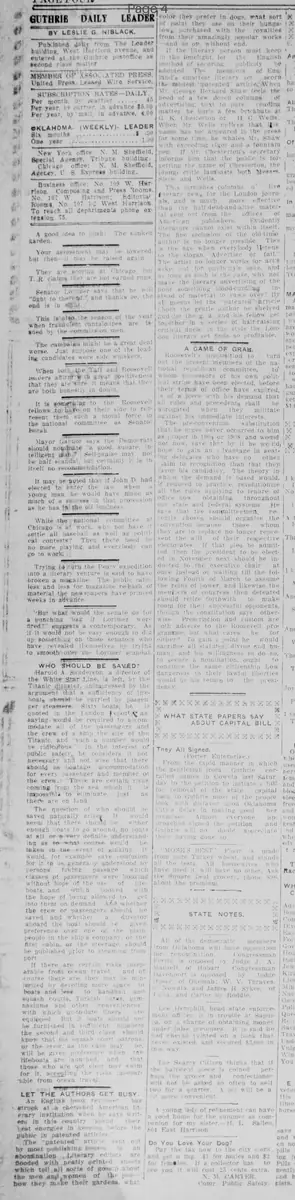
LET THE AUTHORS GET BUSY
An English book reviewer has struck at a cherished American literary institution when he says writers in this country should devote their best energies in keeping before the public in patented articles The "patented" article sent out by most publishing houses is an abomination. Literary editors are flooded with neatly printed sheets which tell all sorts of gossip about the men and women of the pen how they make their gardens, what color they prefer in dogs, what sort of paint they use on their bungalows purchased with the royalties from their amazingly popular works -and so on without end.
If the literary person must keep in the limelight, let the English method of securing publicity be adopted. The memoirs of England's smartest literary set scorn the modest "patented" article. When Mr. George Bernard Shaw feels the need of a few dozen columns of advertising, he hurls a few brickbats at G. K. Chesterton or H. G. Wells. When Mr. Wells notices that his name has not appeared in the press for some time, he whacks Mr. Shaw with exceeding vigor and a fountain pen. If Mr. Chesterton's secretary informs him that the public is forgetting the name of Chesterton, the plump critic lambasts both Messrs. Shaw and Wells.
This furnishes columns of live literary news for the London journals, and is much more effective than the half dead-and alive material sent out from the offices of American publishers.
Evidently literature cannot exist within itself. The fine seclusion of the old time author is no longer possible. This is the age when everybody listens to the slogan Advertise or fail. The artist no longer works for art's sake, but for publicity's sake, and as long as such is the case, why not make the literary advertising of the hour something blood-curdling instead of material to yawn over By all means let the "patented" article shout the gentle author be shelved and let the G. B. S. and his fellow get to ether in series of hair raising critical duels in the style the London literary set finds so profitable.
An English book reviewer has struck at a cherished American literary institution when he says writers in this country should devote their best energies in keeping before the public in patented articles The "patented" article sent out by most publishing houses is an abomination. Literary editors are flooded with neatly printed sheets which tell all sorts of gossip about the men and women of the pen how they make their gardens, what color they prefer in dogs, what sort of paint they use on their bungalows purchased with the royalties from their amazingly popular works -and so on without end.
If the literary person must keep in the limelight, let the English method of securing publicity be adopted. The memoirs of England's smartest literary set scorn the modest "patented" article. When Mr. George Bernard Shaw feels the need of a few dozen columns of advertising, he hurls a few brickbats at G. K. Chesterton or H. G. Wells. When Mr. Wells notices that his name has not appeared in the press for some time, he whacks Mr. Shaw with exceeding vigor and a fountain pen. If Mr. Chesterton's secretary informs him that the public is forgetting the name of Chesterton, the plump critic lambasts both Messrs. Shaw and Wells.
This furnishes columns of live literary news for the London journals, and is much more effective than the half dead-and alive material sent out from the offices of American publishers.
Evidently literature cannot exist within itself. The fine seclusion of the old time author is no longer possible. This is the age when everybody listens to the slogan Advertise or fail. The artist no longer works for art's sake, but for publicity's sake, and as long as such is the case, why not make the literary advertising of the hour something blood-curdling instead of material to yawn over By all means let the "patented" article shout the gentle author be shelved and let the G. B. S. and his fellow get to ether in series of hair raising critical duels in the style the London literary set finds so profitable.
What sub-type of article is it?
Satire
What keywords are associated?
Patented Articles
Literary Publicity
English Authors
Author Feuds
American Publishing
Advertise Or Fail
What entities or persons were involved?
George Bernard Shaw
G. K. Chesterton
H. G. Wells
American Publishers
Editorial Details
Primary Topic
Criticism Of American Literary Publicity Methods
Stance / Tone
Satirical Advocacy For English Style Author Feuds
Key Figures
George Bernard Shaw
G. K. Chesterton
H. G. Wells
American Publishers
Key Arguments
Patented Articles From Publishers Are Bland And Gossipy Abominations.
English Authors Gain Publicity Through Public Criticisms Of Each Other.
This Method Provides Lively News More Effective Than American Material.
In The Age Of 'Advertise Or Fail,' Literary Promotion Should Be Exciting Rather Than Yawn Inducing.
Replace Patented Articles With Hair Raising Critical Duels Among Authors.