Thank you for visiting SNEWPapers!
Sign up free
The Town Crier
Newington, Hartford County, Connecticut
What is this article about?
Historical account of Mill Pond in Newington, Connecticut, from its 1675 origins as a sawmill site for pipe staves, through various mills (grist, paper, board) under multiple owners including the Carpenters and Garvans, until a 1916 fire led to its conversion into a recreational park with swimming pool and ice rink.
Merged-components note: Merged across pages as the page 1 story explicitly continues on page 10 with 'OLD MILL CONTINUED' matching the Mill Pond history topic.
Clippings
1 of 2
OCR Quality
Full Text
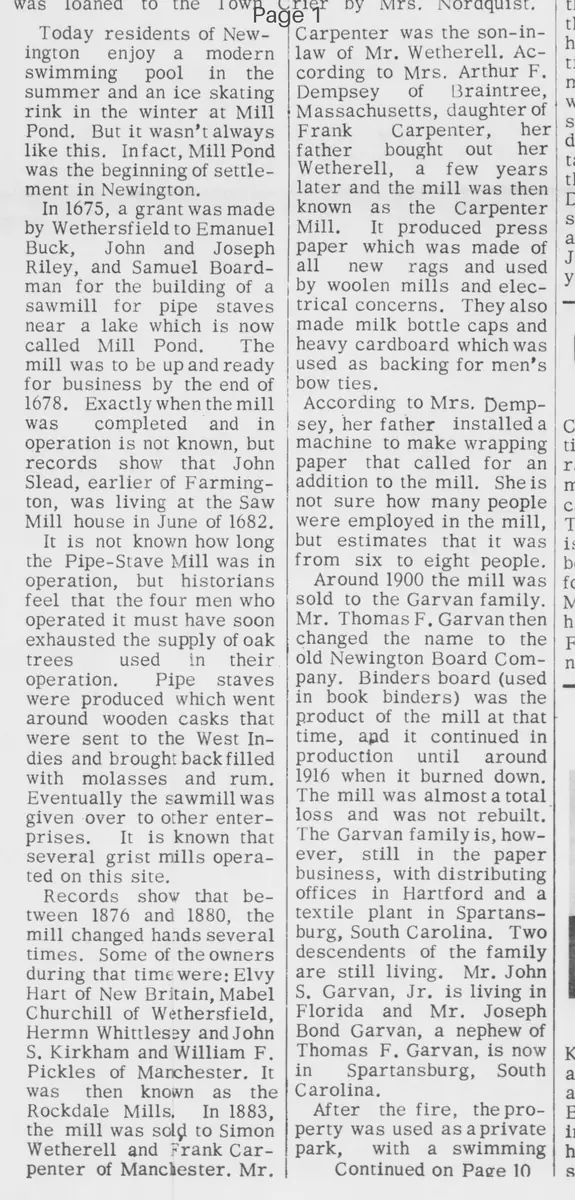
In 1675, a grant was made by Wethersfield to Emanuel Buck, John and Joseph Riley, and Samuel Boardman for the building of a sawmill for pipe staves near a lake which is now called Mill Pond. The mill was to be up and ready for business by the end of 1678.
Exactly when the mill was completed and in operation is not known, but records show that John Slead, earlier of Farming-ton, was living at the Saw Mill house in June of 1682.
It is not known how long the Pipe-Stave Mill was in operation, but historians feel that the four men who operated it must have soon exhausted the supply of oak trees used in their operation.
Pipe staves were produced which went around wooden casks that were sent to the West Indies and brought back filled with molasses and rum.
Eventually the sawmill was given over to other enterprises. It is known that several grist mills operated on this site.
Records show that between 1876 and 1880, the mill changed hands several times. Some of the owners during that time were: Elvy Hart of New Britain, Mabel Churchill of Wethersfield, Herman Whittlesey and John S. Kirkham and William F. Pickles of Manchester. It was then known as the Rockdale Mills.
In 1883, the mill was sold to Simon Wetherell and Frank Carpenter of Manchester. Mr. Carpenter was the son-in-law of Mr. Wetherell. According to Mrs. Arthur F. Dempsey of Braintree, Massachusetts, daughter of Frank Carpenter, her father bought out her Wetherell, a few years later and the mill was then known as the Carpenter Mill.
It produced press paper which was made of all new rags and used by woolen mills and electrical concerns. They also made milk bottle caps and heavy cardboard which was used as backing for men's bow ties.
According to Mrs. Dempsey, her father installed a machine to make wrapping paper that called for an addition to the mill. She is not sure how many people were employed in the mill, but estimates that it was from six to eight people.
Around 1900 the mill was sold to the Garvan family. Mr. Thomas F. Garvan then changed the name to the old Newington Board Company. Binders board (used in book binders) was the product of the mill at that time, and it continued in production until around 1916 when it burned down.
The mill was almost a total loss and was not rebuilt. The Garvan family is, however, still in the paper business, with distributing offices in Hartford and a textile plant in Spartansburg, South Carolina. Two descendants of the family are still living. Mr. John S. Garvan, Jr. is living in Florida and Mr. Joseph Bond Garvan, a nephew of Thomas F. Garvan, is now in Spartansburg, South Carolina.
After the fire, the property was used as a private park, with a swimming pool, by the Garvan family for many years. The property was sold to the town later and is now used for many purposes. There is a swimming pool used by hundreds almost every day during the summer, an ice skating rink used by many during the cold winter months, with plans eventually for a complete park.
On Mill Street are the town garages for school buses and town equipment.
What sub-type of article is it?
What themes does it cover?
What keywords are associated?
What entities or persons were involved?
Where did it happen?
Story Details
Key Persons
Location
Mill Pond, Newington, Connecticut
Event Date
1675 To Present
Story Details
Mill Pond began as site of 1675 sawmill grant for pipe staves; evolved through grist mills, Rockdale Mills (1876-1880), Carpenter Mill (1883-1900) producing paper products, Newington Board Company (1900-1916) making binders board; burned in 1916; became Garvan family park, then town recreational site with pool and rink.