Thank you for visiting SNEWPapers!
Sign up free
The Producers News
Plentywood, Sheridan County, Montana
What is this article about?
In Poland, 246 peasants from Galicia faced trials for resisting tax collections amid poverty and police brutality. Protests forced lighter sentences totaling over 100 years. The events highlight a broader uprising involving armed conflicts and a recent peasant strike.
Clipping
OCR Quality
Full Text
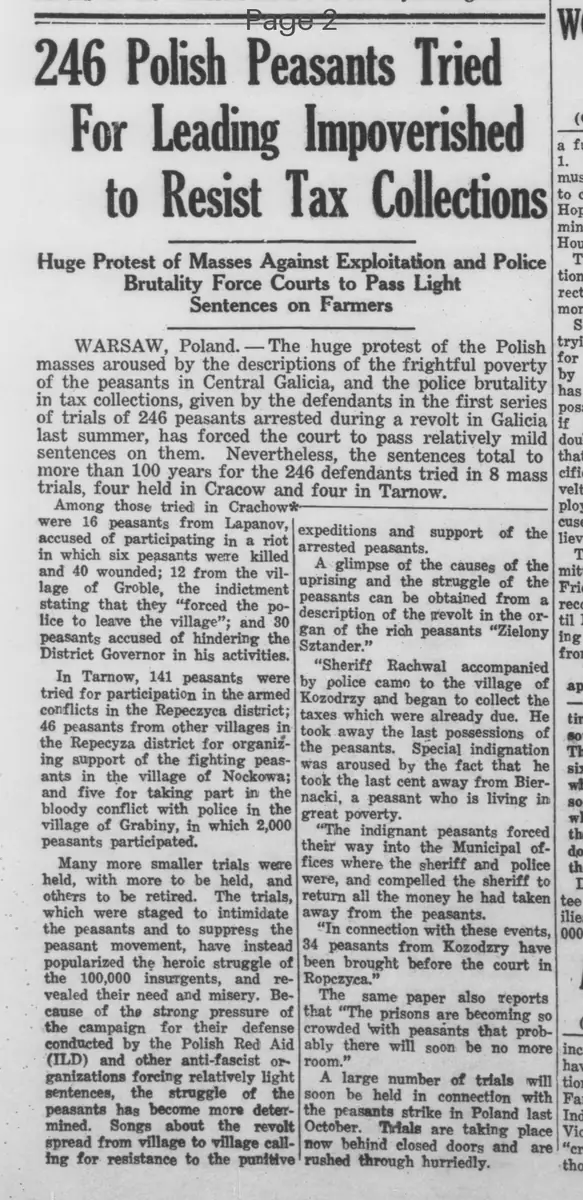
Huge Protest of Masses Against Exploitation and Police Brutality Force Courts to Pass Light Sentences on Farmers
WARSAW, Poland.—The huge protest of the Polish masses aroused by the descriptions of the frightful poverty of the peasants in Central Galicia, and the police brutality in tax collections, given by the defendants in the first series of trials of 246 peasants arrested during a revolt in Galicia last summer, has forced the court to pass relatively mild sentences on them. Nevertheless, the sentences total to more than 100 years for the 246 defendants tried in 8 mass trials, four held in Cracow and four in Tarnow.
Among those tried in Cracow were 16 peasants from Lapanov, accused of participating in a riot in which six peasants were killed and 40 wounded; 12 from the village of Groble, the indictment stating that they "forced the police to leave the village"; and 30 peasants accused of hindering the District Governor in his activities.
In Tarnow, 141 peasants were tried for participation in the armed conflicts in the Repeczyca district; 46 peasants from other villages in the Repeczyca district for organizing support of the fighting peasants in the village of Nockowa; and five for taking part in the bloody conflict with police in the village of Grabiny, in which 2,000 peasants participated.
Many more smaller trials were held, with more to be held, and others to be retried. The trials, which were staged to intimidate the peasants and to suppress the peasant movement, have instead popularized the heroic struggle of the 100,000 insurgents, and revealed their need and misery. Because of the strong pressure of the campaign for their defense conducted by the Polish Red Aid (ILD) and other anti-fascist organizations forcing relatively light sentences, the struggle of the peasants has become more determined. Songs about the revolt spread from village to village calling for resistance to the punitive expeditions and support of the arrested peasants.
A glimpse of the causes of the uprising and the struggle of the peasants can be obtained from a description of the revolt in the organ of the rich peasants "Zielony Sztander."
"Sheriff Rachwal accompanied by police came to the village of Kozodrzy and began to collect the taxes which were already due. He took away the last possessions of the peasants. Special indignation was aroused by the fact that he took the last cent away from Biernacki, a peasant who is living in great poverty.
"The indignant peasants forced their way into the Municipal Offices where the sheriff and police were, and compelled the sheriff to return all the money he had taken away from the peasants.
"In connection with these events, 34 peasants from Kozodrzy have been brought before the court in Ropczyca."
The same paper also reports that "The prisons are becoming so crowded with peasants that probably there will soon be no more room."
A large number of trials will soon be held in connection with the peasants strike in Poland last October. Trials are taking place now behind closed doors and are rushed through hurriedly.
What sub-type of article is it?
What keywords are associated?
What entities or persons were involved?
Where did it happen?
Foreign News Details
Primary Location
Galicia, Poland
Event Date
Last Summer
Key Persons
Outcome
sentences totaling more than 100 years; 6 killed and 40 wounded in lapanov riot; bloody conflict in grabiny with 2,000 participants; lighter sentences due to protests
Event Details
246 peasants tried in mass trials in Cracow and Tarnow for participating in a revolt against tax collections, including riots, forcing police out, and armed conflicts. Protests by masses and organizations like Polish Red Aid led to relatively mild sentences. The uprising involved 100,000 insurgents resisting exploitation and punitive expeditions, with songs spreading resistance. Specific incident in Kozodrzy where peasants forced return of seized money. Upcoming trials for October peasant strike.