Thank you for visiting SNEWPapers!
Sign up free
The Spirit Of Democracy
Woodsfield, Monroe County, Ohio
What is this article about?
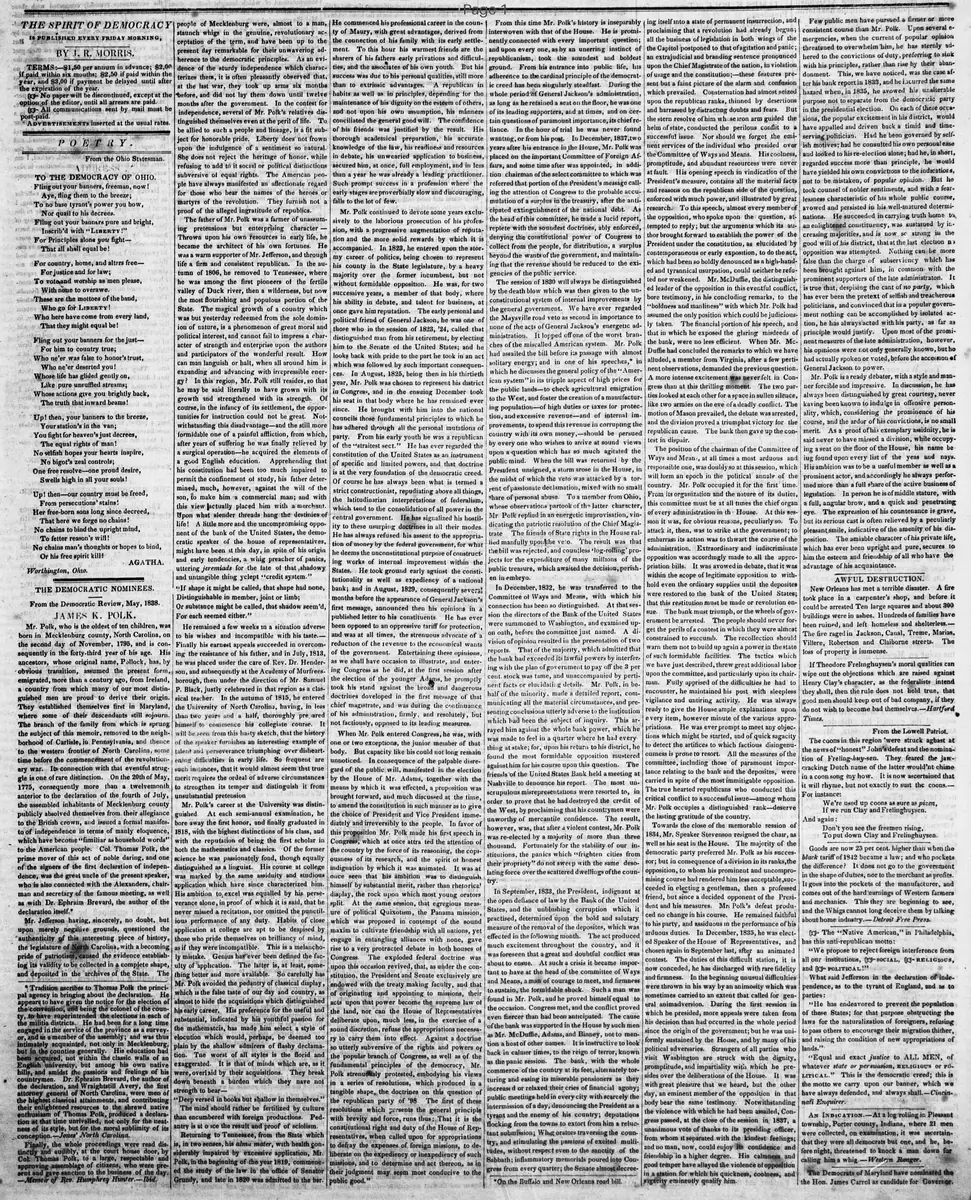
Biographical sketch of James K. Polk from the Democratic Review, May 1838, detailing his family heritage tied to the Mecklenburg Declaration of Independence, early life in North Carolina and Tennessee, education, legal career, and rise in Democratic politics, including his roles in Congress and as Speaker, emphasizing his strict constructionist principles and support for Jackson's administration.
Clipping
OCR Quality
Full Text
From the Democratic Review, May, 1838.
JAMES K. POLK.
Mr. Polk, who is the oldest of ten children, was born in Mecklenburg county, North Carolina, on the second day of November, 1795, and is consequently in the forty-third year of his age. His ancestors, whose original name, Pollock, has, by obvious transition, assumed the present form, emigrated, more than a century ago, from Ireland, a country from which many of our most distinguished men are proud to derive their origin. They established themselves first in Maryland, where some of their descendants still sojourn. The branch of the family from which is sprung the subject of this memoir, removed to the neighborhood of Carlisle, in Pennsylvania, and thence to the western frontier of North Carolina, some time before the commencement of the revolutionary war. Its connection with that eventful struggle is one of rare distinction. On the 20th of May, 1775, consequently more than a twelvemonth anterior to the declaration of the fourth of July, the assembled inhabitants of Mecklenburg county publicly absolved themselves from their allegiance to the British crown, and issued a formal manifesto of independence in terms of manly eloquence, which have become "familiar as household words" to the American people: Col. Thomas Polk, the prime mover of this act of noble daring, and one of the signers of the first declaration of independence, was the great uncle of the present speaker, who is also connected with the Alexanders, chairman and secretary of the famous meeting, as well as with Dr. Ephraim Brevard, the author of the declaration itself. Mr. Jefferson having, sincerely, no doubt, but upon merely negative grounds, questioned the authenticity of this interesting piece of history the legislature of North Carolina, with a becoming pride of patriotism, caused the evidence establishing its validity to be collected in a complete shape, and deposited in the archives of the State. The tradition ascribes to Thomas Polk the principal agency in bringing about the declaration. He appears to have given the notice for the election of the convention, and being the colonel of the county, to have superintended the elections in each of the militia districts. He had been for a long time engaged in the service of the province as a surveyor, and as a member of the assembly; and was thus intimately acquainted, not only in Mecklenburg but in the counties generally. His education had been acquired, not within the classic walls of an English university, but among his own native hills, and amidst the passions and feelings of his countrymen. Dr. Ephraim Brevard, the author of the declaration, and Waightstill Avery, the first attorney general of North Carolina, were men of the highest classical attainments, and contributing their enlightened resources to the shrewd native enthusiasm of Thomas Polk, produced a declaration at that time unrivalled, not only for the neatness of its style, but for the moral sublimity of its conception.—Jones' North Carolina. Finally, the whole proceedings were read distinctly and audibly, at the court house door, by Col. Thomas Polk, to a large, respectable and approving assemblage of citizens, who were present and gave sanction to the business of the day. -Memoir of Rev. Humphrey Hunter.-Ibid.
people of Mecklenburg were, almost to a man, staunch whigs in the genuine, revolutionary acceptation of the term, and have been up to the present day remarkable for their unwavering adherence to the democratic principles. As an evidence of the sturdy independence which characterizes them, it is often pleasantly observed that, at the last war, they took up arms six months before, and did not lay them down until twelve months after the government. In the contest for independence, several of Mr. Polk's relatives distinguished themselves even at the peril of life. To be allied to such a people and lineage, is a fit subject for honorable pride. Liberty does not frown upon the indulgence of a sentiment so natural. She does not reject the heritage of honor, while refusing to add to it social or political distinctions subversive of equal rights. The American people have always manifested an affectionate regard for those who bear the names of the heroes or martyrs of the revolution. They furnish not a proof of the alleged ingratitude of republics. The father of Mr. Polk was a farmer of unassuming pretensions but enterprising character—Thrown upon his own resources in early life, he became the architect of his own fortunes. He was a warm supporter of Mr. Jefferson, and through life a firm and consistent republican. In the autumn of 1806, he removed to Tennessee, where he was among the first pioneers of the fertile valley of Duck river, then a wilderness, but now the most flourishing and populous portion of the State. The magical growth of a country which was but yesterday redeemed from the sole dominion of nature, is a phenomenon of great moral and political interest, and cannot fail to impress a character of strength and enterprise upon the authors and participators of the wonderful result. How can man languish or halt, when all around him is expanding and advancing with irrepressible energy? In this region, Mr. Polk still resides, so that he may be said literally to have grown with its growth and strengthened with its strength. Of course, in the infancy of its settlement, the opportunities for instruction could not be great. Notwithstanding this disadvantage—and the still more formidable one of a painful affliction, from which, after years of suffering he was finally relieved by a surgical operation—he acquired the elements of a good English education, Apprehending that his constitution had been too much impaired to permit the confinement of study, his father determined, much, however, against the will of the son, to make him a commercial man; and with this view actually placed him with a merchant. Upon what slender threads hang the destinies of life! A little more and the uncompromising opponent of the bank of the United States, the democratic speaker of the house of representatives, might have been at this day, in spite of his origin and early tendencies, a whig preacher of panics, uttering jeremiads for the fate of that shadowy and intangible thing yclept "credit system."
"If shape it might be called, that shape had none, Distinguishable in member, joint or limb; Or substance might be called, that shadow seem'd, For each seemed either."
He remained a few weeks in a situation adverse to his wishes and incompatible with his taste.—Finally his earnest appeals succeeded in overcoming the resistance of his father, and in July, 1813, he was placed under the care of Rev. Dr. Henderson, and subsequently at the Academy of Murfreesborough, then under the direction of Mr. Samuel P. Black, justly celebrated in that region as a classical teacher. In the autumn of 1815, he entered the University of North Carolina, having, in less than two years and a half, thoroughly prepared himself to commence his collegiate course. It will be seen from this hasty sketch, that the history of the speaker furnishes an interesting example of talent and perseverance triumphing over disheartening difficulties in early life. So frequent are such instances, that it would almost seem that true merit requires the ordeal of adverse circumstances to strengthen its temper and distinguish it from unsubstantial pretension Mr. Polk's career at the University was distinguished. At each semi-annual examination, he bore away the first honor, and finally graduated in 1818, with the highest distinctions of his class, and with the reputation of being the first scholar in both the mathematics and classics. Of the former science—he was passionately fond, though equally distinguished as a linguist. His course at college was marked by the same assiduity and studious application which have since characterized him. His ambition to excel was equalled by his perseverance alone, in proof of which it is said, that he never missed a recitation, nor omitted the punctilious performance of any duty. Habits of close application at college are apt to be despised by those who pride themselves on brilliancy of mind, as if they were incompatible. This is a melancholy mistake. Genius has ever been defined the faculty of application. The latter is, at least, something better and more available. So carefully has Mr. Polk avoided the pedantry of classical display, which is the false taste of our day and country, as almost to hide the acquisitions which distinguished his early career. His preference for the useful and substantial, indicated by his youthful passion for the mathematics, has made him select a style of elocution which would, perhaps, be deemed too plain by the shallow admirers of flashy declamation. The worst of all styles is the florid and exaggerated. It is that of minds which are, as it were, overlaid by their acquisitions. They break down beneath a burden which they have not
"Deep versed in books but shallow in themselves."
The mind should rather be fertilized by culture than encumbered with foreign productions. Pedantry is at once the result and proof of sciolism. Returning to Tennessee, from the State which is, in two senses, his alma mater, with health considerably impaired by excessive application, Mr. Polk, in the beginning of the year 1819, commenced the study of the law in the office of Senator Grundy, and late in 1820 was admitted to the bar.
He commenced his professional career in the county of Maury, with great advantages, derived from the connection of his family with its early settlement. To this hour his warmest friends are the sharers of his fathers early privations and difficulties, and the associates of his own youth. But his success was due to his personal qualities, still more than to extrinsic advantages. A republican in habits as well as in principles, depending for the maintenance of his dignity on the esteem of others, and not upon his own assumption, his manners conciliated the general good will. The confidence of his friends was justified by the result. His thorough academical preparation, his accurate knowledge of the law, his readiness and resources in debate, his unwearied application to business, secured him at once full employment, and in less than a year he was already a leading practitioner. Such prompt success in a profession where the early stages are proverbially slow and discouraging, falls to the lot of few. Mr. Polk continued to devote some years exclusively to the laborious prosecution of his profession, with a progressive augmentation of reputation and the more solid rewards by which it is accompanied. In 1823, he entered upon the stormy career of politics, being chosen to represent his county in the State legislature, by a heavy majority over the former incumbent, but not without formidable opposition. He was, for two successive years, a member of that body, where his ability in debate, and talent for business, at once gave him reputation. The early personal and political friend of General Jackson, he was one of those who in the session of 1823, '24, called that distinguished man from his retirement, by electing him to the Senate of the United States; and he looks back with pride to the part he took in an act which was followed by such important consequences. In August, 1825, being then in his thirtieth year, Mr. Polk was chosen to represent his district in Congress, and in the ensuing December took his seat in that body where he has remained ever since. He brought with him into the national councils those fundamental principles to which he has adhered through all the personal mutations of party. From his early youth he was a republican of the "straitest sect." He has ever regarded the constitution of the United States as an instrument of specific and limited powers, and that doctrine is at the very foundation of the democratic creed. Of course he has always been what is termed a strict constructionist, repudiating above all things, the latitudinarian interpretations of federalism, which tend to the consolidation of all power in the central government. He has signalized his hostility to these usurping doctrines in all their modes. He has always refused his assent to the appropriation of money by the federal government, for what he deems the unconstitutional purpose of constructing works of internal improvement within the States. He took ground early against the constitutionality as well as expediency of a national bank; and in August, 1829, consequently several months before the appearance of General Jackson's first message, announced then his opinions in a published letter to his constituents. He has ever been opposed to an oppressive tariff for protection, and was at all times, the strenuous advocate of a reduction of the revenue to the economical wants of the government. Entertaining these opinions, as we shall have occasion to illustrate, and entering Congress as he did, at the first session after the election of the younger Adams, he promptly took his stand against the broad and dangerous doctrines developed in the first message of that chief magistrate, and was during the continuance of his administration, firmly, and resolutely, but not factiously, opposed to its leading measures. When Mr. Polk entered Congress, he was, with one or two exceptions, the junior member of that body. But capacity like his could not long remain unnoticed. In consequence of the palpable disregard of the public will, manifested in the election by the House of Mr. Adams, together with the means by which it was effected, a proposition was brought forward, and much discussed at the time, to amend the constitution in such manner as to give the choice of President and Vice President immediately and irreversibly to the people. In favor of this proposition Mr. Polk made his first speech in Congress, which at once attracted the attention of the country by the force of its reasoning, the copiousness of its research, and the spirit of honest indignation by which it was animated. It was at once seen that his ambition was to distinguish himself by substantial merit, rather than rhetorical display, the rock upon which most young orators split. At the same session, that egregious measure of political Quixotism, the Panama mission, which was proposed in contempt of the sound maxim to cultivate friendship with all nations, yet engage in entangling alliances with none, gave rise to a very protracted debate in both houses of Congress. The exploded federal doctrine was upon this occasion revived, that, as under the constitution, the President and Senate exclusively are endowed with the treaty making faculty, and that of originating and appointing to missions, their acts upon that power become the supreme law of the land, nor can the House of Representatives deliberate upon, much less, in the exercise of a sound discretion, refuse the appropriations necessary to carry them into effect. Against a doctrine so utterly subversive of the rights and powers of the popular branch of Congress, as well as of the fundamental principles of the democracy, Mr. Polk strenuously protested, embodying his views in a series of resolutions, which produced in a tangible shape, the doctrines on this question of the republican party of '98 The first of these resolutions which presents the general principle with brevity and force, runs thus: That it is the constitutional right and duty of the House of Representatives, when called upon for appropriations to defray the expenses of foreign missions, to deliberate on the expediency or inexpediency of such missions, and to determine and act thereon, as in their judgment may seem most conducive to the public good.
From this time Mr. Polk's history is inseparably interwoven with that of the House. He is prominently connected with every important question; and upon every one, as by an unerring instinct of republicanism, took the soundest and boldest ground. From his entrance into public life, his adherence to the cardinal principle of the democratic creed has been singularly steadfast. During the whole period of General Jackson's administration, as long as he retained a seat on the floor, he was one of its leading supporters, and at times, and on certain questions of paramount importance, its chief reliance. In the hour of trial he was never found wanting, or from his post. In December, 1837, two years after his entrance in the House, Mr. Polk was placed on the important Committee of Foreign Affairs, and some time after was appointed, in addition chairman of the select committee to which was referred that portion of the President's message calling the attention of Congress to the probable accumulation of a surplus in the treasury, after the anticipated extinguishment of the national debt. As the head of this committee, he made a lucid report, replete with the soundest doctrines, ably enforced, denying the constitutional power of Congress to collect from the people, for distribution, a surplus beyond the wants of the government, and maintaining that the revenue should be reduced to the exigencies of the public service. The session of 1830 will always be distinguished by the death blow which was then given to the unconstitutional system of internal improvements by the general government. We have ever regarded the Maysville road veto as second in importance to none of the acts of General Jackson's energetic administration. It lopped off one of the worst branches of the miscalled American system. Mr. Polk had assailed the bill before its passage with almost solitary energy; and in one of his speeches,* in which he discusses the general policy of the "American system" in its triple aspect of high prices for the public lands—to check agricultural emigration to the West, and foster the creation of a manufacturing population—of high duties or taxes for protection, and excessive revenue—and of internal improvements, to spend this revenue in corrupting the country with its own money,—should be perused by every one who wishes to arrive at sound views upon a question which has so much agitated the public mind. When the bill was returned by the President unsigned, a storm arose in the House, in the midst of which the veto was attacked by a torrent of passionate declamation, mixed with no small share of personal abuse. To a member from Ohio, whose observations partook of the latter character, Mr. Polk replied in an energetic improvisation, vindicating the patriotic resolution of the Chief Magistrate The friends of State rights in the House rallied manfully upon the veto. The result was that the bill was rejected, and countless 'log-rolling' projects for the expenditure of many millions of the public treasure, which awaited the decision, perished in embryo. In December, 1832, he was transferred to the Committee of Ways and Means, with which his connection has been so distinguished. At that session the directors of the Bank of the United States were summoned to Washington, and examined upon oath, before the committee just named. A division of opinion resulted in the presentation of two reports. That of the majority, which admitted that the bank had exceeded its lawful powers by interfering with the plan of government to pay off the 3 per cent. stock was tame, and unaccompanied by pertinent facts or elucidating details. Mr. Polk, in behalf of the minority, made a detailed report, communicating all the material circumstances, and presenting conclusions utterly adverse to the institution which had been the subject of inquiry. This arrayed him against the whole bank power, which he was made to feel in a quarter where he had everything at stake; for, upon his return to his district, he found the most formidable opposition mustered against him or his course upon this question. The friends of the United States Bank held a meeting at Nashville to denounce his report. The most unscrupulous misrepresentations were resorted to, in order to prove that he had destroyed the credit of the West, by proclaiming that his countrymen were unworthy of mercantile confidence. The result, however, was, that after a violent contest, Mr. Polk was re-elected by a majority of more than three thousand. Fortunately for the stability of our institutions, the panics which "frighten cities from their propriety" do not sweep with the same desolating force over the scattered dwellings of the country In September, 1833, the President, indignant at the open defiance of law by the Bank of the United States, and the unblushing corruption which it practised, determined upon the bold and salutary measure of the removal of the deposites, which was effected in the following month. The act produced much excitement throughout the country, and it was foreseen that a great and doubtful conflict was about to ensue. At such a crisis it became important to have at the head of the committee of Ways and Means, a man of courage to meet, and firmness to sustain, the formidable shock. Such a man was found in Mr. Polk, and he proved himself equal to the occasion. Congress met, and the conflict proved even fiercer than had been anticipated. The cause of the bank was supported in the House by such men as Mr. McDuffie, Adams, and Binney, not to mention a host of other names. It is instructive to look back in calmer times, to the reign of terror, known as the panic session. The bank, with the whole commerce of the country at its feet, alternately torturing and easing its miserable pensioners as they increased or relaxed their cries of financial agony; public meetings held in every city with scarcely the intermission of a day, denouncing the President as a tyrant and the enemy of his country; deputations flocking from the towns to extort from him a reluctant submission; Whig orators traversing the country, and stimulating the passions of excited multitudes, without respect even to the sanctity of the Sabbath; inflammatory memorials poured into Congress from every quarter; the Senate almost decreeing itself into a state of permanent insurrection, and proclaiming that a revolution had already begun; all the business of legislation in both wings of the Capitol postponed to that of agitation and panic; an extrajudicial and branding sentence pronounced upon the Chief Magistrate of the nation, in violation of usage and the constitution;—these features present but a faint picture of the alarm and confusion which prevailed. Consternation had almost seized upon the republican ranks, thinned by desertions and harassed by distracting doubts and fears. But the stern resolve of him whose iron arm guided the helm of state, conducted the perilous conflict to a successful issue. Nor should we forget the eminent services of the individual who presided over the Committee of Ways and Means. His coolness, promptitude, and abundant resources were never at fault. His opening speech in vindication of the President's measure, contains all the material facts and reasons on the republican side of the question, enforced with much power, and illustrated by great research. To this speech, almost every member of the opposition, who spoke upon the question, attempted to reply; but the arguments which its author brought forward to establish the power of the President under the constitution, as elucidated by contemporaneous or early exposition, to do the act, which had been so boldly denounced as a high-handed and tyrannical usurpation, could neither be refuted nor weakened. Mr. McDuffie, the distinguished leader of the opposition in this eventful conflict, bore testimony, in his concluding remarks, to the "boldness and manliness" with which Mr. Polk had assumed the only position which could be judiciously taken. The financial portion of his speech, and that in which he exposed the glaring misdeeds of the bank, were no less efficient. When Mr. McDuffie had concluded the remarks to which we have alluded, a member from Virginia, after a few pertinent observations, demanded the previous question. A more intense excitement was never felt in Congress than at this thrilling moment. The two parties looked at each other for a space in sullen silence, like two armies on the eve of a deadly conflict. The motion of Mason prevailed, the debate was arrested, and the division proved a triumphant victory for the republican cause. The bank then gave up the contest in despair. The position of the chairman of the Committee of Ways and Means, at all times a most arduous and responsible one, was doubly so at this session, which will form an epoch in the political annals of the country. Mr. Polk occupied it for the first time. From its organization and the nature of its duties, this committee must be at all times the chief organ of every administration in the House. At this session it was, for obvious reasons, peculiarly so. To attack it, then, was to strike at the government; to embarrass its action was to thwart the course of the administration. Extraordinary and indiscriminate opposition was accordingly made to all the appropriation bills. It was avowed in debate, that it was within the scope of legitimate opposition to withhold even the ordinary supplies until the deposites were restored to the bank of the United States; that this restitution must be made or revolution ensue. The bank must triumph, or the wheels of government be arrested. The people should never forget the perils of a contest in which they were almost constrained to succumb. The recollection should warn them not to build up again a power in the state of such formidable facilities. The tactics which we have just described, threw great additional labor upon the committee, and particularly upon its chairman. Fully apprised of the difficulties he had to encounter, he maintained his post with sleepless vigilance and untiring activity. He was always ready to give the House ample explanations upon every item, however minute of the various appropriations. He was ever prompt to meet any objections which might be started, and of quick sagacity to detect the artifices to which factious disingenuousness is prone to resort. All the measures of the committee, including those of paramount importance relating to the bank and the deposites, were carried in spite of the most immitigable opposition. The true hearted republicans who conducted this critical conflict to a successful issue—among whom Mr. Polk occupies a distinguished rank—deserve the lasting gratitude of the country. Towards the close of the memorable session of 1834, Mr. Speaker Stevenson resigned the chair, as well as his seat in the House. The majority of the democratic party preferred Mr. Polk as his successor; but in consequence of a division in its ranks, the opposition, to whom his prominent and uncompromising course had rendered him less acceptable, succeeded in electing a gentleman, then a professed friend, but since a decided opponent of the President and his measures. Mr. Polk's defeat produced no change in his course. He remained faithful to his party, and assiduous in the performance of his arduous duties. In December, 1835, he was elected Speaker of the House of Representatives, and chosen again in September last, after an animated contest. The duties of this difficult station, it is now conceded, he has discharged with rare fidelity and firmness. In the beginning unusual difficulties were thrown in his way by an animosity which was sometimes carried to an extent that called for general animadversion. During the first session in which he presided, more appeals were taken from his decision than had occurred in the whole period since the origin of the government; but he was uniformly sustained by the House, and by many of his political adversaries. Strangers of all parties who visit Washington are struck with the dignity, promptitude, and impartiality with which he presides over the deliberations of the House. It was with great pleasure that we heard, but the other day, an eminent member of the opposition in that body bear the same testimony. Notwithstanding the violence with which he had been assailed, Congress passed, at the close of the session in 1837, a unanimous vote of thanks to its presiding officer, from whom it separated with the kindest feelings; and no man, now, could enjoy its confidence and friendship in a higher degree. His calmness and good temper have allayed the violence of opposition in a station for which his quickness, coolness, and sagacity eminently qualify him. Few public men have pursued a firmer or more consistent course than Mr. Polk. Upon several emergencies, when the current of popular opinion threatened to overwhelm him, he has sternly adhered to the convictions of duty, preferring to sink with his principles, rather than rise by their abandonment. This, we have noticed, was the case after his bank report in 1833, and he incurred the same hazard when, in 1835, he avowed his unalterable purpose not to separate from the democratic party in the presidential election. On each of these occasions, the popular excitement in his district, would have appalled and driven back a timid and time-serving politician. Had he been governed by selfish motives; had he consulted his own personal ease and looked to his re-election alone; had he, in short, regarded success more than principle, he would have yielded his own convictions to the indications, not to be mistaken, of popular opinion. But he took counsel of nobler sentiments, and with a fearlessness characteristic of his whole public course, avowed and persisted in his well-matured determinations. He succeeded in carrying truth home to an enlightened constituency, was sustained by increasing majorities, and is now so strong in the good will of his district, that at the last election no opposition was attempted. Nothing can be more false than the charge of subserviency which has been brought against him, in common with the prominent supporters of the late administration. It is true that, despising the cant of no party, which has ever been the pretext of selfish and treacherous politicians, and convinced that in a popular government nothing can be accomplished by isolated action, he has always acted with his party, as far as principle would justify. Upon most of the prominent measures of the late administration, however, his opinions were not only generally known, but he had actually spoken or voted, before the accession of General Jackson to power. Mr. Polk is a ready debater, with a style and manner forcible and impressive. In discussion, he has always been distinguished by great courtesy, never having been known to indulge in offensive personality, which, considering the prominence of his course, and the ardor of his convictions, is no small merit. As a proof of his exemplary assiduity, he is said never to have missed a division, while occupying a seat on the floor of the House, his name being found upon every list of the yeas and nays. His ambition was to be a useful member as well as a prominent actor, and accordingly he always performed more than a full share of the active business of legislation. In person he is of middle stature, with a full, angular brow, and a quick and penetrating eye. The expression of his countenance is grave, but its serious cast is often relieved by a peculiarly pleasant smile, indicative of the amenity of his disposition. The amiable character of his private life, which has ever been upright and pure, secures to him the esteem and friendship of all who have the advantage of his acquaintance.
What sub-type of article is it?
What themes does it cover?
What keywords are associated?
What entities or persons were involved?
Where did it happen?
Story Details
Key Persons
Location
Mecklenburg County, North Carolina; Tennessee; Washington, D.C.
Event Date
November 2, 1795 To 1838
Story Details
James K. Polk, born in 1795 in North Carolina to a family linked to the Mecklenburg Declaration, moved to Tennessee as a child, overcame health issues and limited education to excel at university, study law, and enter politics as a strict constructionist Democrat, supporting Jackson against the national bank and internal improvements, rising to Speaker of the House by 1835.