Thank you for visiting SNEWPapers!
Sign up free
Story
September 27, 1820
Daily National Intelligencer
Washington, District Of Columbia
What is this article about?
In a Senate speech on April 6, Mr. Barbour of Virginia defends a supplemental bill on US-British West India navigation, urging perseverance in retaliatory policy against Britain's monopoly to ensure equality, protect commerce, and strengthen the navy as a bond of union.
Clipping
OCR Quality
98%
Excellent
Full Text
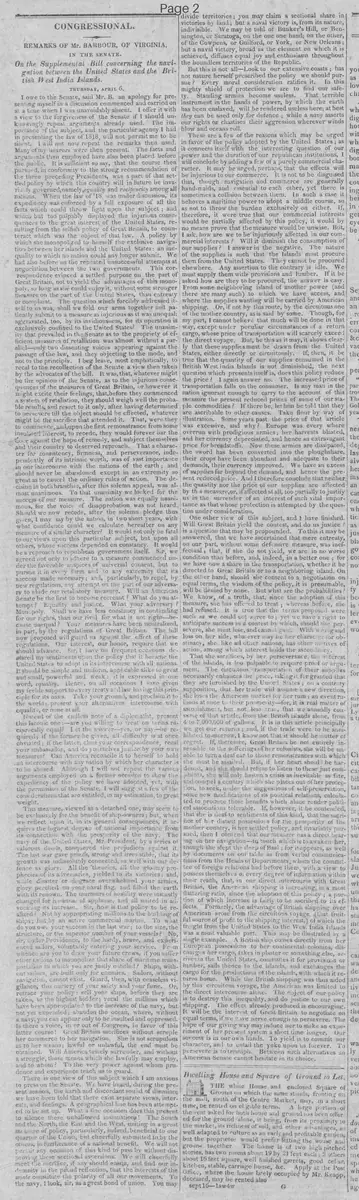
CONGRESSIONAL.
REMARKS OF Mr. BARBOUR, OF VIRGINIA, IN THE SENATE.
On the Supplemental Bill concerning the navigation between the United States and the British West India Islands.
THURSDAY, APRIL 6.
I owe to the Senate, said Mr. B. an apology for presenting myself in a discussion commenced and carried on at a time when I was unavoidably absent. I offer it with a view to the forgiveness of the Senate if I should unknowingly repeat arguments already used. The importance of the subject, and the particular agency I had in presenting the law of 1818, will not permit me to be silent. I will not now repeat the remarks then used. Many of my hearers were then present. The facts and arguments then employed have also been placed before the public. It is sufficient to say, that the course then pursued, in conformity to the strong recommendation of the three preceding Presidents, was a part of that settled policy by which this country will in future be invariably governed, namely, equality and reciprocity among all nations. When the law of '18 was under discussion, its expediency was enforced by a full exposure of all the facts which could throw light upon the subject; and which but too palpably displayed the injurious consequences to the great interest of the United States, resulting from the selfish policy of Great Britain, to counteract which was the object of that law. A policy by which she monopolized to herself the exclusive navigation between her islands and the United States: an inequality to which no nation could any longer submit. We had also before us the repeated unsuccessful attempts at negotiation between the two governments. This correspondence evinced a settled purpose on the part of Great Britain, not to yield the advantages of this monopoly, so long as she could enjoy it, without some stronger measure on the part of the United States, than entreaty or complaint. The question which forcibly addressed itself to us was, shall we fold our arms together and patiently submit to a measure as injurious as it was unequal: aggravated, too, by its invidiousness, for its operation is exclusively confined to the United States? The unanimity that prevailed in the Senate as to the propriety of efficient measures of retaliation was almost without a parallel—only two dissenting voices appearing against the passage of the law, and they objecting to the mode, and not to the principle. I beg leave, most emphatically, to recal to the recollection of the Senate a view then taken by the advocates of the bill. It was, that, whatever might be the opinion of the Senate, as to the injurious consequences of the measures of Great Britain, or however it might excite their feelings, that, before they commenced a system of retaliation, they should weigh well the probable results, and resort to it only, after having determined to persevere till the object should be effected, whatever might be the sacrifice that attended it. That, were they to commence, and upon the first remonstrance from some insulated interest, to recede, they would forever bar the door against the hope of remedy, and subject themselves and their country to deserved reproach. That a character for consistency, firmness, and perseverance, independently of its intrinsic worth, was of vast importance in our intercourse with the nations of the earth; and should never be abandoned except in an extremity so great as to cancel the ordinary rules of action. The decision in both branches, after this solemn appeal, was almost unanimous. To that unanimity we looked for the success of our measure. The nation was equally unanimous, for the voice of disapprobation was not heard. Should we now recede, after the solemn pledge thus given, I may say by the nation, in two short years, with what confidence could we calculate hereafter on any measure of a similar character? It would not only be fatal to our views upon this particular subject, but upon all others, whose success depended on constancy. It would be a reproach to republican government itself. Sir, we agreed not only to adhere to a measure commenced under the favorable auspices of universal consent, but to pursue it in every form and to any extremity that its success made necessary; and, particularly, to repel, by new regulations, any attempt on the part of our adversary to elude our retaliatory measure. Will an American Senate be the first to become recreant? What do you attempt? Equality and justice. What your adversary? Monopoly. Shall we have less constancy in contending for our rights, than our rival for what is not right—because unequal? Your measures have been neutralized, in part, by the regulations of Great Britain. The bill now proposed will guard us against the effect of these regulations. Our interest, our honor, require that we should advance. Sir, I have on frequent occasions declared my sentiments upon the policy that it became the United States to adopt in its intercourse with all nations. It should be simple and uniform, applicable alike to great and small, powerful and weak: it is expressed in one word, equality. Hence, on all occasions I have given my feeble support to every treaty and law having this principle for its basis. Take your ground, and proclaim it to the world; present your alternatives—intercourse with equality, or none at all. Instead of the endless note of a diplomatist, present this laconic one:—are you willing to treat on terms reciprocally equal? Let the answer—yea, or nay—be required; if the former be given, all difficulty is at once obviated; if the latter, close your correspondence, recal your ambassador, and do yourselves justice by your own measures? Can America reconcile it to herself to hold an intercourse with any nation by which her character is to be abused. Although I will not repeat the various arguments employed on a former occasion to show the expediency of the policy we have adopted, yet, with the permission of the Senate, I will suggest a few of the considerations that are entitled, in my estimation, to great weight.
This measure, viewed as a detached one, may seem to be exclusively for the benefit of ship-owners; but, when we reflect upon it, in its general consequences, it acquires the highest degree of national importance from its connections with the prosperity of the navy. The navy of the United States, Mr. President, by a series of valorous deeds, conquered the prejudices against it. The last war gave proofs, strong and irresistible, that its growth was indissolubly connected, as well with our defence as glory. All the theories, all the gloomy prophecies of its adversaries, yielded to its victories; and, while disaster or disgrace overwhelmed your armies, glory perched on your naval flag, and filled the earth with its renown. The murmurs of hostility were instantly changed for hosanna of applause, and all united in advocating its increase. Sir, how is that policy to be realized? Not by appropriating millions to the building of ships, but by an active commercial marine. To what do you owe your success in the last war; to the size, the structure, or the superior number of your vessels? No, sir, under Providence, to the hardy, brave, and experienced sailors, voluntarily entering your service. From whence are you to draw your future crews, if you suffer other nations to monopolize that share of maritime transportation to which you are justly entitled? Ships, without sailors, are built only for enemies. Sailors, without navigation, cannot exist. Guard, then, with ceaseless vigilance, this nursery of your safety and your fame. Or, retrace your policy: sell your ships, before they are taken, to the highest bidder; recal the millions which have been appropriated to the increase of the navy, but not yet expended; abandon the ocean, where, without a navy, you can appear only to be insulted and oppressed. Is there a voice, in or out of Congress, in favor of this latter course! Great Britain sacrifices without scruple her commerce to her navigation. She is not scrupulous as to her means; lawful or unlawful, the end must be obtained. Will America tamely surrender, and without a struggle, those means which she lawfully may employ, and to whom? To the very power against whom prudence and experience teach us to guard.
There is one view of this subject which I am anxious to press on the Senate. We have heard, during the present session, the harsh and discordant sound of disunion; we have been told that there exist separate views, interests, and feelings. A geographical line has been attempted to be set up. What a fine occasion does this present to silence these unhallowed insinuations! The South and the North, the East and the West, uniting in a great measure of policy, particularly, indeed, beneficial to one quarter of the Union, but cheerfully submitted to by the others, in furtherance of a national benefit. We will not permit any occasion of this kind to pass by without disproving these sectional aspersions. We will cheerfully meet the sacrifice, if any should ensue, and find our indemnity in the proud reflection, that the interests of the whole constitute the polarity of all our movements. To the navy, I look, sir, as a great bond of union. You may divide territories; you may claim a sectional share in victories by land; but a naval victory is, from its nature, indivisible. We may be told of Bunker's Hill, or Bennington, or Saratoga, on the one hand; on the other, of the Cowpens, or Guilford, or York, or New Orleans; but a naval victory, broad as the element on which it is achieved, diffuses equal joy and enthusiasm throughout the boundless territories of the Republic.
But this is not all. Look to our extensive coasts; has not nature herself prescribed the policy we should pursue? Every moral consideration ratifies it. In this mighty shield of protection we are to find our safety. Standing armies become useless. That terrible instrument in the hands of power, by which the earth has been enslaved, will be rendered useless here; at best they can be used only for defence; while a navy asserts our rights or chastises their aggression wherever winds blow and oceans roll.
These are a few of the reasons which may be urged in favor of the policy adopted by the United States; as it connects itself with the interesting question of our power and the duration of our republican institutions, I will conclude by adding a few of a purely commercial character. It may be urged, perhaps, that the effects will be injurious to our commerce. It is not to be disguised that, though navigation and commerce are generally hand-maids, and essential to each other, yet there is sometimes a collision between them. In such a case it behoves a maritime power to adopt a middle course, so as not to throw the burden exclusively on either. If, therefore, it were true that our commercial interests would be partially affected by this policy, it would by no means prove that the measure would be unwise. But, I ask, how are we to be injuriously affected in our commercial interests? Will it diminish the consumption of our supplies? I answer in the negative. The nature of the supplies is such that the Islands must procure them from the United States. They cannot be procured elsewhere. Any assertion to the contrary is idle. We must supply them with provisions and lumber. If it be asked how are they to be procured, the answer is easy. From some neighboring island of another power (and there are many such) to which we have access, and where the supplies wanting will be carried by American shipping. Or, if not by this route, by the circuitous one of the mother country, as is said by some. Though, for my part, I cannot believe that much will be done in that way, except under peculiar circumstances of a return cargo, whose price of transportation will scarcely exceed the direct voyage. But, be this as it may, it shows clearly that these supplies must be drawn from the United States, either directly or circuitously. If, then, it be true that the quantity of our supplies consumed in the British West India Islands is not diminished, the next question which presents itself is, does this policy reduce the price? I again answer no. The increased price of transportation falls on the consumer. Is any man in the nation ignorant enough to carry to the account of this measure the present reduced prices of some of our staple commodities? If there be, let him be told that they are ascribable to other causes. Take flour by way of illustration. Some years past the price of that article was excessive, and why? Europe was everywhere overrun with prodigious armies; her harvests blasted, and her currency depreciated, and hence an extravagant price for breadstuffs. Now these armies are dissipated, the sword has been converted into the ploughshare, their crops have been abundant and adequate to their demands, their currency improved. We have an excess of supplies far beyond the demand, and hence the present reduced price. And I therefore conclude that neither the quantity nor the price of our supplies are affected by this measure, or, if affected at all, too partially to justify us in the surrender of an interest of such vital importance as that whose protection is attempted by the question under consideration.
One other view of this subject, and I have finished. Will Great Britain yield the contest, and do us justice? is a question that may be propounded. To this it may be answered, that we have ascertained that mere entreaty, on our part, without some defensive measure, was ineffectual; that, if she do not yield, we are in no worse condition than before, and, indeed, in a better one; for we have now a share in the transportation, whether it be directed to Great Britain or to a neighboring island. On the other hand, should she consent to a negotiation on equal terms, the wisdom of the policy, it is presumable, will be denied by none. But what are the probabilities? We know, of a truth, that, since the adoption of this measure, she has offered to treat; whereas before, she had refused. It is true that the terms proposed were such as we could not agree to; yet we have a right to anticipate success in a contest by which, should she persevere, she must lose, and cannot gain. With wrong and loss on her side, whatever may be her character for obstinacy, she like all other nations, has other motives of action, among which interest holds the ascendancy. That she sacrifices, by her perseverance, the interest of the islands, is too palpable to require proof or argument. The circuitous transportation of their supplies necessarily enhances the price, taking it for granted that they are furnished by the United States; on a contrary supposition, that her trade will assume a new direction, she loses the American market for her rum; an event ruinous at once to their prosperity—for, it is real matter of astonishment, but not less true, that we annually consume of that article, from the British islands alone, from 4 to 7,000,000 of gallons. It is in this article principally we get our returns; and, if the trade were to be annihilated to-morrow, I know not that it should be matter of regret. If, therefore, Great Britain be not entirely insensible to the sufferings of her colonists, she will be unable to turn a deaf ear to those remonstrances with which she must be assailed. But, if her heart should be hardened, and she should refuse to listen to these just complaints, she will only hasten a crisis as inevitable as fate, and compel a country which she places out of her protection, to seek, under the suggestions of self-preservation, some new modifications of its political relations, calculated to produce those benefits which alone render political associations tolerable. If, however, it be contended that she is deaf to sentiments of this kind, that the sacrifice of her distant possessions for the prosperity of the mother country, is her settled policy, and invariably pursued, then I contend that our measure has a direct bearing on her navigation—to touch which is to awaken her, though she slept the sleep of Baal; for it appears, as well by documents on our table as from verbal communications from the heads of Departments, whom the committee of foreign relations had before them, with a view to possess themselves of every degree of information within their reach, that, in our direct intercourse with Great Britain, the American shipping is increasing, in a most flattering ratio, since the adoption of this policy; a portion of which increase is fairly to be ascribed to its effects. Formerly, the advantage of British shipping over American arose from the circuitous voyage (that fruitful source of profit to the shipping interest,) of which the freight from the United States to the West India Islands was a most valuable part. This may be illustrated by a single example. A British ship comes directly from her European possessions to her continental colonies, discharges her cargo, takes in plaster or something else, arrives in the United States, commutes it for provisions or lumber, sails thence to the islands, and exchanges the cargo for the productions of the islands, with which it returns home. While the British shipping was thus aided by this circuitous voyage, the American was limited to the direct intercourse alone. The object of our policy is to destroy this inequality, and do justice to our own shipping. The effect already produced is encouraging. It will be the interest of Great Britain to negotiate on equal terms, if we have nerve enough to persevere. The hope of our giving way may induce her to make an experiment of her present system a short time longer. Our success is in our own hands. To yield is to commit our character, and to entail the yoke upon us forever. To persevere is to triumph. Between such alternatives an American Senate cannot hesitate in its choice.
REMARKS OF Mr. BARBOUR, OF VIRGINIA, IN THE SENATE.
On the Supplemental Bill concerning the navigation between the United States and the British West India Islands.
THURSDAY, APRIL 6.
I owe to the Senate, said Mr. B. an apology for presenting myself in a discussion commenced and carried on at a time when I was unavoidably absent. I offer it with a view to the forgiveness of the Senate if I should unknowingly repeat arguments already used. The importance of the subject, and the particular agency I had in presenting the law of 1818, will not permit me to be silent. I will not now repeat the remarks then used. Many of my hearers were then present. The facts and arguments then employed have also been placed before the public. It is sufficient to say, that the course then pursued, in conformity to the strong recommendation of the three preceding Presidents, was a part of that settled policy by which this country will in future be invariably governed, namely, equality and reciprocity among all nations. When the law of '18 was under discussion, its expediency was enforced by a full exposure of all the facts which could throw light upon the subject; and which but too palpably displayed the injurious consequences to the great interest of the United States, resulting from the selfish policy of Great Britain, to counteract which was the object of that law. A policy by which she monopolized to herself the exclusive navigation between her islands and the United States: an inequality to which no nation could any longer submit. We had also before us the repeated unsuccessful attempts at negotiation between the two governments. This correspondence evinced a settled purpose on the part of Great Britain, not to yield the advantages of this monopoly, so long as she could enjoy it, without some stronger measure on the part of the United States, than entreaty or complaint. The question which forcibly addressed itself to us was, shall we fold our arms together and patiently submit to a measure as injurious as it was unequal: aggravated, too, by its invidiousness, for its operation is exclusively confined to the United States? The unanimity that prevailed in the Senate as to the propriety of efficient measures of retaliation was almost without a parallel—only two dissenting voices appearing against the passage of the law, and they objecting to the mode, and not to the principle. I beg leave, most emphatically, to recal to the recollection of the Senate a view then taken by the advocates of the bill. It was, that, whatever might be the opinion of the Senate, as to the injurious consequences of the measures of Great Britain, or however it might excite their feelings, that, before they commenced a system of retaliation, they should weigh well the probable results, and resort to it only, after having determined to persevere till the object should be effected, whatever might be the sacrifice that attended it. That, were they to commence, and upon the first remonstrance from some insulated interest, to recede, they would forever bar the door against the hope of remedy, and subject themselves and their country to deserved reproach. That a character for consistency, firmness, and perseverance, independently of its intrinsic worth, was of vast importance in our intercourse with the nations of the earth; and should never be abandoned except in an extremity so great as to cancel the ordinary rules of action. The decision in both branches, after this solemn appeal, was almost unanimous. To that unanimity we looked for the success of our measure. The nation was equally unanimous, for the voice of disapprobation was not heard. Should we now recede, after the solemn pledge thus given, I may say by the nation, in two short years, with what confidence could we calculate hereafter on any measure of a similar character? It would not only be fatal to our views upon this particular subject, but upon all others, whose success depended on constancy. It would be a reproach to republican government itself. Sir, we agreed not only to adhere to a measure commenced under the favorable auspices of universal consent, but to pursue it in every form and to any extremity that its success made necessary; and, particularly, to repel, by new regulations, any attempt on the part of our adversary to elude our retaliatory measure. Will an American Senate be the first to become recreant? What do you attempt? Equality and justice. What your adversary? Monopoly. Shall we have less constancy in contending for our rights, than our rival for what is not right—because unequal? Your measures have been neutralized, in part, by the regulations of Great Britain. The bill now proposed will guard us against the effect of these regulations. Our interest, our honor, require that we should advance. Sir, I have on frequent occasions declared my sentiments upon the policy that it became the United States to adopt in its intercourse with all nations. It should be simple and uniform, applicable alike to great and small, powerful and weak: it is expressed in one word, equality. Hence, on all occasions I have given my feeble support to every treaty and law having this principle for its basis. Take your ground, and proclaim it to the world; present your alternatives—intercourse with equality, or none at all. Instead of the endless note of a diplomatist, present this laconic one:—are you willing to treat on terms reciprocally equal? Let the answer—yea, or nay—be required; if the former be given, all difficulty is at once obviated; if the latter, close your correspondence, recal your ambassador, and do yourselves justice by your own measures? Can America reconcile it to herself to hold an intercourse with any nation by which her character is to be abused. Although I will not repeat the various arguments employed on a former occasion to show the expediency of the policy we have adopted, yet, with the permission of the Senate, I will suggest a few of the considerations that are entitled, in my estimation, to great weight.
This measure, viewed as a detached one, may seem to be exclusively for the benefit of ship-owners; but, when we reflect upon it, in its general consequences, it acquires the highest degree of national importance from its connections with the prosperity of the navy. The navy of the United States, Mr. President, by a series of valorous deeds, conquered the prejudices against it. The last war gave proofs, strong and irresistible, that its growth was indissolubly connected, as well with our defence as glory. All the theories, all the gloomy prophecies of its adversaries, yielded to its victories; and, while disaster or disgrace overwhelmed your armies, glory perched on your naval flag, and filled the earth with its renown. The murmurs of hostility were instantly changed for hosanna of applause, and all united in advocating its increase. Sir, how is that policy to be realized? Not by appropriating millions to the building of ships, but by an active commercial marine. To what do you owe your success in the last war; to the size, the structure, or the superior number of your vessels? No, sir, under Providence, to the hardy, brave, and experienced sailors, voluntarily entering your service. From whence are you to draw your future crews, if you suffer other nations to monopolize that share of maritime transportation to which you are justly entitled? Ships, without sailors, are built only for enemies. Sailors, without navigation, cannot exist. Guard, then, with ceaseless vigilance, this nursery of your safety and your fame. Or, retrace your policy: sell your ships, before they are taken, to the highest bidder; recal the millions which have been appropriated to the increase of the navy, but not yet expended; abandon the ocean, where, without a navy, you can appear only to be insulted and oppressed. Is there a voice, in or out of Congress, in favor of this latter course! Great Britain sacrifices without scruple her commerce to her navigation. She is not scrupulous as to her means; lawful or unlawful, the end must be obtained. Will America tamely surrender, and without a struggle, those means which she lawfully may employ, and to whom? To the very power against whom prudence and experience teach us to guard.
There is one view of this subject which I am anxious to press on the Senate. We have heard, during the present session, the harsh and discordant sound of disunion; we have been told that there exist separate views, interests, and feelings. A geographical line has been attempted to be set up. What a fine occasion does this present to silence these unhallowed insinuations! The South and the North, the East and the West, uniting in a great measure of policy, particularly, indeed, beneficial to one quarter of the Union, but cheerfully submitted to by the others, in furtherance of a national benefit. We will not permit any occasion of this kind to pass by without disproving these sectional aspersions. We will cheerfully meet the sacrifice, if any should ensue, and find our indemnity in the proud reflection, that the interests of the whole constitute the polarity of all our movements. To the navy, I look, sir, as a great bond of union. You may divide territories; you may claim a sectional share in victories by land; but a naval victory is, from its nature, indivisible. We may be told of Bunker's Hill, or Bennington, or Saratoga, on the one hand; on the other, of the Cowpens, or Guilford, or York, or New Orleans; but a naval victory, broad as the element on which it is achieved, diffuses equal joy and enthusiasm throughout the boundless territories of the Republic.
But this is not all. Look to our extensive coasts; has not nature herself prescribed the policy we should pursue? Every moral consideration ratifies it. In this mighty shield of protection we are to find our safety. Standing armies become useless. That terrible instrument in the hands of power, by which the earth has been enslaved, will be rendered useless here; at best they can be used only for defence; while a navy asserts our rights or chastises their aggression wherever winds blow and oceans roll.
These are a few of the reasons which may be urged in favor of the policy adopted by the United States; as it connects itself with the interesting question of our power and the duration of our republican institutions, I will conclude by adding a few of a purely commercial character. It may be urged, perhaps, that the effects will be injurious to our commerce. It is not to be disguised that, though navigation and commerce are generally hand-maids, and essential to each other, yet there is sometimes a collision between them. In such a case it behoves a maritime power to adopt a middle course, so as not to throw the burden exclusively on either. If, therefore, it were true that our commercial interests would be partially affected by this policy, it would by no means prove that the measure would be unwise. But, I ask, how are we to be injuriously affected in our commercial interests? Will it diminish the consumption of our supplies? I answer in the negative. The nature of the supplies is such that the Islands must procure them from the United States. They cannot be procured elsewhere. Any assertion to the contrary is idle. We must supply them with provisions and lumber. If it be asked how are they to be procured, the answer is easy. From some neighboring island of another power (and there are many such) to which we have access, and where the supplies wanting will be carried by American shipping. Or, if not by this route, by the circuitous one of the mother country, as is said by some. Though, for my part, I cannot believe that much will be done in that way, except under peculiar circumstances of a return cargo, whose price of transportation will scarcely exceed the direct voyage. But, be this as it may, it shows clearly that these supplies must be drawn from the United States, either directly or circuitously. If, then, it be true that the quantity of our supplies consumed in the British West India Islands is not diminished, the next question which presents itself is, does this policy reduce the price? I again answer no. The increased price of transportation falls on the consumer. Is any man in the nation ignorant enough to carry to the account of this measure the present reduced prices of some of our staple commodities? If there be, let him be told that they are ascribable to other causes. Take flour by way of illustration. Some years past the price of that article was excessive, and why? Europe was everywhere overrun with prodigious armies; her harvests blasted, and her currency depreciated, and hence an extravagant price for breadstuffs. Now these armies are dissipated, the sword has been converted into the ploughshare, their crops have been abundant and adequate to their demands, their currency improved. We have an excess of supplies far beyond the demand, and hence the present reduced price. And I therefore conclude that neither the quantity nor the price of our supplies are affected by this measure, or, if affected at all, too partially to justify us in the surrender of an interest of such vital importance as that whose protection is attempted by the question under consideration.
One other view of this subject, and I have finished. Will Great Britain yield the contest, and do us justice? is a question that may be propounded. To this it may be answered, that we have ascertained that mere entreaty, on our part, without some defensive measure, was ineffectual; that, if she do not yield, we are in no worse condition than before, and, indeed, in a better one; for we have now a share in the transportation, whether it be directed to Great Britain or to a neighboring island. On the other hand, should she consent to a negotiation on equal terms, the wisdom of the policy, it is presumable, will be denied by none. But what are the probabilities? We know, of a truth, that, since the adoption of this measure, she has offered to treat; whereas before, she had refused. It is true that the terms proposed were such as we could not agree to; yet we have a right to anticipate success in a contest by which, should she persevere, she must lose, and cannot gain. With wrong and loss on her side, whatever may be her character for obstinacy, she like all other nations, has other motives of action, among which interest holds the ascendancy. That she sacrifices, by her perseverance, the interest of the islands, is too palpable to require proof or argument. The circuitous transportation of their supplies necessarily enhances the price, taking it for granted that they are furnished by the United States; on a contrary supposition, that her trade will assume a new direction, she loses the American market for her rum; an event ruinous at once to their prosperity—for, it is real matter of astonishment, but not less true, that we annually consume of that article, from the British islands alone, from 4 to 7,000,000 of gallons. It is in this article principally we get our returns; and, if the trade were to be annihilated to-morrow, I know not that it should be matter of regret. If, therefore, Great Britain be not entirely insensible to the sufferings of her colonists, she will be unable to turn a deaf ear to those remonstrances with which she must be assailed. But, if her heart should be hardened, and she should refuse to listen to these just complaints, she will only hasten a crisis as inevitable as fate, and compel a country which she places out of her protection, to seek, under the suggestions of self-preservation, some new modifications of its political relations, calculated to produce those benefits which alone render political associations tolerable. If, however, it be contended that she is deaf to sentiments of this kind, that the sacrifice of her distant possessions for the prosperity of the mother country, is her settled policy, and invariably pursued, then I contend that our measure has a direct bearing on her navigation—to touch which is to awaken her, though she slept the sleep of Baal; for it appears, as well by documents on our table as from verbal communications from the heads of Departments, whom the committee of foreign relations had before them, with a view to possess themselves of every degree of information within their reach, that, in our direct intercourse with Great Britain, the American shipping is increasing, in a most flattering ratio, since the adoption of this policy; a portion of which increase is fairly to be ascribed to its effects. Formerly, the advantage of British shipping over American arose from the circuitous voyage (that fruitful source of profit to the shipping interest,) of which the freight from the United States to the West India Islands was a most valuable part. This may be illustrated by a single example. A British ship comes directly from her European possessions to her continental colonies, discharges her cargo, takes in plaster or something else, arrives in the United States, commutes it for provisions or lumber, sails thence to the islands, and exchanges the cargo for the productions of the islands, with which it returns home. While the British shipping was thus aided by this circuitous voyage, the American was limited to the direct intercourse alone. The object of our policy is to destroy this inequality, and do justice to our own shipping. The effect already produced is encouraging. It will be the interest of Great Britain to negotiate on equal terms, if we have nerve enough to persevere. The hope of our giving way may induce her to make an experiment of her present system a short time longer. Our success is in our own hands. To yield is to commit our character, and to entail the yoke upon us forever. To persevere is to triumph. Between such alternatives an American Senate cannot hesitate in its choice.
What sub-type of article is it?
Historical Event
What themes does it cover?
Justice
Moral Virtue
What keywords are associated?
Congressional Speech
Navigation Bill
British West Indies
Trade Reciprocity
Retaliatory Policy
Us Navy
National Unity
What entities or persons were involved?
Mr. Barbour
Mr. B.
Where did it happen?
Senate, United States
Story Details
Key Persons
Mr. Barbour
Mr. B.
Location
Senate, United States
Event Date
Thursday, April 6
Story Details
Mr. Barbour defends the 1818 navigation law and urges support for a supplemental bill to retaliate against Britain's monopoly on trade with its West India Islands, emphasizing equality, reciprocity, naval strength, national unity, and commercial benefits while arguing against recession.