Thank you for visiting SNEWPapers!
Sign up free
Editorial
January 10, 1820
Daily National Intelligencer
Washington, District Of Columbia
What is this article about?
This continued editorial argues for exclusive federal control over the national currency to replace chaotic state banks, drawing lessons from England and past U.S. experience. It advocates infrastructure improvements like canals and roads, and promoting internal manufactures to reduce foreign dependence, warning of disunion without such measures.
Clipping
OCR Quality
98%
Excellent
Full Text
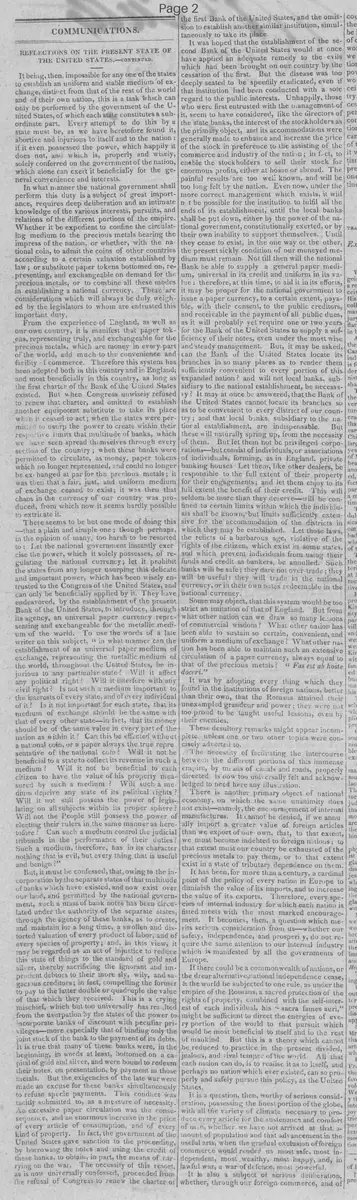
COMMUNICATIONS.
REFLECTIONS ON THE PRESENT STATE OF THE UNITED STATES.—CONTINUED.
It being, then, impossible for any one of the states to establish an uniform and stable medium of exchange, distinct from that of the rest of the world and of their own nation, this is a task which can only be performed by the government of the United States, of which each state constitutes a subordinate part. Every attempt to do this by a state must be, as we have heretofore found it, abortive and injurious to itself and to the nation: if it even possessed the power, which happily it does not, and which is, properly and wisely, solely conferred on the government of the nation, which alone can exert it beneficially for the general convenience and interests.
In what manner the national government shall perform this duty is a subject of great importance, requires deep deliberation and an intimate knowledge of the various interests, pursuits, and relations of the different portions of the empire. Whether it be expedient to confine the circulating medium to the precious metals bearing the impress of the nation, or whether, with the national coin, to admit the coins of other countries according to a certain valuation established by law; or substitute paper tokens bottomed on, representing, and exchangeable on demand for the precious metals, or to combine all these modes in establishing a national currency. These are considerations which will always be duly weighed by the legislators to whom are entrusted this important duty.
From the experience of England, as well as our own country, it is manifest that paper tokens, representing truly, and exchangeable for the precious metals, which are money in every part of the world, add much to the convenience and facility of commerce. Therefore this system has been adopted both in this country and in England; and most beneficially in this country, as long as the first charter of the Bank of the United States existed. But when Congress unwisely refused to renew that charter, and omitted to establish another equipotent substitute to take its place when it ceased to act; when the states were permitted to usurp the power to create within their respective limits that multitude of banks, which we have seen spread themselves through every section of the country; when these banks were permitted to circulate, as money, paper tokens which no longer represented, and could no longer be exchanged at par for the precious metals; it was then that a fair, just, and uniform medium of exchange ceased to exist; it was then that chaos in the currency of our country was produced, from which now it seems hardly possible to extricate it.
There seems to be but one mode of doing this—that a plain and simple one; though perhaps, in the opinion of many, too harsh to be resorted to: Let the national government instantly exercise the power, which it solely possesses, of regulating the national currency; let it prohibit the states from any longer usurping this delicate and important power, which has been wisely entrusted to the Congress of the United States, and can only be beneficially applied by it. They have endeavored, by the establishment of the present Bank of the United States, to introduce, through its agency, an universal paper currency representing and exchangeable for the metallic medium of the world. To use the words of a late writer on this subject, "in what manner can the establishment of an universal paper medium of exchange, representing the metallic medium of the world, throughout the United States, be injurious to any particular state? Will it affect any political right? Will it interfere with any civil right? Is not such a medium important to the interests of every state, and of every individual of it? Is it not important for each state, that its medium of exchange should be the same with that of every other state—in fact, that its money should be of the same value in every part of the nation as within it? Can this be effected without a national coin, or a paper always the true representative of the national coin? Will it not be beneficial to a state to collect its revenue in such a medium? Will it not be beneficial to each citizen to have the value of his property measured by such a medium? Will such a medium deprive any state of its political rights? Will it not still possess the power of legislating on all subjects within its proper sphere? Will not the People still possess the power of electing their rulers in the same manner as heretofore? Can such a medium control the judicial tribunals in the performance of their duties? Such a medium, therefore, has in its character nothing that is evil, but every thing that is useful and benign?"
But, it must be confessed, that, owing to the incorporation by the separate states of that multitude of banks which have existed, and now exist over our land, and permitted by the national government, such a mass of bank notes has been circulated under the authority of the separate states, through the agency of these banks, as to create, and maintain for a long time, a swollen and distorted valuation of every product of labor, and of every species of property; and, in this view, it may be regarded as an act of injustice to reduce this state of things to the standard of gold and silver, thereby sacrificing the ignorant and imprudent debtors to their more sly, wily, and sagacious creditors; in fact, compelling the former to pay to the latter double or quadruple the value of that which they received. This is a crying mischief, which but too universally has resulted from the usurpation by the states of the power to incorporate banks of discount with peculiar privileges—more especially that of binding only the joint stock of the bank to the payment of its debts.
It is true that many of these banks were, in the beginning, in words at least, bottomed on a capital of gold and silver, and were bound to redeem their notes, on presentation, by payment in those metals. But the exigencies of the late war were made an excuse for these banks simultaneously to refuse specie payments. This conduct was tacitly submitted to, as a measure of necessity. An excessive paper circulation was the consequence, and an enormous increase in the price of every article of consumption, and of every kind of property. In fact, the government of the United States gave sanction to the proceeding, by borrowing the notes and using the credit of these banks, to obtain, in part, the means of carrying on the war. The necessity of this resort, as is now universally confessed, proceeded from the refusal of Congress to renew the charter of the first Bank of the United States, and the omission to establish another similar institution, simultaneously to take its place.
It was hoped that the establishment of the second Bank of the United States would at once have applied an adequate remedy to the evils which had been brought on our country by the cessation of the first. But the disease was too deeply seated to be speedily eradicated, even if that institution had been conducted with a sole regard to the public interests. Unhappily, those who were first entrusted with the management of it, seem to have considered, like the directors of the state banks, the interest of the stockholders as the primary object, and its accommodations were generally made to enhance and increase the price of the stock in preference to the assisting of the commerce and industry of the nation; in fact, to enable the stockholders to sell their stock for enormous profits, either at home or abroad. The painful results are too well known, and will be too long felt by the nation. Even now, under the more correct management which exists, it will not be possible for the institution to fulfil all the ends of its establishment, until the local banks shall be put down, either by the power of the national government, constitutionally exerted, or by their own inability to support themselves. Until they cease to exist, in the one way or the other, the present sickly condition of our moneyed medium must remain. Not till then will the national Bank be able to supply a general paper medium, universal in its credit and uniform in its value: therefore, at this time, to aid it in its efforts, it may be proper for the national government to issue a paper currency, to a certain extent, payable, with their consent, to the public creditors, and receivable in the payment of all public dues, as it will probably yet require one or two years for the Bank of the United States to supply a sufficiency of their notes, even under the most wise and steady management. But, it may be asked, can the Bank of the United States locate its branches in so many places as to render them sufficiently convenient to every portion of this expanded nation? and will not local banks, subsidiary to the national establishment, be necessary? It may at once be answered, that the Bank of the United States cannot locate its branches so as to be convenient to every district of our country; and that local banks, subsidiary to the national establishment, are indispensable. But these will naturally spring up, from the necessity of them. But let them not be privileged corporations—but consist of individuals, or associations of individuals, forming, as in England, private banking houses. Let them, like other dealers, be responsible to the full extent of their property for their engagements; and let them enjoy to its full extent the benefit of their credit. This will seldom be more than they deserve—will be confined to certain limits within which the individuals shall be known, but limits sufficiently extensive for the accommodation of the districts in which they may be established. Let those laws, the relicts of a barbarous age, violative of the rights of the citizen, which exist in some states, and which prevent individuals from using their funds and credit as bankers, be annulled. Such banks will be safe; they dare not over-trade; they will be useful: they will trade in the national currency, or in their own notes redeemable in the national currency.
Some may object, that this system would be too strict an imitation of that of England. But from what other nation can we draw so many lessons of commercial wisdom? What other nation has been able to sustain so certain, convenient, and uniform a medium of exchange? What other nation has been able to maintain such an extensive circulation of a paper currency, always equal to that of the precious metals? "Fas est ab hoste doceri."
It was by adopting every thing which they found in the institutions of foreign nations, better than their own, that the Romans attained their unexampled grandeur and power; they were not too proud to be taught useful lessons, even by their enemies.
These desultory remarks might appear incomplete, unless one or two other topics were concisely adverted to.
The necessity of facilitating the intercourse between the different portions of this immense empire, by means of canals and roads, properly directed is now too universally felt and acknowledged to need here any illustration.
There is another primary object of national economy, on which the same unanimity does not exist—namely, the encouragement of internal manufactures. It cannot be denied, if we annually import a greater value of foreign articles than we export of our own, that, to that extent, we must become indebted to foreign nations; to that extent must our country be exhausted of the precious metals to pay them, or to that extent exist in a state of tributary dependence on them.
It has been, for more than a century, a cardinal point of the policy of every nation in Europe to diminish the value of its imports, and to increase the value of its exports. Therefore, every species of internal industry for which each nation is fitted meets with the most marked encouragement. It becomes, then, a question which merits serious consideration from us—whether our safety, independence, and prosperity, do not require the same attention to our internal industry which is manifested by all the governments of Europe.
If there could be a commonwealth of nations, or the drear alternative, national independence cease, & the world be subjected to one rule, as under the empire of the Romans, a sacred protection of the rights of property, combined with the self-interest of each individual, his "sacra fames auri," might be sufficient to direct the energies of every portion of the world to that pursuit which would be most beneficial to itself and to the rest of mankind. But this is a theory which cannot be reduced to practice in the present divided, jealous, and rival temper of the world. All that each nation can do, is to realise it as to itself, and perhaps no nation which ever existed, can so properly and safely pursue this policy, as the United States.
It is a question, then, worthy of serious consideration, possessing the finest portion of the globe, with all the variety of climate necessary to produce every article for the sustenance and comfort of man, whether we have not arrived at that amount of population and that advancement in the useful arts, when the gradual exclusion of foreign commerce would render us most safe, most independent, most wealthy, most happy, and, in lawful war, a war of defence, most powerful.
It is also a subject of serious deliberation, whether, through our foreign commerce, and of course, our intercourse with foreign nations, all their opinions, habits, customs, views, may not be introduced into our land, and prove the grave of our liberty, as they have of that of the old world? By such a gradual exclusion, would we not also introduce, by immigrants from the nations of Europe, all the arts necessary to our power and to our comfort, and these immigrants would settle so gradually amongst us as to receive, and not to give, the manners to our country. The time has arrived when it will be necessary to consider these questions. And unless permanent measures shall now be adopted, to consolidate the Union of these states, by a connection of the parts founded on mutual interests, we can expect nothing but a speedy dismemberment of this empire; and that the different portions of it will fall first a prey to anarchy, then to despotism; and that we shall thus travel the road of preceding nations, to ruin and slavery, and from one happy and united people, be divided into distinct, rival and hostile communities.
REFLECTIONS ON THE PRESENT STATE OF THE UNITED STATES.—CONTINUED.
It being, then, impossible for any one of the states to establish an uniform and stable medium of exchange, distinct from that of the rest of the world and of their own nation, this is a task which can only be performed by the government of the United States, of which each state constitutes a subordinate part. Every attempt to do this by a state must be, as we have heretofore found it, abortive and injurious to itself and to the nation: if it even possessed the power, which happily it does not, and which is, properly and wisely, solely conferred on the government of the nation, which alone can exert it beneficially for the general convenience and interests.
In what manner the national government shall perform this duty is a subject of great importance, requires deep deliberation and an intimate knowledge of the various interests, pursuits, and relations of the different portions of the empire. Whether it be expedient to confine the circulating medium to the precious metals bearing the impress of the nation, or whether, with the national coin, to admit the coins of other countries according to a certain valuation established by law; or substitute paper tokens bottomed on, representing, and exchangeable on demand for the precious metals, or to combine all these modes in establishing a national currency. These are considerations which will always be duly weighed by the legislators to whom are entrusted this important duty.
From the experience of England, as well as our own country, it is manifest that paper tokens, representing truly, and exchangeable for the precious metals, which are money in every part of the world, add much to the convenience and facility of commerce. Therefore this system has been adopted both in this country and in England; and most beneficially in this country, as long as the first charter of the Bank of the United States existed. But when Congress unwisely refused to renew that charter, and omitted to establish another equipotent substitute to take its place when it ceased to act; when the states were permitted to usurp the power to create within their respective limits that multitude of banks, which we have seen spread themselves through every section of the country; when these banks were permitted to circulate, as money, paper tokens which no longer represented, and could no longer be exchanged at par for the precious metals; it was then that a fair, just, and uniform medium of exchange ceased to exist; it was then that chaos in the currency of our country was produced, from which now it seems hardly possible to extricate it.
There seems to be but one mode of doing this—that a plain and simple one; though perhaps, in the opinion of many, too harsh to be resorted to: Let the national government instantly exercise the power, which it solely possesses, of regulating the national currency; let it prohibit the states from any longer usurping this delicate and important power, which has been wisely entrusted to the Congress of the United States, and can only be beneficially applied by it. They have endeavored, by the establishment of the present Bank of the United States, to introduce, through its agency, an universal paper currency representing and exchangeable for the metallic medium of the world. To use the words of a late writer on this subject, "in what manner can the establishment of an universal paper medium of exchange, representing the metallic medium of the world, throughout the United States, be injurious to any particular state? Will it affect any political right? Will it interfere with any civil right? Is not such a medium important to the interests of every state, and of every individual of it? Is it not important for each state, that its medium of exchange should be the same with that of every other state—in fact, that its money should be of the same value in every part of the nation as within it? Can this be effected without a national coin, or a paper always the true representative of the national coin? Will it not be beneficial to a state to collect its revenue in such a medium? Will it not be beneficial to each citizen to have the value of his property measured by such a medium? Will such a medium deprive any state of its political rights? Will it not still possess the power of legislating on all subjects within its proper sphere? Will not the People still possess the power of electing their rulers in the same manner as heretofore? Can such a medium control the judicial tribunals in the performance of their duties? Such a medium, therefore, has in its character nothing that is evil, but every thing that is useful and benign?"
But, it must be confessed, that, owing to the incorporation by the separate states of that multitude of banks which have existed, and now exist over our land, and permitted by the national government, such a mass of bank notes has been circulated under the authority of the separate states, through the agency of these banks, as to create, and maintain for a long time, a swollen and distorted valuation of every product of labor, and of every species of property; and, in this view, it may be regarded as an act of injustice to reduce this state of things to the standard of gold and silver, thereby sacrificing the ignorant and imprudent debtors to their more sly, wily, and sagacious creditors; in fact, compelling the former to pay to the latter double or quadruple the value of that which they received. This is a crying mischief, which but too universally has resulted from the usurpation by the states of the power to incorporate banks of discount with peculiar privileges—more especially that of binding only the joint stock of the bank to the payment of its debts.
It is true that many of these banks were, in the beginning, in words at least, bottomed on a capital of gold and silver, and were bound to redeem their notes, on presentation, by payment in those metals. But the exigencies of the late war were made an excuse for these banks simultaneously to refuse specie payments. This conduct was tacitly submitted to, as a measure of necessity. An excessive paper circulation was the consequence, and an enormous increase in the price of every article of consumption, and of every kind of property. In fact, the government of the United States gave sanction to the proceeding, by borrowing the notes and using the credit of these banks, to obtain, in part, the means of carrying on the war. The necessity of this resort, as is now universally confessed, proceeded from the refusal of Congress to renew the charter of the first Bank of the United States, and the omission to establish another similar institution, simultaneously to take its place.
It was hoped that the establishment of the second Bank of the United States would at once have applied an adequate remedy to the evils which had been brought on our country by the cessation of the first. But the disease was too deeply seated to be speedily eradicated, even if that institution had been conducted with a sole regard to the public interests. Unhappily, those who were first entrusted with the management of it, seem to have considered, like the directors of the state banks, the interest of the stockholders as the primary object, and its accommodations were generally made to enhance and increase the price of the stock in preference to the assisting of the commerce and industry of the nation; in fact, to enable the stockholders to sell their stock for enormous profits, either at home or abroad. The painful results are too well known, and will be too long felt by the nation. Even now, under the more correct management which exists, it will not be possible for the institution to fulfil all the ends of its establishment, until the local banks shall be put down, either by the power of the national government, constitutionally exerted, or by their own inability to support themselves. Until they cease to exist, in the one way or the other, the present sickly condition of our moneyed medium must remain. Not till then will the national Bank be able to supply a general paper medium, universal in its credit and uniform in its value: therefore, at this time, to aid it in its efforts, it may be proper for the national government to issue a paper currency, to a certain extent, payable, with their consent, to the public creditors, and receivable in the payment of all public dues, as it will probably yet require one or two years for the Bank of the United States to supply a sufficiency of their notes, even under the most wise and steady management. But, it may be asked, can the Bank of the United States locate its branches in so many places as to render them sufficiently convenient to every portion of this expanded nation? and will not local banks, subsidiary to the national establishment, be necessary? It may at once be answered, that the Bank of the United States cannot locate its branches so as to be convenient to every district of our country; and that local banks, subsidiary to the national establishment, are indispensable. But these will naturally spring up, from the necessity of them. But let them not be privileged corporations—but consist of individuals, or associations of individuals, forming, as in England, private banking houses. Let them, like other dealers, be responsible to the full extent of their property for their engagements; and let them enjoy to its full extent the benefit of their credit. This will seldom be more than they deserve—will be confined to certain limits within which the individuals shall be known, but limits sufficiently extensive for the accommodation of the districts in which they may be established. Let those laws, the relicts of a barbarous age, violative of the rights of the citizen, which exist in some states, and which prevent individuals from using their funds and credit as bankers, be annulled. Such banks will be safe; they dare not over-trade; they will be useful: they will trade in the national currency, or in their own notes redeemable in the national currency.
Some may object, that this system would be too strict an imitation of that of England. But from what other nation can we draw so many lessons of commercial wisdom? What other nation has been able to sustain so certain, convenient, and uniform a medium of exchange? What other nation has been able to maintain such an extensive circulation of a paper currency, always equal to that of the precious metals? "Fas est ab hoste doceri."
It was by adopting every thing which they found in the institutions of foreign nations, better than their own, that the Romans attained their unexampled grandeur and power; they were not too proud to be taught useful lessons, even by their enemies.
These desultory remarks might appear incomplete, unless one or two other topics were concisely adverted to.
The necessity of facilitating the intercourse between the different portions of this immense empire, by means of canals and roads, properly directed is now too universally felt and acknowledged to need here any illustration.
There is another primary object of national economy, on which the same unanimity does not exist—namely, the encouragement of internal manufactures. It cannot be denied, if we annually import a greater value of foreign articles than we export of our own, that, to that extent, we must become indebted to foreign nations; to that extent must our country be exhausted of the precious metals to pay them, or to that extent exist in a state of tributary dependence on them.
It has been, for more than a century, a cardinal point of the policy of every nation in Europe to diminish the value of its imports, and to increase the value of its exports. Therefore, every species of internal industry for which each nation is fitted meets with the most marked encouragement. It becomes, then, a question which merits serious consideration from us—whether our safety, independence, and prosperity, do not require the same attention to our internal industry which is manifested by all the governments of Europe.
If there could be a commonwealth of nations, or the drear alternative, national independence cease, & the world be subjected to one rule, as under the empire of the Romans, a sacred protection of the rights of property, combined with the self-interest of each individual, his "sacra fames auri," might be sufficient to direct the energies of every portion of the world to that pursuit which would be most beneficial to itself and to the rest of mankind. But this is a theory which cannot be reduced to practice in the present divided, jealous, and rival temper of the world. All that each nation can do, is to realise it as to itself, and perhaps no nation which ever existed, can so properly and safely pursue this policy, as the United States.
It is a question, then, worthy of serious consideration, possessing the finest portion of the globe, with all the variety of climate necessary to produce every article for the sustenance and comfort of man, whether we have not arrived at that amount of population and that advancement in the useful arts, when the gradual exclusion of foreign commerce would render us most safe, most independent, most wealthy, most happy, and, in lawful war, a war of defence, most powerful.
It is also a subject of serious deliberation, whether, through our foreign commerce, and of course, our intercourse with foreign nations, all their opinions, habits, customs, views, may not be introduced into our land, and prove the grave of our liberty, as they have of that of the old world? By such a gradual exclusion, would we not also introduce, by immigrants from the nations of Europe, all the arts necessary to our power and to our comfort, and these immigrants would settle so gradually amongst us as to receive, and not to give, the manners to our country. The time has arrived when it will be necessary to consider these questions. And unless permanent measures shall now be adopted, to consolidate the Union of these states, by a connection of the parts founded on mutual interests, we can expect nothing but a speedy dismemberment of this empire; and that the different portions of it will fall first a prey to anarchy, then to despotism; and that we shall thus travel the road of preceding nations, to ruin and slavery, and from one happy and united people, be divided into distinct, rival and hostile communities.
What sub-type of article is it?
Economic Policy
Infrastructure
Trade Or Commerce
What keywords are associated?
National Currency
Bank Of The United States
State Banks
Internal Improvements
Manufactures
Foreign Commerce
Economic Independence
Federal Power
What entities or persons were involved?
Bank Of The United States
Congress
State Banks
England
Editorial Details
Primary Topic
Federal Regulation Of National Currency And Promotion Of Economic Independence
Stance / Tone
Advocacy For Strong Federal Control Over Currency And Internal Development To Prevent Disunion
Key Figures
Bank Of The United States
Congress
State Banks
England
Key Arguments
States Cannot Establish Stable Currency; Only Federal Government Can.
Paper Currency Backed By Metals Is Beneficial If Properly Managed.
Failure To Renew First Bank Of The Us Led To Chaotic State Banks And Currency Issues.
Federal Government Must Prohibit State Banks And Regulate National Currency.
Infrastructure Like Canals And Roads Essential For National Unity.
Encourage Internal Manufactures To Reduce Foreign Imports And Dependence.
Imitate Successful English Banking Model Without Privileged Corporations.
Gradual Exclusion Of Foreign Commerce For Safety And Prosperity.
Foreign Influences Via Commerce Threaten Liberty; Immigrants Can Bring Arts Safely.
Without Consolidation, Union Faces Dismemberment, Anarchy, And Despotism.