Thank you for visiting SNEWPapers!
Sign up free
Las Vegas Age
Las Vegas, Clark County, Lincoln County, Nevada
What is this article about?
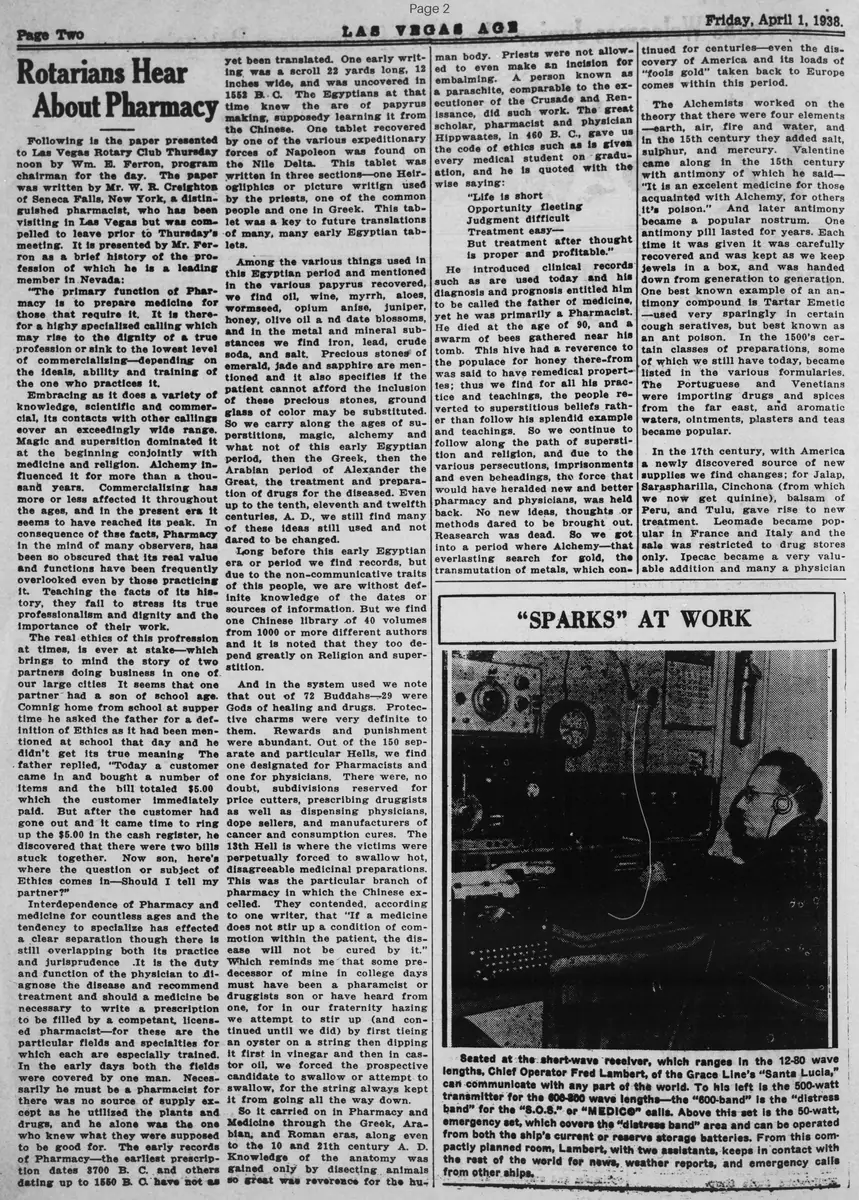
A paper by W. R. Creighton on the history of pharmacy, from ancient Egyptian origins through alchemy, Greek, Arabian, and modern eras, emphasizing ethics and professionalism, presented by Wm. E. Ferron to the Las Vegas Rotary Club.
Merged-components note: Continuation of the Rotarians Hear About Pharmacy story from page 2 to page 3.
Clippings
1 of 2
OCR Quality
Full Text
Rotarians Hear About Pharmacy
Following is the paper presented to Las Vegas Rotary Club Thursday noon by Wm. E. Ferron, program chairman for the day. The paper was written by Mr. W. R. Creighton of Seneca Falls, New York, a distinguished pharmacist, who has been visiting in Las Vegas but was compelled to leave prior to Thursday's meeting. It is presented by Mr. Ferron as a brief history of the profession of which he is a leading member in Nevada:
"The primary function of Pharmacy is to prepare medicine for those that require it. It is therefore a highly specialized calling which may rise to the dignity of a true profession or sink to the lowest level of commercializing—depending on the ideals, ability and training of the one who practices it.
Embracing as it does a variety of knowledge, scientific and commercial, its contacts with other callings cover an exceedingly wide range.
Magic and superstition dominated it at the beginning conjointly with medicine and religion. Alchemy influenced it for more than a thousand years. Commercializing has more or less affected it throughout the ages, and in the present era it seems to have reached its peak. In consequence of these facts, Pharmacy in the mind of many observers, has been so obscured that its real value and functions have been frequently overlooked even by those practicing it. Teaching the facts of its history, they fail to stress its true professionalism and dignity and the importance of their work.
The real ethics of this profession at times, is ever at stake which brings to mind the story of two partners doing business in one of our large cities. It seems that one partner had a son of school age. Coming home from school at supper time he asked the father for a definition of Ethics as it had been mentioned at school that day and he didn't get its true meaning. The father replied, "Today a customer came in and bought a number of items and the bill totaled $5.00 which the customer immediately paid. But after the customer had gone out and it came time to ring up the $5.00 in the cash register, he discovered that there were two bills stuck together. Now son, here's where the question or subject of Ethics comes in—Should I tell my partner?"
Interdependence of Pharmacy and medicine for countless ages and the tendency to specialize has effected a clear separation though there is still overlapping both its practice and jurisprudence. It is the duty and function of the physician to diagnose the disease and recommend treatment and should a medicine be necessary to write a prescription to be filled by a competent, licensed pharmacist for these are the particular fields and specialties for which each are especially trained.
In the early days both the fields were covered by one man. Necessarily he must be a pharmacist for there was no source of supply except as he utilized the plants and drugs, and he alone was the one who knew what they were supposed to be good for. The early records of Pharmacy—the earliest prescription dates 3700 B. C. and others dating up to 1550 B. C.—have not as yet been translated. One early writing was a scroll 22 yards long, 12 inches wide, and was uncovered in 1552 B. C. The Egyptians at that time knew the art of papyrus making, supposedly learning it from the Chinese. One tablet recovered by one of the various expeditionary forces of Napoleon was found on the Nile Delta. This tablet was written in three sections—one Hieroglyphics or picture writing used by the priests, one of the common people and one in Greek. This tablet was a key to future translations of many, many early Egyptian tablets.
Among the various things used in this Egyptian period and mentioned in the various papyrus recovered, we find oil, wine, myrrh, aloes, wormseed, opium anise, juniper, honey, olive oil and date blossoms, and in the metal and mineral substances we find iron, lead, crude soda, and salt. Precious stones of emerald, jade and sapphire are mentioned and it also specifies if the patient cannot afford the inclusion of these precious stones, ground glass of color may be substituted.
So we carry along the ages of superstitions, magic, alchemy and what not of this early Egyptian period, then the Greek, then the Arabian period of Alexander the Great, the treatment and preparation of drugs for the diseased. Even up to the tenth, eleventh and twelfth centuries, A. D. we still find many of these ideas still used and not dared to be changed.
Long before this early Egyptian era or period we find records, but due to the non-communicative traits of this people, we are without definite knowledge of the dates or sources of information. But we find one Chinese library of 40 volumes from 1000 or more different authors and it is noted that they too depended greatly on Religion and superstition.
And in the system used we note that out of 72 Buddhas—29 were Gods of healing and drugs. Protective charms were very definite to them. Rewards and punishment were abundant. Out of the 150 separate and particular Hells, we find one designated for Pharmacists and one for physicians. There were, no doubt, subdivisions reserved for price cutters, prescribing druggists as well as dispensing physicians, dope sellers, and manufacturers of cancer and consumption cures. The 13th Hell is where the victims were perpetually forced to swallow hot, disagreeable medicinal preparations. This was the particular branch of pharmacy in which the Chinese excelled. They contended, according to one writer, that "If a medicine does not stir up a condition of commotion within the patient, the disease will not be cured by it."
Which reminds me that some predecessor of mine in college days must have been a pharmacist or druggist's son or have heard from one, for in our fraternity hazing we attempt to stir up (and continued until we did) by first tying an oyster on a string then dipping it first in vinegar and then in castor oil, we forced the prospective candidate to swallow or attempt to swallow, for the string always kept it from going all the way down.
So it carried on in Pharmacy and Medicine through the Greek, Arabian, and Roman eras, along even to the 10 and 21th century A. D. Knowledge of the anatomy was gained only by dissecting animals so great was reverence for the human body. Priests were not allowed to even make an incision for embalming. A person known as a paraschite, comparable to the executioner of the Crusade and Renaissance, did such work.
The great scholar, pharmacist and physician the code of ethics such as is given Hippocrates, in 460 B. C., gave us every medical student on graduation, and he is quoted with the wise saying:
"Life is short
Opportunity fleeting
Judgment difficult
Treatment easy—
But treatment after thought is proper and profitable."
He introduced clinical records such as are used today and his diagnosis and prognosis entitled him to be called the father of medicine, yet he was primarily a Pharmacist.
He died at the age of 90, and a swarm of bees gathered near his tomb. This hive had a reverence to the populace for honey there-from was said to have remedial properties; thus we find for all his practice and teachings, the people reverted to superstitious beliefs rather than follow his splendid example and teachings. So we continue to follow along the path of superstition and religion, and due to the various persecutions, imprisonments and even beheadings, the force that would have heralded new and better pharmacy and physicians, was held back.
No new ideas, thoughts or methods dared to be brought out. Research was dead.
So we got into a period where Alchemy—that everlasting search for gold, tho transmutation of metals, which continued for centuries even the discovery of America and its loads of "fools gold" taken back to Europe comes within this period.
The Alchemists worked on the theory that there were four elements—earth, air, fire and water, and in the 15th century they added salt, sulphur, and mercury. Valentine came along in the 15th century with antimony of which he said—"It is an excellent medicine for those acquainted with Alchemy, for others it's poison."
And later antimony became a popular nostrum. One antimony pill lasted for years. Each time it was given it was carefully recovered and was kept as we keep jewels in a box, and was handed down from generation to generation.
One best known example of an antimony compound is Tartar Emetic—used very sparingly in certain cough sedatives, but best known as an ant poison.
In the 1500's certain classes of preparations, some of which we still have today, became listed in the various formularies.
The Portuguese and Venetians were importing drugs and spices from the far east, and aromatic waters, ointments, plasters and teas became popular.
In the 17th century, with America a newly discovered source of new supplies we find changes; for Jalap, Sarsaparilla, Cinchona (from which we now get quinine), balsam of Peru, and Tolu, gave rise to new treatment.
Lemonade became popular in France and Italy and the sale was restricted to drug stores only.
Ipecac became a very valuable addition and many a physician
was reputed because of the miraculous cures of dysentery.
Tea, coffee, chocolate were also introduced along with tobacco, although at various times the use of tobacco was barred in public.
New chemicals appeared when Glauber boiled down water from different spirits and found them to contain sodium sulphate and today is still known as Glauber or Glauber's salts. Rochelle Salts was also brought out at this time as well as Epsom.
The first daily newspaper made its appearance in England in 1690 and with it probably patent medicine advertising. Chemistry began to take an active part and its theories, ideas and processes started in evolution in both pharmacy and medicine.
Secrecy, mystery and superstition have been indispensable ingredients of many successful prescriptions and remedies from the early Egyptians to the present time. The evolution of the Nostrum or known as "Patent Medicine" of today, was evolved by physicians of the 17th and 18th century and has today developed into a Frankenstein--in the U. S. A. alone last year more than $200,000,000.00 was spent for such items. This has had its bad effect on both medicine and pharmacy and gave rise to many cults of drugless cures.
In the 19th century pharmaceutical chemistry became a big division of chemistry. The isolation and preparation of the active principles of plants and drugs was an accomplishment and a beginning to the present knowledge of the why's and wherefore's of today.
The tablet and pill, plain, uncoated was introduced; thus the early pharmacist began to give up his old duties and the messy, fussy process gave way to the machine age, and time could be taken out for the present display and commercialization of today.
Louis Pasteur about this time discovered through his advent of the microscope the microscopic forms of life and microbe and bacteria came into being and a factor in dealing with the cause, diagnosis, prescribing and treatment of common use.
Carbonated waters were introduced in 1790 in Geneva, New York, first being made by a mix of soda and tartaric acid; then under pressure by marble dust, or soda and sulphuric acid. Thus began the first exploits of the modern soda fountain.
Percolation, as we know it, became a process in America introduced and used extensively by E. R. Squibb, a pharmacist and physician later, and to this day being the outstanding manufacturing pharmacist and manufacturing company after his death to the medical profession. Yet percolation is as much a process and habit in ethical pharmacy and pharmaceutical practice and manufacturing. U.S.A. of course leads, though there are still some in the medical service who persist in European forms of practice.
In 1906 we saw and are again now, or soon to see, a Food and Drug Law though few changes can be made not effective already. If proper and ethical care were taken by authority and conscience, the pure Food Law answers the purpose.
1914 saw the advent of the Harrison anti narcotic act and we are very conscious of the effects it should have had ages ago, although
What sub-type of article is it?
What themes does it cover?
What keywords are associated?
What entities or persons were involved?
Where did it happen?
Story Details
Key Persons
Location
Las Vegas
Story Details
Overview of pharmacy's evolution from ancient Egyptian and Chinese origins influenced by magic, superstition, and alchemy, through Greek, Arabian, and Roman periods, to modern developments including patent medicines, chemical advancements, and ethical considerations, presented as a brief history.