Thank you for visiting SNEWPapers!
Sign up free
Editorial
April 26, 1954
Trainman News
Indianapolis, Marion County, Indiana
What is this article about?
Editorial criticizes the Eisenhower administration's pro-business policies, including inaction on Taft-Hartley amendments, biased Labor Department evaluation, and financial policies favoring big banks. Highlights Sen. Humphrey's warnings on banking and references historical parallels.
Clipping
OCR Quality
95%
Excellent
Full Text
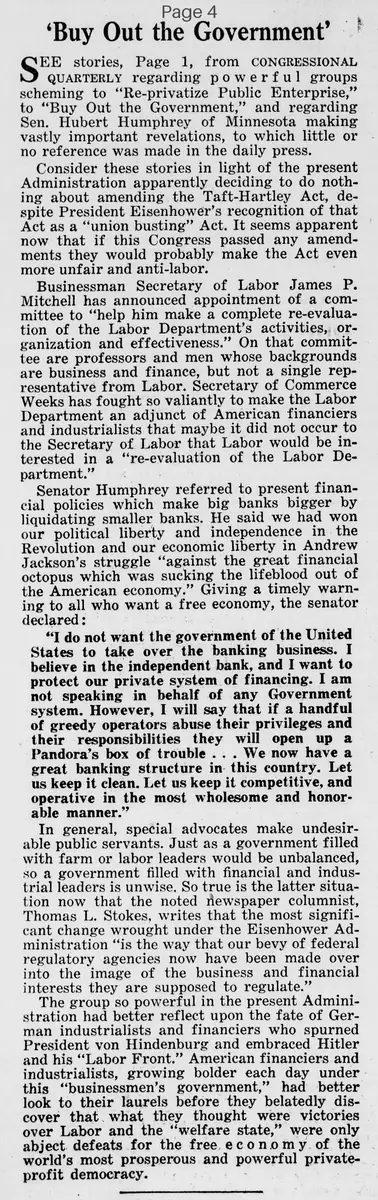
'Buy Out the Government'
Key stories, Page 1, from Congressional
QUARTERLY regarding powerful groups
scheming to "Re-privatize Public Enterprise,"
to "Buy Out the Government," and regarding
Sen. Hubert Humphrey of Minnesota making
vastly important revelations, to which little or
no reference was made in the daily press.
Consider these stories in light of the present
Administration apparently deciding to do nothing
about amending the Taft-Hartley Act, despite
President Eisenhower's recognition of that
Act as a "union busting" Act. It seems apparent
now that if this Congress passed any amendments
they would probably make the Act even
more unfair and anti-labor.
Businessman Secretary of Labor James P.
Mitchell has announced appointment of a committee
to "help him make a complete re-evaluation
of the Labor Department's activities, organization
and effectiveness." On that committee are professors
and men whose backgrounds
are business and finance, but not a single representative
from Labor. Secretary of Commerce
Weeks has fought so valiantly to make the Labor
Department an adjunct of American financiers
and industrialists that maybe it did not occur to
the Secretary of Labor that Labor would be interested
in a "re-evaluation of the Labor Department."
Senator Humphrey referred to present financial
policies which make big banks bigger by
liquidating smaller banks. He said we had won
our political liberty and independence in the
Revolution and our economic liberty in Andrew
Jackson's struggle "against the great financial
octopus which was sucking the lifeblood out of
the American economy." Giving a timely warning
to all who want a free economy, the senator declared:
"I do not want the government of the United
States to take over the banking business. I
believe in the independent bank, and I want to
protect our private system of financing. I am
not speaking in behalf of any Government
system. However, I will say that if a handful
of greedy operators abuse their privileges and
their responsibilities they will open up a
Pandora's box of trouble . . . We now have a
great banking structure in this country. Let
us keep it clean. Let us keep it competitive, and
operative in the most wholesome and honorable
manner."
In general, special advocates make undesirable
public servants. Just as a government filled
with farm or labor leaders would be unbalanced,
so a government filled with financial and industrial
leaders is unwise. So true is the latter situation
now that the noted newspaper columnist,
Thomas L. Stokes, writes that the most significant
change wrought under the Eisenhower Administration
"is the way that our bevy of federal
regulatory agencies now have been made over
into the image of the business and financial
interests they are supposed to regulate."
The group so powerful in the present Administration
had better reflect upon the fate of German
industrialists and financiers who spurned
President von Hindenburg and embraced Hitler
and his "Labor Front." American financiers and
industrialists, growing bolder each day under
this "businessmen's government," had better
look to their laurels before they belatedly discover
that what they thought were victories
over Labor and the "welfare state," were only
abject defeats for the free economy of the
world's most prosperous and powerful private-profit
democracy.
Key stories, Page 1, from Congressional
QUARTERLY regarding powerful groups
scheming to "Re-privatize Public Enterprise,"
to "Buy Out the Government," and regarding
Sen. Hubert Humphrey of Minnesota making
vastly important revelations, to which little or
no reference was made in the daily press.
Consider these stories in light of the present
Administration apparently deciding to do nothing
about amending the Taft-Hartley Act, despite
President Eisenhower's recognition of that
Act as a "union busting" Act. It seems apparent
now that if this Congress passed any amendments
they would probably make the Act even
more unfair and anti-labor.
Businessman Secretary of Labor James P.
Mitchell has announced appointment of a committee
to "help him make a complete re-evaluation
of the Labor Department's activities, organization
and effectiveness." On that committee are professors
and men whose backgrounds
are business and finance, but not a single representative
from Labor. Secretary of Commerce
Weeks has fought so valiantly to make the Labor
Department an adjunct of American financiers
and industrialists that maybe it did not occur to
the Secretary of Labor that Labor would be interested
in a "re-evaluation of the Labor Department."
Senator Humphrey referred to present financial
policies which make big banks bigger by
liquidating smaller banks. He said we had won
our political liberty and independence in the
Revolution and our economic liberty in Andrew
Jackson's struggle "against the great financial
octopus which was sucking the lifeblood out of
the American economy." Giving a timely warning
to all who want a free economy, the senator declared:
"I do not want the government of the United
States to take over the banking business. I
believe in the independent bank, and I want to
protect our private system of financing. I am
not speaking in behalf of any Government
system. However, I will say that if a handful
of greedy operators abuse their privileges and
their responsibilities they will open up a
Pandora's box of trouble . . . We now have a
great banking structure in this country. Let
us keep it clean. Let us keep it competitive, and
operative in the most wholesome and honorable
manner."
In general, special advocates make undesirable
public servants. Just as a government filled
with farm or labor leaders would be unbalanced,
so a government filled with financial and industrial
leaders is unwise. So true is the latter situation
now that the noted newspaper columnist,
Thomas L. Stokes, writes that the most significant
change wrought under the Eisenhower Administration
"is the way that our bevy of federal
regulatory agencies now have been made over
into the image of the business and financial
interests they are supposed to regulate."
The group so powerful in the present Administration
had better reflect upon the fate of German
industrialists and financiers who spurned
President von Hindenburg and embraced Hitler
and his "Labor Front." American financiers and
industrialists, growing bolder each day under
this "businessmen's government," had better
look to their laurels before they belatedly discover
that what they thought were victories
over Labor and the "welfare state," were only
abject defeats for the free economy of the
world's most prosperous and powerful private-profit
democracy.
What sub-type of article is it?
Labor
Economic Policy
Partisan Politics
What keywords are associated?
Taft Hartley Act
Labor Department
Banking Policies
Eisenhower Administration
Business Influence
Economic Liberty
Senator Humphrey
Regulatory Agencies
What entities or persons were involved?
Sen. Hubert Humphrey
President Eisenhower
Secretary Of Labor James P. Mitchell
Secretary Of Commerce Weeks
Thomas L. Stokes
Andrew Jackson
German Industrialists
Hitler
Editorial Details
Primary Topic
Criticism Of Eisenhower Administration's Pro Business Policies Affecting Labor And Economy
Stance / Tone
Strongly Critical Of Business Dominated Government, Supportive Of Labor And Balanced Economy
Key Figures
Sen. Hubert Humphrey
President Eisenhower
Secretary Of Labor James P. Mitchell
Secretary Of Commerce Weeks
Thomas L. Stokes
Andrew Jackson
German Industrialists
Hitler
Key Arguments
Administration Unlikely To Amend Taft Hartley Act Fairly, Potentially Making It More Anti Labor
Labor Department Re Evaluation Committee Lacks Labor Representatives, Dominated By Business Interests
Financial Policies Favor Big Banks By Liquidating Smaller Ones, Echoing Historical Threats To Economic Liberty
Senator Humphrey Warns Against Greedy Bankers Abusing Privileges, Advocating For Clean And Competitive Banking
Government Filled With Financial And Industrial Leaders Is Unbalanced And Unwise
Federal Regulatory Agencies Reshaped To Favor Business Interests They Regulate
Warning To American Financiers: Overreach Could Lead To Defeats For Free Economy, Drawing Parallel To German Industrialists' Embrace Of Hitler