Thank you for visiting SNEWPapers!
Sign up free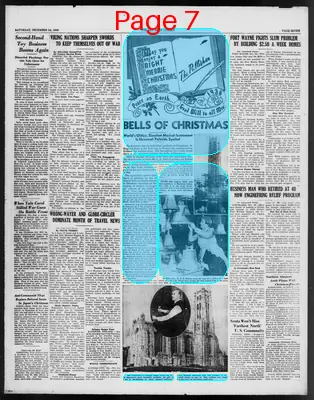
Story
December 24, 1938
The Key West Citizen
Key West, Monroe County, Florida
What is this article about?
Historical article on the universal symbolism of Christmas bells across cultures, tracing their origins from ancient uses to church instruments, with examples like the Liberty Bell and modern carillons in the US.
Clipping
OCR Quality
95%
Excellent
Full Text
THE KEY WEST CITIZEN
BELLS OF CHRISTMAS
World's Oldest, Simplest Musical Instrument Is Universal Yuletide Symbol
Each nation has its individual symbols of Christmas: In England there is the Yule log, in France the candles and in Holland the wooden shoe. But throughout the entire world there is one universal symbol, the bells of Christmas.
This is strange because bells were not associated with the church until at least 400 A. D. when Paulinus, an Italian bishop, installed them in his church. Some bell authorities claim that Pope Sabinianus gave us the first church bells in 604.
The custom has grown until there is perhaps no use of church bells so widely known in Christian countries as the ringing of chimes to herald the advent of the birth of Christ. From huge cathedrals to tiny country churches, from the frozen arctic to the sunny tropics, the bells peal forth each Christmas season an old, old story of "Peace on Earth. Good Will to Men."
America's very national existence is wrapped up in the priceless Liberty bell at Philadelphia, and certainly no one can say that bell music isn't the most democratic music in the world.
In recent years the ancient bell has "grown up" into the carillon, a highly sensitive instrument on which Christmas carols seem to find their most perfect expression. There are now more than 200 of these instruments, 30 of them in the United States. Similar to the carillon, but differing in the number of bells, tuning and arrangement of keyboard, are chimes. Some of the finest chimes hang in English cathedrals and spread the Christmas message each December.
A chapter in the history of bells may be found in the story of almost any creed or culture. First known in the East, they were used by aboriginal people as ornaments. They came down through Grecian days and called Roman citizens to the forums, later summoning early Christians to worship. In the Middle ages they called people to arise, guided the far-away traveler.
Napoleon loved bells so dearly he would not destroy them, while Henry VIII took fiendish delight in destroying them.
Bells have made people laugh and cry, have stirred them to action and lulled them to sleep. Bells are the simplest, yet the most compelling musical instrument in the world and it is fitting that they should toll the universal message of Christmas, of "Peace on Earth. Good Will to Men."
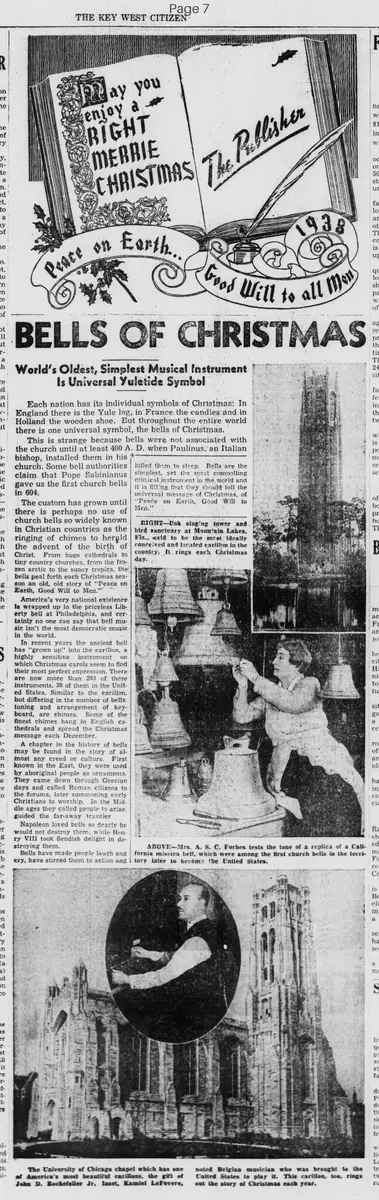
RIGHT—Bok singing tower and bird sanctuary at Mountain Lakes, Fla., said to be the most ideally conceived and located carillon in the country. It rings each Christmas day.
ABOVE—Mrs. A. S. C. Forbes tests the tone of a replica of a California mission bell, which were among the first church bells in the territory later to become the United States.
The University of Chicago chapel which has one of America's most beautiful carillons, the gift of John D. Rockefeller Jr. Inset, Kamiel LeFevere, noted Belgian musician who was brought to the United States to play it. This carillon, too, rings out the story of Christmas each year.
BELLS OF CHRISTMAS
World's Oldest, Simplest Musical Instrument Is Universal Yuletide Symbol
Each nation has its individual symbols of Christmas: In England there is the Yule log, in France the candles and in Holland the wooden shoe. But throughout the entire world there is one universal symbol, the bells of Christmas.
This is strange because bells were not associated with the church until at least 400 A. D. when Paulinus, an Italian bishop, installed them in his church. Some bell authorities claim that Pope Sabinianus gave us the first church bells in 604.
The custom has grown until there is perhaps no use of church bells so widely known in Christian countries as the ringing of chimes to herald the advent of the birth of Christ. From huge cathedrals to tiny country churches, from the frozen arctic to the sunny tropics, the bells peal forth each Christmas season an old, old story of "Peace on Earth. Good Will to Men."
America's very national existence is wrapped up in the priceless Liberty bell at Philadelphia, and certainly no one can say that bell music isn't the most democratic music in the world.
In recent years the ancient bell has "grown up" into the carillon, a highly sensitive instrument on which Christmas carols seem to find their most perfect expression. There are now more than 200 of these instruments, 30 of them in the United States. Similar to the carillon, but differing in the number of bells, tuning and arrangement of keyboard, are chimes. Some of the finest chimes hang in English cathedrals and spread the Christmas message each December.
A chapter in the history of bells may be found in the story of almost any creed or culture. First known in the East, they were used by aboriginal people as ornaments. They came down through Grecian days and called Roman citizens to the forums, later summoning early Christians to worship. In the Middle ages they called people to arise, guided the far-away traveler.
Napoleon loved bells so dearly he would not destroy them, while Henry VIII took fiendish delight in destroying them.
Bells have made people laugh and cry, have stirred them to action and lulled them to sleep. Bells are the simplest, yet the most compelling musical instrument in the world and it is fitting that they should toll the universal message of Christmas, of "Peace on Earth. Good Will to Men."
RIGHT—Bok singing tower and bird sanctuary at Mountain Lakes, Fla., said to be the most ideally conceived and located carillon in the country. It rings each Christmas day.
ABOVE—Mrs. A. S. C. Forbes tests the tone of a replica of a California mission bell, which were among the first church bells in the territory later to become the United States.
The University of Chicago chapel which has one of America's most beautiful carillons, the gift of John D. Rockefeller Jr. Inset, Kamiel LeFevere, noted Belgian musician who was brought to the United States to play it. This carillon, too, rings out the story of Christmas each year.
What sub-type of article is it?
Historical Event
Curiosity
What themes does it cover?
Providence Divine
Moral Virtue
What keywords are associated?
Christmas Bells
Bell History
Carillon
Liberty Bell
Church Bells
Yuletide Symbol
What entities or persons were involved?
Paulinus
Pope Sabinianus
Napoleon
Henry Viii
Mrs. A. S. C. Forbes
John D. Rockefeller Jr.
Kamiel Lefevere
Where did it happen?
Worldwide
Story Details
Key Persons
Paulinus
Pope Sabinianus
Napoleon
Henry Viii
Mrs. A. S. C. Forbes
John D. Rockefeller Jr.
Kamiel Lefevere
Location
Worldwide
Story Details
Explores the history and universal symbolism of Christmas bells, from ancient origins to church adoption around 400-604 AD, their role in Christian tradition, evolution to carillons, and cultural impact across nations and history.