Thank you for visiting SNEWPapers!
Sign up free
Foreign News
December 5, 1820
The Alexandrian: A Commercial, Agricultural And Literary Journal
Alexandria, District Of Columbia
What is this article about?
A clerk in Montreal was tried for stealing paid bank checks from his employers, M'Tavish, M'Gillivrays & Co., but acquitted due to lack of master's possession and checks' lack of value after payment.
Clipping
OCR Quality
95%
Excellent
Full Text
LAW INTELLIGENCE
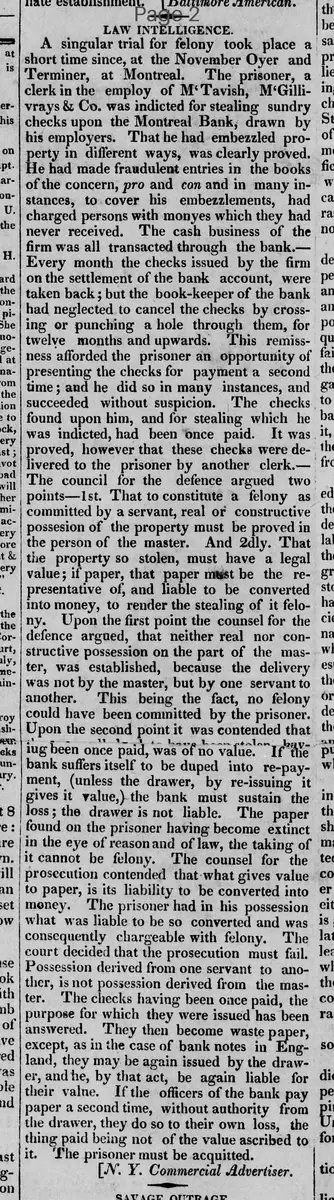
A singular trial for felony took place a short time since, at the November Oyer and Terminer, at Montreal. The prisoner, a clerk in the employ of M'Tavish, M'Gillivrays & Co. was indicted for stealing sundry checks upon the Montreal Bank, drawn by his employers. That he had embezzled property in different ways, was clearly proved. He had made fraudulent entries in the books of the concern, pro and con and in many instances, to cover his embezzlements, had charged persons with moneys which they had never received. The cash business of the firm was all transacted through the bank.-- Every month the checks issued by the firm on the settlement of the bank account, were taken back; but the book-keeper of the bank had neglected to cancel the checks by crossing or punching a hole through them, for twelve months and upwards. This remissness afforded the prisoner an opportunity of presenting the checks for payment a second time; and he did so in many instances, and succeeded without suspicion. The checks found upon him, and for stealing which he was indicted, had been once paid. It was proved, however that these checks were delivered to the prisoner by another clerk.-- The council for the defence argued two points-1st. That to constitute a felony as committed by a servant, real or constructive possession of the property must be proved in the person of the master. And 2dly. That the property so stolen, must have a legal value; if paper, that paper must be the representative of, and liable to be converted into money, to render the stealing of it felony. Upon the first point the counsel for the defence argued, that neither real nor constructive possession on the part of the master, was established, because the delivery was not by the master, but by one servant to another. This being the fact, no felony could have been committed by the prisoner. Upon the second point it was contended that the check having been once paid, was of no value. If the bank suffers itself to be duped into re-payment, (unless the drawer, by re-issuing it gives it value,) the bank must sustain the loss; the drawer is not liable. The paper found on the prisoner having become extinct in the eye of reason and of law, the taking of it cannot be felony. The counsel for the prosecution contended that what gives value to paper, is its liability to be converted into money. The prisoner had in his possession what was liable to be so converted and was consequently chargeable with felony. The court decided that the prosecution must fail. Possession derived from one servant to another, is not possession derived from the master. The checks having been once paid, the purpose for which they were issued has been answered. They then become waste paper, except, as in the case of bank notes in England, they may be again issued by the drawer, and he, by that act, be again liable for their value. If the officers of the bank pay paper a second time, without authority from the drawer, they do so to their own loss, the thing paid being not of the value ascribed to it. The prisoner must be acquitted.
[N. Y. Commercial Advertiser.]
A singular trial for felony took place a short time since, at the November Oyer and Terminer, at Montreal. The prisoner, a clerk in the employ of M'Tavish, M'Gillivrays & Co. was indicted for stealing sundry checks upon the Montreal Bank, drawn by his employers. That he had embezzled property in different ways, was clearly proved. He had made fraudulent entries in the books of the concern, pro and con and in many instances, to cover his embezzlements, had charged persons with moneys which they had never received. The cash business of the firm was all transacted through the bank.-- Every month the checks issued by the firm on the settlement of the bank account, were taken back; but the book-keeper of the bank had neglected to cancel the checks by crossing or punching a hole through them, for twelve months and upwards. This remissness afforded the prisoner an opportunity of presenting the checks for payment a second time; and he did so in many instances, and succeeded without suspicion. The checks found upon him, and for stealing which he was indicted, had been once paid. It was proved, however that these checks were delivered to the prisoner by another clerk.-- The council for the defence argued two points-1st. That to constitute a felony as committed by a servant, real or constructive possession of the property must be proved in the person of the master. And 2dly. That the property so stolen, must have a legal value; if paper, that paper must be the representative of, and liable to be converted into money, to render the stealing of it felony. Upon the first point the counsel for the defence argued, that neither real nor constructive possession on the part of the master, was established, because the delivery was not by the master, but by one servant to another. This being the fact, no felony could have been committed by the prisoner. Upon the second point it was contended that the check having been once paid, was of no value. If the bank suffers itself to be duped into re-payment, (unless the drawer, by re-issuing it gives it value,) the bank must sustain the loss; the drawer is not liable. The paper found on the prisoner having become extinct in the eye of reason and of law, the taking of it cannot be felony. The counsel for the prosecution contended that what gives value to paper, is its liability to be converted into money. The prisoner had in his possession what was liable to be so converted and was consequently chargeable with felony. The court decided that the prosecution must fail. Possession derived from one servant to another, is not possession derived from the master. The checks having been once paid, the purpose for which they were issued has been answered. They then become waste paper, except, as in the case of bank notes in England, they may be again issued by the drawer, and he, by that act, be again liable for their value. If the officers of the bank pay paper a second time, without authority from the drawer, they do so to their own loss, the thing paid being not of the value ascribed to it. The prisoner must be acquitted.
[N. Y. Commercial Advertiser.]
What sub-type of article is it?
Criminal Trial
Embezzlement Case
What keywords are associated?
Montreal Trial
Embezzlement
Bank Checks
Felony Acquittal
Legal Arguments
What entities or persons were involved?
M'tavish, M'gillivrays & Co.
Where did it happen?
Montreal
Foreign News Details
Primary Location
Montreal
Event Date
November Oyer And Terminer
Key Persons
M'tavish, M'gillivrays & Co.
Outcome
prisoner acquitted
Event Details
A clerk employed by M'Tavish, M'Gillivrays & Co. was indicted for stealing previously paid checks on the Montreal Bank. Evidence showed embezzlement through fraudulent book entries and reusing uncancelled checks. Defense argued lack of master's possession and no legal value in paid checks. Court ruled in favor of defense, acquitting the prisoner.