Thank you for visiting SNEWPapers!
Sign up free
Story
September 19, 1868
Sunbury American
Sunbury, Northumberland County, Pennsylvania
What is this article about?
Count Gurowski's diary entries from 1861 and 1864 laud Ulysses S. Grant's simplicity, shyness, decision, and avoidance of Washington corruption, contrasting him with McClellan and praising his soldierly qualities during the Civil War.
Clipping
OCR Quality
95%
Excellent
Full Text
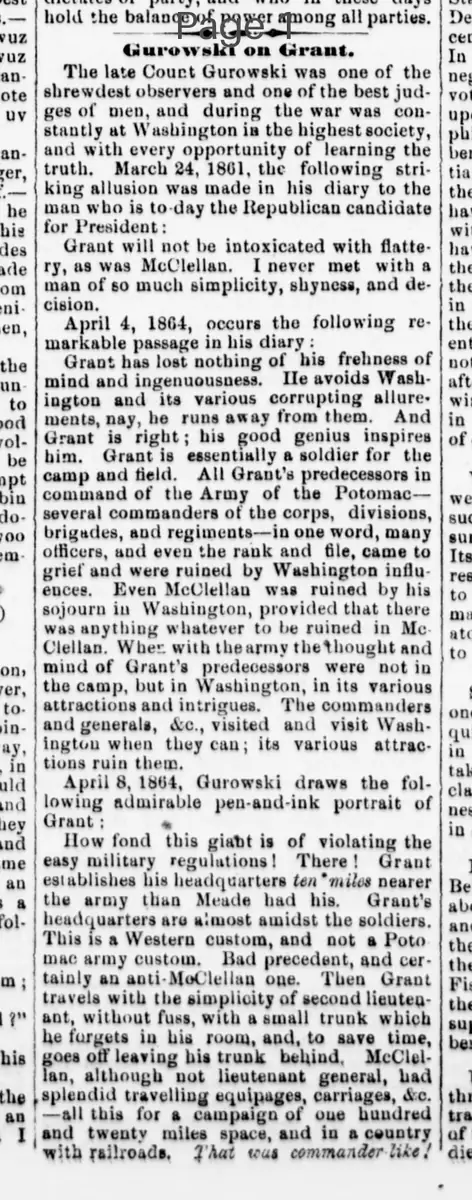
Gurowski on Grant.
The late Count Gurowski was one of the shrewdest observers and one of the best judges of men, and during the war was constantly at Washington in the highest society, and with every opportunity of learning the truth. March 24, 1861, the following striking allusion was made in his diary to the man who is to-day the Republican candidate for President:
Grant will not be intoxicated with flattery, as was McClellan. I never met with a man of so much simplicity, shyness, and decision.
April 4, 1864, occurs the following remarkable passage in his diary :
Grant has lost nothing of his freshness of mind and ingenuousness. He avoids Washington and its various corrupting allurements, nay, he runs away from them. And Grant is right; his good genius inspires him. Grant is essentially a soldier for the camp and field. All Grant's predecessors in command of the Army of the Potomac— several commanders of the corps, divisions, brigades, and regiments—in one word, many officers, and even the rank and file, came to grief and were ruined by Washington influences. Even McClellan was ruined by his sojourn in Washington, provided that there was anything whatever to be ruined in McClellan. Wherewith the army the thought and mind of Grant's predecessors were not in the camp, but in Washington, in its various attractions and intrigues. The commanders and generals, &c., visited and visit Washington when they can; its various attractions ruin them.
April 8, 1864, Gurowski draws the following admirable pen-and-ink portrait of Grant:
How fond this giant is of violating the easy military regulations! There! Grant establishes his headquarters ten miles nearer the army than Meade had his. Grant's headquarters are almost amidst the soldiers. This is a Western custom, and not a Potomac army custom. Bad precedent, and certainly an anti-McClellan one. Then Grant travels with the simplicity of second lieutenant, without fuss, with a small trunk which he forgets in his room, and, to save time, goes off leaving his trunk behind. McClellan, although not lieutenant general, had splendid travelling equipages, carriages, &c. -all this for a campaign of one hundred and twenty miles space, and in a country with railroads. That was commander like.
If Grant fails, then a curse is on his Potomac army. Grant is a soldier to the core, and a genuine democratic (not in the party sense) commander of a democratic army from a democratic people. Further, Grant sends off his wife to the farm of her father, somewhere in Missouri. If all this, to be classical and highfaluting, is not Roman, Cincinnatus, and matron-like, then I am at a loss for precedents and for historical illustrations.
Per contra : McClellan tried as much as he could to ape aristocratic Europe. Brilliant receptions, representations, servility surrounded him, and he thrived on them.
The final question is: Will Grant remain a diamond, resisting the dissolving Washington acids!
April 11, 1864, Grant is again graphically depicted :
From what I can learn of Grant, he is no more afraid to take the responsibility of a million men than of a single company. This is a very praiseworthy feature in his character, and the more so as it is not generated by conceit or indifference.
The late Count Gurowski was one of the shrewdest observers and one of the best judges of men, and during the war was constantly at Washington in the highest society, and with every opportunity of learning the truth. March 24, 1861, the following striking allusion was made in his diary to the man who is to-day the Republican candidate for President:
Grant will not be intoxicated with flattery, as was McClellan. I never met with a man of so much simplicity, shyness, and decision.
April 4, 1864, occurs the following remarkable passage in his diary :
Grant has lost nothing of his freshness of mind and ingenuousness. He avoids Washington and its various corrupting allurements, nay, he runs away from them. And Grant is right; his good genius inspires him. Grant is essentially a soldier for the camp and field. All Grant's predecessors in command of the Army of the Potomac— several commanders of the corps, divisions, brigades, and regiments—in one word, many officers, and even the rank and file, came to grief and were ruined by Washington influences. Even McClellan was ruined by his sojourn in Washington, provided that there was anything whatever to be ruined in McClellan. Wherewith the army the thought and mind of Grant's predecessors were not in the camp, but in Washington, in its various attractions and intrigues. The commanders and generals, &c., visited and visit Washington when they can; its various attractions ruin them.
April 8, 1864, Gurowski draws the following admirable pen-and-ink portrait of Grant:
How fond this giant is of violating the easy military regulations! There! Grant establishes his headquarters ten miles nearer the army than Meade had his. Grant's headquarters are almost amidst the soldiers. This is a Western custom, and not a Potomac army custom. Bad precedent, and certainly an anti-McClellan one. Then Grant travels with the simplicity of second lieutenant, without fuss, with a small trunk which he forgets in his room, and, to save time, goes off leaving his trunk behind. McClellan, although not lieutenant general, had splendid travelling equipages, carriages, &c. -all this for a campaign of one hundred and twenty miles space, and in a country with railroads. That was commander like.
If Grant fails, then a curse is on his Potomac army. Grant is a soldier to the core, and a genuine democratic (not in the party sense) commander of a democratic army from a democratic people. Further, Grant sends off his wife to the farm of her father, somewhere in Missouri. If all this, to be classical and highfaluting, is not Roman, Cincinnatus, and matron-like, then I am at a loss for precedents and for historical illustrations.
Per contra : McClellan tried as much as he could to ape aristocratic Europe. Brilliant receptions, representations, servility surrounded him, and he thrived on them.
The final question is: Will Grant remain a diamond, resisting the dissolving Washington acids!
April 11, 1864, Grant is again graphically depicted :
From what I can learn of Grant, he is no more afraid to take the responsibility of a million men than of a single company. This is a very praiseworthy feature in his character, and the more so as it is not generated by conceit or indifference.
What sub-type of article is it?
Biography
Historical Event
What themes does it cover?
Bravery Heroism
Moral Virtue
Triumph
What keywords are associated?
Grant
Gurowski
Mcclellan
Civil War
Leadership
Washington Corruption
Army Of The Potomac
What entities or persons were involved?
Count Gurowski
Ulysses S. Grant
Mcclellan
Meade
Where did it happen?
Washington And Army Of The Potomac
Story Details
Key Persons
Count Gurowski
Ulysses S. Grant
Mcclellan
Meade
Location
Washington And Army Of The Potomac
Event Date
1861 1864
Story Details
Gurowski's diary praises Grant's simplicity, decision, avoidance of Washington corruption, and soldierly focus, contrasting with McClellan's aristocratic tendencies and ruin by influences.