Thank you for visiting SNEWPapers!
Sign up free
Literary
December 26, 1787
The New York Journal, And Daily Patriotic Register
New York, New York County, New York
What is this article about?
This philosophical essay examines the universal human pursuit of happiness through external means, such as wealth, status, or change in circumstances, across all social classes. It argues that such quests lead to disappointment, as true felicity lies within, illustrated by examples from leisure, business, clergy, military, and nobility. Concludes with intent to continue.
Merged-components note: Continuation of the essay 'ON HAPPINESS' across pages 2 and 3.
Clippings
1 of 2
OCR Quality
98%
Excellent
Full Text
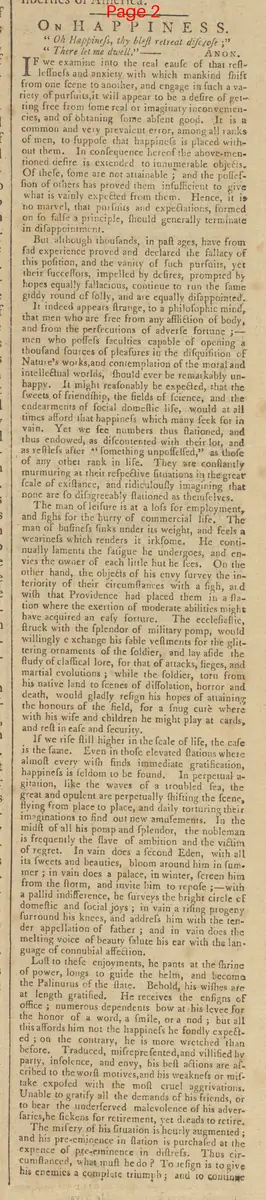
ON HAPPINESS.
"Oh Happiness, thy blest retreat disclose;"
"There let me dwell."—ANON.
If we examine into the real cause of that restlessness and anxiety with which mankind shift from one scene to another, and engage in such a variety of pursuits, it will appear to be a desire of getting free from some real or imaginary inconveniences, and of obtaining some absent good. It is a common and very prevalent error, among all ranks of men, to suppose that happiness is placed without them. In consequence hereof the above-mentioned desire is extended to innumerable objects. Of these, some are not attainable; and the possession of others has proved them insufficient to give what is vainly expected from them. Hence, it is no marvel, that pursuits and expectations, formed on so false a principle, should generally terminate in disappointment. But although thousands, in past ages, have from sad experience proved and declared the fallacy of this position, and the vanity of such pursuits, yet their successors, impelled by desires, prompted by hopes equally fallacious, continue to run the same giddy round of folly, and are equally disappointed. It indeed appears strange, to a philosophic mind, that men who are free from any affliction of body, and from the persecutions of adverse fortune;—men who possess faculties capable of opening a thousand sources of pleasures in the disquisition of Nature's works, and contemplation of the moral and intellectual worlds, should ever be remarkably unhappy. It might reasonably be expected, that the sweets of friendship, the fields of science, and the endearments of social domestic life, would at all times afford that happiness which many seek for in vain. Yet we see numbers thus stationed, and thus endowed, as discontented with their lot, and as restless after "something unpossessed," as those of any other rank in life. They are constantly murmuring at their respective situations in the great scale of existence, and ridiculously imagining that none are so disagreeably stationed as themselves. The man of leisure is at a loss for employment, and sighs for the hurry of commercial life. The man of business sinks under its weight, and feels a weariness which renders it irksome. He continually laments the fatigue he undergoes, and envies the owner of each little hut he sees. On the other hand, the objects of his envy survey the inferiority of their circumstances with a sigh, and with that Providence had placed them in a situation where the exertion of moderate abilities might have acquired an easy fortune. The ecclesiastic, struck with the splendor of military pomp, would willingly exchange his sable vestments for the glittering ornaments of the soldier, and lay aside the study of classical lore, for that of attacks, sieges, and martial evolutions; while the soldier, torn from his native land to scenes of desolation, horror and death, would gladly resign his hopes of attaining the honours of the field, for a snug cure where with his wife and children he might play at cards, and rest in ease and security. If we rise still higher in the scale of life, the case is the same. Even in those elevated stations where almost every wish finds immediate gratification, happiness is seldom to be found. In perpetual agitation, like the waves of a troubled sea, the great and opulent are perpetually shifting the scene, flying from place to place, and daily torturing their imaginations to find out new amusements. In the midst of all his pomp and splendor, the nobleman is frequently the slave of ambition and the victim of regret. In vain does a second Eden, with all its sweets and beauties, bloom around him in summer; in vain does a palace, in winter, screen him from the storm, and invite him to repose;—with a pallid indifference, he surveys the bright circle of domestic and social joys; in vain a rising progeny surround his knees, and address him with the tender appellation of father; and in vain does the melting voice of beauty salute his ear with the language of connubial affection. Lost to these enjoyments, he pants at the shrine of power, longs to guide the helm, and become the Palinurus of the state. Behold, his wishes are at length gratified. He receives the ensigns of office; numerous dependents bow at his levee for the honor of a word, a smile, or a nod; but all this affords him not the happiness he fondly expected; on the contrary, he is more wretched than before. Traduced, misrepresented, and vilified by party, insolence, and envy, his best actions are ascribed to the worst motives, and his weakness or mistake exposed with the most cruel aggravations. Unable to gratify all the demands of his friends, or to bear the undeserved malevolence of his adversaries, he sickens for retirement, yet dreads to retire. The misery of his situation is hourly augmented; and his pre-eminence in station is purchased at the expense of pre-eminence in distress. Thus circumstanced, what must he do? To feign is to give his enemies a complete triumph; and to continue
in office is to suffer the greatest mortification. In this dilemma, he is tossed by a conflict of passions; his tranquillity is sacrificed to pride, and the lust of power : he determines to resist every storm of faction, and, by a persevering magnanimity, to repel the attacks, and defeat the designs of his enemies. He endeavours by every means to strengthen and establish his authority; until, having conquered his shame, in courting some, and extinguished his humanity, in punishing others, he becomes divested of principle, and regardless of reputation. At length, by the united influence of good and bad men, he is chased from the presence of his sovereign; the clamour becomes universal ; he sinks under it, and buries himself in solitude, detesting others, and detested by society.
I grant there is nothing new in the portraits here drawn of the unhappy. Moralists have frequently remarked them, and observation daily points out the originals : but still, in the foregoing hints, there is something which may tend to elucidate the remaining part of this essay.
It is generally supposed, that a man must be happy, when, by his situation in life, and easiness of circumstances, he is on the one hand exempted from the fatigues of business, and on the other, defended by the humility of his wishes from the dangers of ambition. But, enviable as this situation may appear, we see, in numerous instances, that neither a comfortable competency, nor a limited expectation, are able to secure real and lasting felicity. As a proof of this, I will adduce an example :
[To be continued.]
"Oh Happiness, thy blest retreat disclose;"
"There let me dwell."—ANON.
If we examine into the real cause of that restlessness and anxiety with which mankind shift from one scene to another, and engage in such a variety of pursuits, it will appear to be a desire of getting free from some real or imaginary inconveniences, and of obtaining some absent good. It is a common and very prevalent error, among all ranks of men, to suppose that happiness is placed without them. In consequence hereof the above-mentioned desire is extended to innumerable objects. Of these, some are not attainable; and the possession of others has proved them insufficient to give what is vainly expected from them. Hence, it is no marvel, that pursuits and expectations, formed on so false a principle, should generally terminate in disappointment. But although thousands, in past ages, have from sad experience proved and declared the fallacy of this position, and the vanity of such pursuits, yet their successors, impelled by desires, prompted by hopes equally fallacious, continue to run the same giddy round of folly, and are equally disappointed. It indeed appears strange, to a philosophic mind, that men who are free from any affliction of body, and from the persecutions of adverse fortune;—men who possess faculties capable of opening a thousand sources of pleasures in the disquisition of Nature's works, and contemplation of the moral and intellectual worlds, should ever be remarkably unhappy. It might reasonably be expected, that the sweets of friendship, the fields of science, and the endearments of social domestic life, would at all times afford that happiness which many seek for in vain. Yet we see numbers thus stationed, and thus endowed, as discontented with their lot, and as restless after "something unpossessed," as those of any other rank in life. They are constantly murmuring at their respective situations in the great scale of existence, and ridiculously imagining that none are so disagreeably stationed as themselves. The man of leisure is at a loss for employment, and sighs for the hurry of commercial life. The man of business sinks under its weight, and feels a weariness which renders it irksome. He continually laments the fatigue he undergoes, and envies the owner of each little hut he sees. On the other hand, the objects of his envy survey the inferiority of their circumstances with a sigh, and with that Providence had placed them in a situation where the exertion of moderate abilities might have acquired an easy fortune. The ecclesiastic, struck with the splendor of military pomp, would willingly exchange his sable vestments for the glittering ornaments of the soldier, and lay aside the study of classical lore, for that of attacks, sieges, and martial evolutions; while the soldier, torn from his native land to scenes of desolation, horror and death, would gladly resign his hopes of attaining the honours of the field, for a snug cure where with his wife and children he might play at cards, and rest in ease and security. If we rise still higher in the scale of life, the case is the same. Even in those elevated stations where almost every wish finds immediate gratification, happiness is seldom to be found. In perpetual agitation, like the waves of a troubled sea, the great and opulent are perpetually shifting the scene, flying from place to place, and daily torturing their imaginations to find out new amusements. In the midst of all his pomp and splendor, the nobleman is frequently the slave of ambition and the victim of regret. In vain does a second Eden, with all its sweets and beauties, bloom around him in summer; in vain does a palace, in winter, screen him from the storm, and invite him to repose;—with a pallid indifference, he surveys the bright circle of domestic and social joys; in vain a rising progeny surround his knees, and address him with the tender appellation of father; and in vain does the melting voice of beauty salute his ear with the language of connubial affection. Lost to these enjoyments, he pants at the shrine of power, longs to guide the helm, and become the Palinurus of the state. Behold, his wishes are at length gratified. He receives the ensigns of office; numerous dependents bow at his levee for the honor of a word, a smile, or a nod; but all this affords him not the happiness he fondly expected; on the contrary, he is more wretched than before. Traduced, misrepresented, and vilified by party, insolence, and envy, his best actions are ascribed to the worst motives, and his weakness or mistake exposed with the most cruel aggravations. Unable to gratify all the demands of his friends, or to bear the undeserved malevolence of his adversaries, he sickens for retirement, yet dreads to retire. The misery of his situation is hourly augmented; and his pre-eminence in station is purchased at the expense of pre-eminence in distress. Thus circumstanced, what must he do? To feign is to give his enemies a complete triumph; and to continue
in office is to suffer the greatest mortification. In this dilemma, he is tossed by a conflict of passions; his tranquillity is sacrificed to pride, and the lust of power : he determines to resist every storm of faction, and, by a persevering magnanimity, to repel the attacks, and defeat the designs of his enemies. He endeavours by every means to strengthen and establish his authority; until, having conquered his shame, in courting some, and extinguished his humanity, in punishing others, he becomes divested of principle, and regardless of reputation. At length, by the united influence of good and bad men, he is chased from the presence of his sovereign; the clamour becomes universal ; he sinks under it, and buries himself in solitude, detesting others, and detested by society.
I grant there is nothing new in the portraits here drawn of the unhappy. Moralists have frequently remarked them, and observation daily points out the originals : but still, in the foregoing hints, there is something which may tend to elucidate the remaining part of this essay.
It is generally supposed, that a man must be happy, when, by his situation in life, and easiness of circumstances, he is on the one hand exempted from the fatigues of business, and on the other, defended by the humility of his wishes from the dangers of ambition. But, enviable as this situation may appear, we see, in numerous instances, that neither a comfortable competency, nor a limited expectation, are able to secure real and lasting felicity. As a proof of this, I will adduce an example :
[To be continued.]
What sub-type of article is it?
Essay
What themes does it cover?
Moral Virtue
Social Manners
Political
What keywords are associated?
Happiness
Discontentment
Social Ranks
Ambition
Moral Philosophy
External Pursuits
Internal Felicity
What entities or persons were involved?
Anon.
Literary Details
Title
On Happiness.
Author
Anon.
Subject
On The Pursuit And Nature Of Happiness
Key Lines
"Oh Happiness, Thy Blest Retreat Disclose;" "There Let Me Dwell."—Anon.
It Is A Common And Very Prevalent Error, Among All Ranks Of Men, To Suppose That Happiness Is Placed Without Them.
Happiness Is Seldom To Be Found.
His Pre Eminence In Station Is Purchased At The Expense Of Pre Eminence In Distress.
Neither A Comfortable Competency, Nor A Limited Expectation, Are Able To Secure Real And Lasting Felicity.