Thank you for visiting SNEWPapers!
Sign up free
Kentucky Gazette
Lexington, Fayette County, Kentucky
What is this article about?
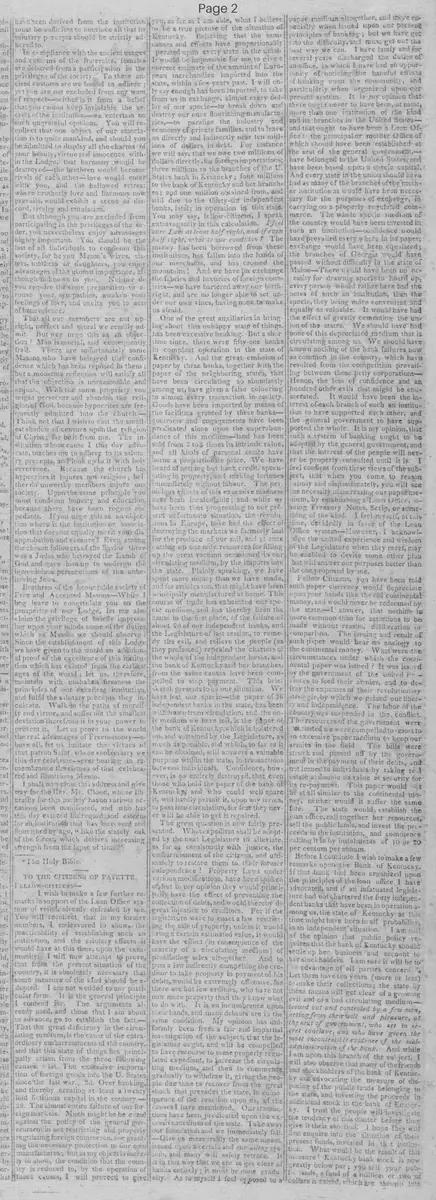
James E. Davis writes to Fayette citizens advocating a Loan Office system to relieve Kentucky's economic woes from excessive foreign imports, over-banking, and lost markets, proposing it as a stable paper medium alternative to failed banks. Dated July 24, 1820.
Merged-components note: Merged continuation of the letter to the citizens of Fayette by James E. Davis across pages 2 and 3; relabeled from 'editorial' to 'letter_to_editor' as it is a signed, addressed opinion piece.
Clippings
1 of 2
OCR Quality
Full Text
FELLOW-CITIZENS—
I wish to make a few further remarks in support of the Loan Office system of relief, already defended by me. You will recollect, that in my former numbers, I endeavored to show the practicability of establishing such an institution, and the salutary effects it would have at this time, upon the community. I will now attempt to prove, that from the present situation of the country, it is absolutely necessary that some measure of the kind should be adopted. I am not wedded to any particular form. It is the general principle I contend for. The arguments already used, and those that I am about to advance, go to establish the fact.—That the great deficiency in the circulating medium, is the cause of the extraordinary embarrassments of the country, and that this state of things has principally arisen from the three following causes. 1st. The excessive importation of foreign goods into the U. States since the last war. 2d. Over banking and thereby creating at least a twenty fold fictitious capital in the country. 3d. The almost entire failure of our foreign markets. Much might be here said against the policy of the general government in not restricting and properly regulating foreign commerce, nor granting the necessary protection to our own manufactures; but as my object is merely to show, the condition that the country is reduced to, by the operation of these causes, I will proceed to give you, as far as I am able, what I believe to be a true picture of the situation of Kentucky. Believing that the same causes and effects have proportionably operated upon every state in the union it would be impossible for me to give a correct estimate of the amount of European merchandize imported into the state, within a few years past. I will only say enough has been imported, to take from us in exchange, almost every dollar of our specie—to break down and destroy our once flourishing manufactories,—to paralyze the industry and economy of private families, and to leave us directly and indirectly near ten millions of dollars in debt. For instance we will say, that we owe two millions of dollars directly, for foreign importations; three millions to the branches of the U. States bank in Kentucky: our millions to the bank of Kentucky and her branches; and one million obtained from, and still due to the thirty-six independent banks, lately in operation in this state. You may say, fellow-citizens, I speak extravagantly in this calculation. I feel sure I am at least half right, and if even half right, what is our condition? The money has been borrowed from these institutions, has fallen into the hands of our merchants, and has crossed the mountains! And we have in exchange the fabrics and luxuries of foreign countries—we have bartered away our birth-right, and are no longer able to set under our own vines, having none to make us afraid.
One of the great auxiliaries in bringing about this unhappy state of things has been excessive banking. But a short time since, there were fifty-one banks in complete operation in the state of Kentucky. And the great emission of paper by these banks, together with the paper of the neighboring states, that have been circulating so abundantly among us, have given a false colouring to almost every transaction in society. Goods have been imported by means of the facilities granted by these banks—contracts and engagements have been predicated alone upon the superabundance of this medium—land has been sold from 3 to 5 times its intrinsic value, and all kinds of personal estate have borne a proportionate price. We have heard of nothing but bank credit, speculating in property, and making fortunes immediately without labour. The pernicious effects of this excessive madness have been incalculable: and while we have been thus progressing to our present unfortunate situation. the revolutions in Europe, have had the effect of destroying the markets we formerly had for the produce of our soil, and at once cutting off our only resources for filling up the great vacuum occasioned in our circulating medium, by the imports into the state. Plainly speaking, we have spent more money than we have made, and for articles too, that might have been principally manufactured at home. This course of trade has exhausted our specie medium, and has thereby been the cause in the first place, of the failure of about 20 of our independent banks, and the Legislature of last session, to remedy the evil, and relieve the people (as they professed) repealed the charters of the whole of the independent banks, and the bank of Kentucky and her branches. From the same causes have been compelled to stop payment. This brief sketch, presents to us our situation. We have lost our specie—the paper of 36 independent banks in the state, has been withdrawn from circulation, and the only medium we have left, is the paper of the bank of Kentucky, which is bolstered up, and sustained by the Legislature, as much as possible, and which, so far as it can be obtained, still answers a valuable purpose within the state, in transactions between individuals. Confidence, however, is so entirely destroyed, that even those who hold the paper of the bank of Kentucky, and who could well spare it, will hardly permit it, upon any terms, to pass into circulation, for fear they never will be able to get it repaired.
The great question is now fairly presented. What expedient shall be adopted by the next Legislature to alleviate, as far as consistently with justice, the embarrassment of the citizens. and ultimately to restore them to their former independence? Property Laws under various modifications, have been spoken of but in my opinion they would principally have the effect of preventing the collection of debts, and would thereby do great injustice to creditors. For if the Legislature were to enact a law restricting the sale of property, unless it would bring a certain estimated value, it would have the effect (in consequence of the scarcity of a circulating medium) of prohibiting sales altogether. And to pass a law indirectly compelling the creditor to take property in payment of his debts, would be extremely offensive, for there are but few creditors, who have not now more property than they know what to do with. It is an incumbrance upon their hands, and many debtors are in the same condition. My opinion has uniformly been from a fair and impartial investigation of the subject, that the legislature ought, and will be compelled to have recourse to some properly regulated expedient, to increase the circulating medium, and then to commence gradually to withdraw it, giving the people due time to recover from the great shock that pervades the state, in consequence of the reaction upon us, of the causes I have mentioned. Our transactions have been predicated upon the excessive medium of the state. Take away our foundation and we immediately fall.—Give us measurably the same means, issued upon a certain and curtailing system, and many will safely retrace. It is in this way that we are to get clear of banks entirely; it must be done gradually. As to myself I feel opposed to a paper medium altogether, and more especially when issued upon our present principles of banking; but we have got into the difficulty, and must get out the best way we can. I have lately and for several years discharged the duties of an office, in which I have had an opportunity of noticing the baneful effects of banking upon the community, and particularly when organized upon our present system. It is my opinion that there ought never to have been, at most more than one institution of the kind and its branches in the United States—and that ought to have been a Loan Office: the principal or mother Office of which should have been established at the seat of the general government,—have belonged to the United States, and have been based upon a specie capital. And every state in the union should have had as many of the branches of the mother institution as would have been necessary for the purposes of exchange, in carrying on a properly regulated commerce. The whole specie medium of the country would have been invested in such an institution—confidence would have prevailed every where in its paper; exchange would have been equalized; the branches of Georgia would have passed without difficulty in the state of Maine—There would have been no necessity for drawing specie to hoard up, every person would rather have had the notes of such an institution, than the specie, they being more convenient and equally as valuable. It would have had the effect of greatly cementing the union of the states. We should have had none of this depreciated medium that is circulating among us. We should have known nothing of the bank failures now so common in the country, which have resulted from the competition prevailing between those petty corporations—Hence, the loss of confidence and a hundred other evils that might be enumerated. It would have been the interest of each branch of such an institution to have supported each other, and the general government to have supported the whole. It is my opinion, that such a system of banking ought to be adopted by the general government, and that the interest of the people will never be properly consulted until it is. I feel confident from these views of the subject, that when you come to reason calmly and dispassionately, you will see the necessity of increasing our paper medium, by establishing a Loan Office, issuing Treasury Notes, Scrip, or something of the kind. I feel myself, at this time, decidedly in favor of the Loan Office system—However, I acknowledge the united experience and wisdom of the Legislature when they meet, may be enabled to devise some other plan that will answer our purposes better than the one proposed by me.
Fellow Citizens, you have been told such paper currency would depreciate upon your hands like the old continental money, and would never be redeemed by the state.—I answer, that nothing is more common than for assertions to be made without reason, deliberation or comparison. The issuing and result of such paper would bear no analogy to the continental money. What were the circumstances under which the continental paper was issued? It was issued by the government of the united Provinces to feed their armies, and to defray the expenses of their revolutionary struggle, by which we gained our liberty and independence. The labor of the country was suspended in the conflict. The resources of the government were exhausted we were compelled to resort to an excessive paper medium to keep our armies in the field The bills were struck and passed off by the government in the payment of their debts, and not loaned to individuals by taking real estate at double its value as security for its re-payment. This paper would not be at all similar to the continental money, neither would it suffer the same fate. The state would establish the loan office, call together her resources, sell the public lands, and invest the proceeds in the institution, and commence calling it in by instalments of 10 or 20 per centum per annum.
Before I conclude I wish to make a few remarks upon the Bank of Kentucky. If that bank had been organized upon the principles of the loan office I have advocated, and if an infatuated legislature had not chartered the forty independent banks that have been in operation among us, the state of Kentucky at this time might have been in all probability, in an independent situation. I am still of the opinion that public policy requires that the bank of Kentucky should settle up her business and account to her stock holders. I am sure it will be to the advantage of all parties concerned. Let them have ten years (more or less) to make their collections; the state by these means will get clear of a growing evil and of a bad circulating medium—issued out and controlled by a few men, acting from their will and pleasure, at the seat of government, who set in secret conclave, and who have given the most incontestible evidence of the mal-administration of the bank. And while I am upon this branch of the subject, I will also observe that many of the friends and stockholders of the bank of Kentucky are advocating the measure of disposing of the public lands belonging to the state, and investing the proceeds in additional stock in the bank of Kentucky. I trust the people will investigate the tendency of this matter before they give it their sanction. I hope they will first enquire into the situation of their present funds, invested in that institution. What would be the result of this measure? Kentucky bank stock is now greatly below par; you sell your public lands, a fund of a million or two of dollars is raised, which are thrown into the stock of the bank, and the value of the whole is diminished in the same proportion.
the empty vaults of the bank of Kentucky at the rate of $100 to the share; it is immediately reduced to a proportionate value with the present stock.—It would have the tendency it is true, of raising the present stock; but is it just that the new and unembarrassed funds of the state, raised in this way, should be blended and become contaminated with the old stock of the bank of Kentucky? It is thought that the stock which the state holds at this time in the bank might as well be out; and I have but little doubt, that when the bank shall finally close her business, if there are any losses that the state will have to sustain them.—The state is a clumsy creature and cannot keep pace with the individual stockholders, She has never yet obtained a discount upon her stock. I hope the people of Kentucky will not be gulled by the advocates of this measure—let them look before they leap. I say again, let the bank of Kentucky settle up her business, and if we are to have a paper medium that is not immediately redeemed in specie, let us have it by the will and consent of the people; let the interest for the money so loaned be paid into the treasury, and disbursed for the benefit of all.
Fellow citizens,
I have given you my sentiments as extensively as convenient in this way. You have them before you under my own hand. I regret that my private engagements have not permitted me to intermingle with you more than I have. I can assure you that although I have but seldom paid you my personal addresses, I have as much zeal for your welfare as if I had, and will serve you as faithfully—I also regret that I have had to contend with the united efforts of eight or ten candidates, who have been opposed to my sentiments. I do not pretend to say that my system of relief would be a sovereign remedy for the times, and suit every man's case. The people must not expect too much from legislation. It would be but a measure of policy which I think ought to be adopted, and which I hope will be adopted. It would have the effect of doing much immediate good: but our ultimate redemption will depend upon the cultivation of our soil, encouraging of our manufactures, and attention to our domestic economy.
JAMES E. DAVIS.
July 24, 1820.
What sub-type of article is it?
What themes does it cover?
What keywords are associated?
What entities or persons were involved?
Letter to Editor Details
Author
James E. Davis
Recipient
To The Citizens Of Fayette, Fellow Citizens
Main Argument
the loan office system is necessary to increase the circulating medium and relieve economic embarrassments in kentucky caused by excessive foreign imports, over-banking, and market failures, providing a stable alternative to failed banks and critiquing the bank of kentucky.
Notable Details