Thank you for visiting SNEWPapers!
Sign up free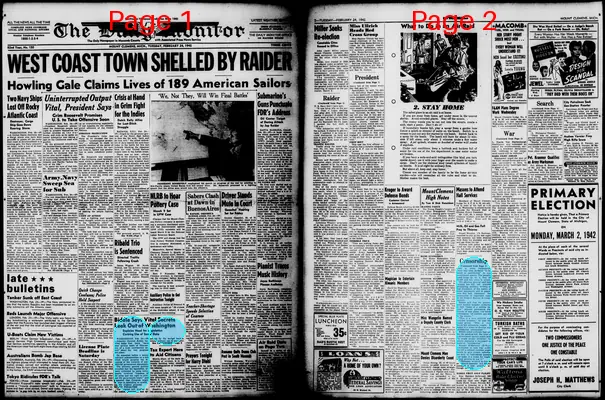
The Daily Monitor
Mount Clemens, Macomb County, Michigan
What is this article about?
In Washington on Feb. 24, Attorney General Biddle testified before a Senate judiciary subcommittee supporting a bill to penalize leaks of confidential war information, while acknowledging press freedom concerns and suggesting amendments. Penalties could include $5,000 fines and two years in prison.
Merged-components note: Continuation of censorship bill story across pages.
Clippings
1 of 2
OCR Quality
Full Text
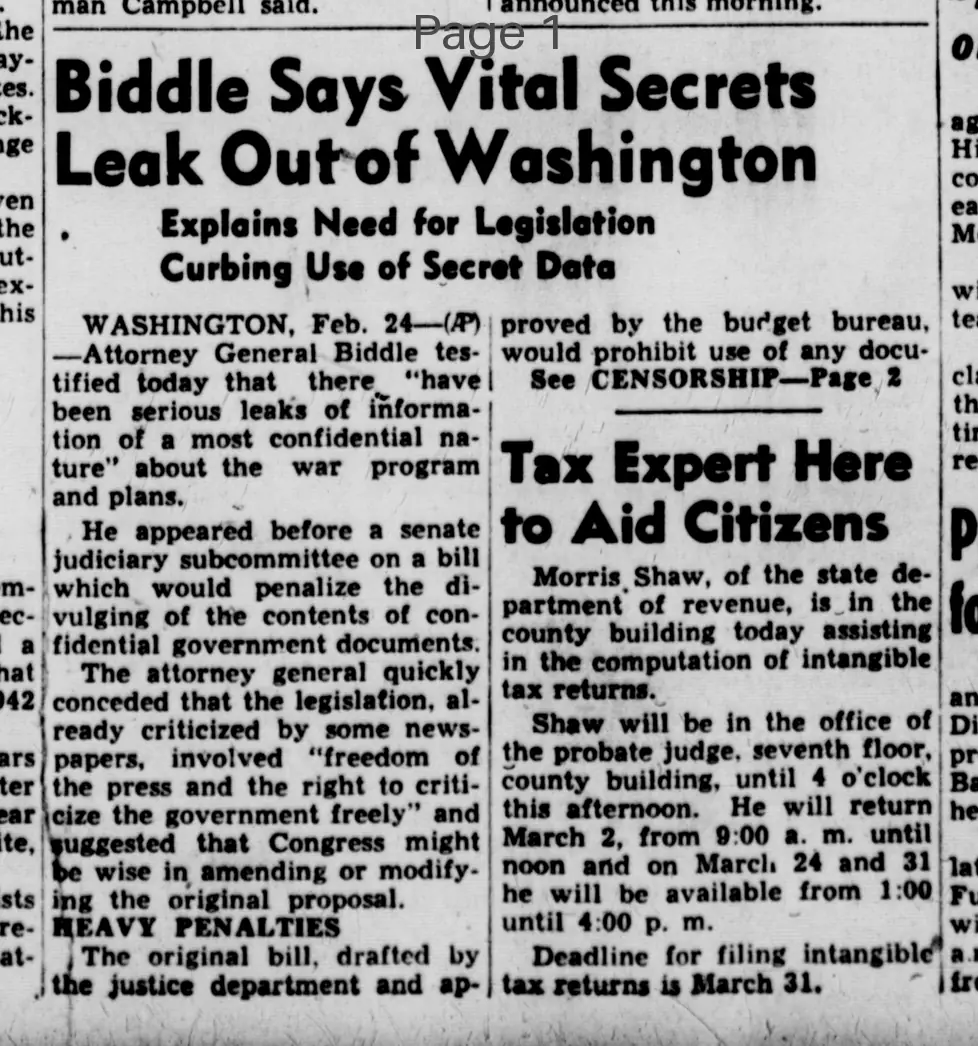
WASHINGTON, Feb. 24--(AP)--Attorney General Biddle testified today that there have been serious leaks of information of a most confidential nature about the war program and plans.
He appeared before a senate judiciary subcommittee on a bill which would penalize the divulging of the contents of confidential government documents.
The attorney general quickly conceded that the legislation, already criticized by some newspapers, involved "freedom of the press and the right to criticize the government freely" and suggested that Congress might be wise in amending or modifying the original proposal.
HEAVY PENALTIES
The original bill, drafted by the justice department and approved by the budget bureau, would prohibit use of any docu-
See CENSORSHIP-Page 2
Censorship
(Continued from Page 1)
ment or other Information which had been declared "to be secret or confidential" by any government agency. The penalty could range up to a fine of $5,000 and two years in prison.
The attorney general said that existing law did not prevent photostating, printing, writing or oral disclosure of the copies of secret documents and in peace-time this had hampered the prosecution of important cases by the Federal Bureau of Investigation.
Biddle said that the government needed broader authority to halt "leaks of a serious nature," prevent premature disclosure of war plans, and block information "of comfort and aid to the enemy."
"This is a very difficult and complex problem," he told the senate group.
"This is very broad but extremely simple. It makes it a crime to divulge any confidential information."
Biddle noted criticism that under the pending bill, the head of a government agency might seek "to evade proper criticism" by simply stamping a document or material "confidential"
Senator O'Mahoney (D-Wyo) interrupted to note that under the bill a cabinet member might decide to give certain information only to "red-haired persons and make it a crime for black-haired persons to use it."
O'Mahoney referred to this as an "absurd example but Biddle conceded it was possible although unlikely.
What sub-type of article is it?
What keywords are associated?
What entities or persons were involved?
Where did it happen?
Domestic News Details
Primary Location
Washington
Event Date
Feb. 24
Key Persons
Event Details
Attorney General Biddle testified before a senate judiciary subcommittee on a bill which would penalize the divulging of the contents of confidential government documents. He conceded the legislation involved freedom of the press and suggested amendments. The bill would prohibit use of any document or information declared secret or confidential by any government agency, with penalties up to a fine of $5,000 and two years in prison. Biddle stated existing law did not prevent disclosure of secret documents and the government needed broader authority to halt serious leaks, prevent premature disclosure of war plans, and block information aiding the enemy. He noted criticism that agency heads might evade criticism by stamping documents confidential. Senator O'Mahoney gave an absurd example of a cabinet member restricting information by hair color, which Biddle conceded was possible though unlikely.