Thank you for visiting SNEWPapers!
Sign up free
Editorial
July 24, 1818
Kentucky Gazette
Lexington, Fayette County, Kentucky
What is this article about?
Post-War of 1812 editorial from the Democratic Press reprints a London Courier article accusing the US of under-rating its warships to deceive enemies, then offers American remarks defending the practice as non-deceptive, emphasizing superior US naval design, armament, and discipline while critiquing British inconsistencies.
Clipping
OCR Quality
95%
Excellent
Full Text
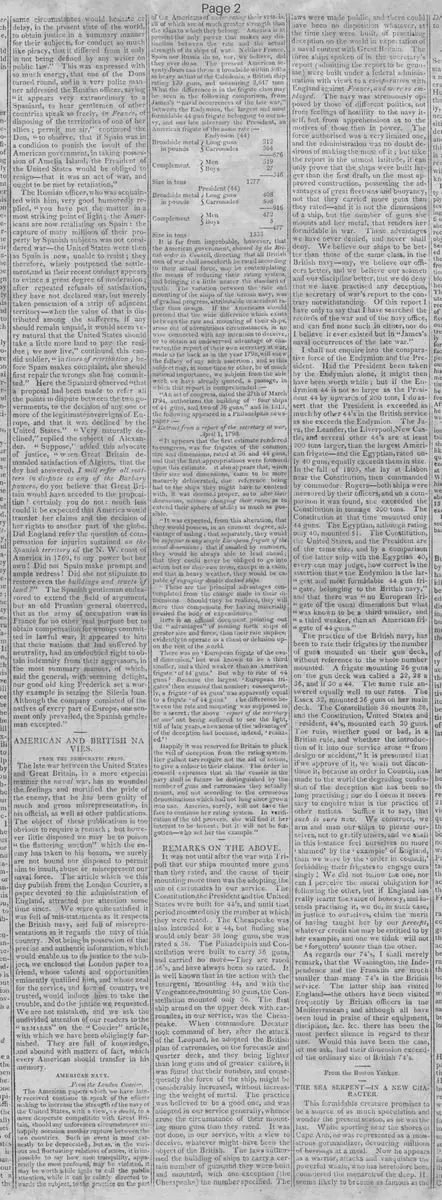
AMERICAN AND BRITISH NAVIES.
FROM THE DEMOCRATIC PRESS.
The late war between the United States and Great Britain, in a more especial manner the naval war, has so wounded the feelings and mortified the pride of the enemy, that he has been guilty of much and gross misrepresentation, in his official, as well as other publications. The object of these publications is too obvious to require a remark; but however little disposed we may be to poison "the flattering unction" which the enemy has taken to his bosom, we surely are not bound nor disposed to permit him to insult, abuse or misrepresent our naval force. The article which we this day publish from the London Courier, a paper devoted to the administration of England, attracted our attention some time since. We were quite satisfied it was full of mis-statements as it respects the British navy, and full of misrepresentations as it regards the navy of this country. Not being in possession of that precise and authentic information, which would enable us to do justice to the subject, we enclosed the London paper to a friend, whose talents and opportunities eminently qualified him, and whose zeal for the service, and love of country, we trusted, would induce him to take the trouble, and do the justice we requested. We are not mistaken, and we ask the undivided attention of our readers to the "REMARKS" on the "Courier" article, with which we have been obligingly furnished. They are full of knowledge, and abound with matters of fact, which every American should transfer in his memory.
AMERICAN NAVY.
From the London Courier,
The American papers which we have lately received continue to speak of the efforts making to increase the strength of the navy of the United States, with a view, to doubt, to a more desperate competition with Great Britain. Happily occasion another rupture between the two countries, at present the most profound, may be violated, it may be worth while again to call the public attention, while it can be calmly directed to. warls the subject, to the practice on the part of the Americans of under-rating their vessels, all of which are of much greater strength than the class to which they belong. America is at present the only power that makes any distinction between the rate and the actual strength of its ships of war. Neither France, Spain nor Russia do so, nor, we believe, did they ever do so. The present American seventy-fours can throw a broadside within 50lbs as heavy as that of the Caledonia; a British ship rating 120 guns, and measuring 2,617 tons What the difference is in the frigate class may be seen in the following comparison, from James's "naval occurrences of the late war," between the Endymion, the largest and most formidable 44 gun frigate belonging to our navy, and our late adversary the President, an American frigate of the same rate:—
Endymion (44)
Broadside metal—Long guns 312 in pounds
Carronades 364
—676
Men 319
Complement. Boys 27
346
Size in tons 1277
President (44)
Broadside metal Long guns 408 in pounds
Carronades 508
916
Men 472
Complement Boys 5
—477
Size in tons 1533
It is far from improbable, however, that the American government, shamed by the British order in Council, directing that all British men of war shall henceforth be rated according to their actual force, may be contemplating the means of reducing their rating system, and bringing it a little nearer the standard of truth. The variation between the rate and mounting of the ships of the British navy, was of gradual progress, attributable to accident rather than design. If the Americans should pretend that the wide difference which exists between the rate and mounting of their ships, arose out of adventitious circumstances, in no wise connected with any intention to deceive, or to obtain an undeserved advantage or character, the report of their own secretary at war, made as far back as in the year 1794, will show the fallacy of any such assertion; and as this subject may, at some time or other, be of much national importance, we subjoin from the able work we have already quoted, a passage, in which that report is comprehended :—
"An act of congress, dated the 27th of March 1794, authorized the building of … four ships of 44 guns, and two of 36 guns;" and in 1813, the following appeared in a Philadelphia newspaper:-
"Extract from a report of the secretary at war April 1, 1798.
"It appears that the first estimate rendered to congress, was for frigates of the common size and dimensions, rated at 36 and 44 guns, and that the first appropriations were founded upon this estimate. It also appears that, when their size and dimensions, came to be more maturely deliberated, due reference being had to the ships they might have to contend with, it was deemed proper, so to alter their dimensions, without changing their rates, as to extend their sphere of utility as much as possible.
"It was expected, from this alteration, that they would possess, in an eminent degree, advantage of sailing; that separately, they would be superior to any single European frigate of the usual dimensions : that if assailed by numbers, they would be always able to lead ahead; that they could never be obliged to go into action but on their own terms, except in a calm and that in heavy weather, they would be capable of engaging double decked ships.
"These are the principal advantages contemplated from the change made in their dimensions. Should they be realized, they will more than compensate for having materially swelled the body of expenditures."
Here is an official document pointing out the "advantages" of sending forth ships of greater size and force, than their rate implies; evidently to operate as a cheat or delusion upon the rest of the world.
There was no 'European frigate of the usual dimension,' but was known to be a third smaller, and a third weaker than an American frigate 'of 44 guns.' But why to rate of 44 guns? Because the largest European frigates' then mounted that number; consequently, a frigate 'of 44 guns' was apparently equal to a frigate 'of 44 guns.' The difference between the rate and mounting was supposed to be a secret; the above report of the secretary at war' not being suffered to see the light till of late years, when some of the 'advantages of the deception had become, indeed, 'realized.'!
Happily it was reserved for Britain to pluck the veil of deception from the rating system. Her gallant tars require not the aid of fiction, to give a colour to their claims. The order in council expresses that all the 'vessels in the navy shall in future be distinguished by the number of guns and carronades they actually mount, and not according to the erroneous denominations which had not long since grown into use. America, surely, will not have the face to continue her rating system. In verification of the old proverb. she will find it her interest to be honest; but it will not be forgotten—who set her the example."
REMARKS ON THE ABOVE.
It was not until after the war with Tripoli that our ships mounted more guns than they rated, and the cause of their mounting more then was the adopting the use of carronades in our service. The Constitution, the President and the United States were built for 44's, and until that period mounted only the number at which they were rated. The Chesapeake was also intended for a 44, but finding she would only bear 38 long guns, she was rated a 38. The Philadelphia and Constellation were built to carry 36 guns, and carried no more—They are rated 36's, and have always been so rated. It is well known that in the action with the Insurgent, mounting 44, and with the Vengeance, mounting 50 guns, the Constellation mounted only 36. The first ship armed on the upper deck with carronades, in our service, was the Chesapeake. When commodore Decatur took command of her, after the attack of the Leopard, he adopted the British plan of carronades, on the forecastle and quarter deck, and they being lighter than long guns and of greater calibre, it was found that their number, and consequently the force of the ship, might be considerably increased, without increasing the weight of metal. The practice was believed to be a good one, and was adopted in our service generally, whence arose the circumstance of their mounting more guns than they rated. It was not done, in our service, with a view to deceive, whatever might have been the object of the British. The laws authorised the building of ships to carry a certain number of guns, and they were built and mounted, with one exception (the Chesapeake) the number specified. The laws were made public, and there could have been no disposition whatever, at the time they were built, of practising deception on the world in expectation of a naval contest with Great Britain. The three ships spoken of in the secretary's report (admitting the report to be genuine) were built under a federal administration with views to a co-operation with England against France, and were so employed. The navy was strenuously opposed by those of different politics, not from feelings of hostility to the navy itself, but from apprehensions as to the motives of those then in power. The force authorised was a very limited one, and the administration was no doubt desirous of making the most of it : but take the report in the utmost latitude, it can only prove that the ships were built larger than the first draft, on the most approved construction, possessing the advantages of great fleetness and buoyancy, not that they carried more guns than they rated—and it is not the dimensions of a ship, but the number of guns she mounts and her metal, that renders her formidable in war. These advantages we have never denied, and never shall deny. We believe our ships to be better than those of the same class. in the British navy—nay, we believe our officers better, and we believe our seamen and our discipline better, but we do deny that we have practised any deception, the secretary of war's report to the contrary notwithstanding. Of this report I have only to say that I have searched the records of the war and of the navy office. and can find none such in either, nor do I believe it ever existed but in "James's naval occurrences of the late war."
I shall not enquire into the comparative force of the Endymion and the President. Had the President been taken by the Endymion alone, it might then have been worth while : but if the Endymion 44 is not so large as the President 44 by upwards of 200 tons, I do assert that the President is exceeded as much by other 44's in the British service as she exceeds the Endymion. The Java, the Leander, the Liverpool, Newcastle, and several other 44's are at least 200 tons larger, than the largest American frigate—and the Egyptian, rated only 40 guns, equally exceeds them in size. In the fall of 1805, she lay at Lisbon near the Constitution, then commanded by commodore Rogers—both ships were measured by their officers, and on a comparison it was found, she exceeded the Constitution in tonnage 200 tons. The Constitution at that time mounted only 44 guns. The Egyptian, although rating only 40, mounted 51. The Constitution, the United States, and the President are of the same size, and by a comparison of the latter ship with the Egyptian 40, every one may judge, how correct is the assertion that " the Endymion is the largest and most formidable 44 gun frigate, belonging to the British navy," and that there was " no European frigate of the usual dimensions but what was known to be a third smaller, and a third weaker. than an American frigate of 44 guns."
The practice of the British navy, has been to rate their frigates by the number of guns mounted on their gun deck, without reference to the whole number mounted. A frigate mounting 26 guns on the gun deck was called a 32, 28 a 36, and if 30 a 44. The same rule answered equally well to our rates. The Essex 32. mounted 36 guns on her main deck. The Constellation 36 mounts 28. and the Constitution, United States and President, 44's, mounted each 30 guns. The rule, whether good or bad, is a British rule, and whether the introduction of it into our service arose " from design or accident," it is presumed that if we approve of it, we shall not discontinue it, because an order in Council, has made to the world the degrading confession of the deception she has been so long practising; nor do I deem it necessary to enquire what is the practice of other nations. Suffice it to say, that such is ours now. We construct, we arm and man our ships to please ourselves, not to gratify others, and we shall in this instance feel ourselves no more 'shamed' by the 'example' of England than we were by the 'order in council, forbidding their frigates to engage ours singly! We did not follow the one, nor can I perceive the moral obligation for following the other, but if England has really learnt the value of honesty, and intends practising it, we do, in such case, in justice to ourselves, claim the merit of having taught her by our precept, whatever credit she may be entitled to by her example, and one we think will not be 'forgotten' sooner than the other.
As regards our 74's, I shall merely remark, that the Washington, the Independence and the Franklin are much smaller than many 74's in the British service. The latter ship has visited England—the others have been visited frequently by British officers in the Mediterranean; and although all have been loud in praise of their equipment, discipline, &c. &c. there has been the most perfect silence in regard to their size. Would this have been the case, let me ask, had their dimensions exceeded the ordinary size of British 74's.
FROM THE DEMOCRATIC PRESS.
The late war between the United States and Great Britain, in a more especial manner the naval war, has so wounded the feelings and mortified the pride of the enemy, that he has been guilty of much and gross misrepresentation, in his official, as well as other publications. The object of these publications is too obvious to require a remark; but however little disposed we may be to poison "the flattering unction" which the enemy has taken to his bosom, we surely are not bound nor disposed to permit him to insult, abuse or misrepresent our naval force. The article which we this day publish from the London Courier, a paper devoted to the administration of England, attracted our attention some time since. We were quite satisfied it was full of mis-statements as it respects the British navy, and full of misrepresentations as it regards the navy of this country. Not being in possession of that precise and authentic information, which would enable us to do justice to the subject, we enclosed the London paper to a friend, whose talents and opportunities eminently qualified him, and whose zeal for the service, and love of country, we trusted, would induce him to take the trouble, and do the justice we requested. We are not mistaken, and we ask the undivided attention of our readers to the "REMARKS" on the "Courier" article, with which we have been obligingly furnished. They are full of knowledge, and abound with matters of fact, which every American should transfer in his memory.
AMERICAN NAVY.
From the London Courier,
The American papers which we have lately received continue to speak of the efforts making to increase the strength of the navy of the United States, with a view, to doubt, to a more desperate competition with Great Britain. Happily occasion another rupture between the two countries, at present the most profound, may be violated, it may be worth while again to call the public attention, while it can be calmly directed to. warls the subject, to the practice on the part of the Americans of under-rating their vessels, all of which are of much greater strength than the class to which they belong. America is at present the only power that makes any distinction between the rate and the actual strength of its ships of war. Neither France, Spain nor Russia do so, nor, we believe, did they ever do so. The present American seventy-fours can throw a broadside within 50lbs as heavy as that of the Caledonia; a British ship rating 120 guns, and measuring 2,617 tons What the difference is in the frigate class may be seen in the following comparison, from James's "naval occurrences of the late war," between the Endymion, the largest and most formidable 44 gun frigate belonging to our navy, and our late adversary the President, an American frigate of the same rate:—
Endymion (44)
Broadside metal—Long guns 312 in pounds
Carronades 364
—676
Men 319
Complement. Boys 27
346
Size in tons 1277
President (44)
Broadside metal Long guns 408 in pounds
Carronades 508
916
Men 472
Complement Boys 5
—477
Size in tons 1533
It is far from improbable, however, that the American government, shamed by the British order in Council, directing that all British men of war shall henceforth be rated according to their actual force, may be contemplating the means of reducing their rating system, and bringing it a little nearer the standard of truth. The variation between the rate and mounting of the ships of the British navy, was of gradual progress, attributable to accident rather than design. If the Americans should pretend that the wide difference which exists between the rate and mounting of their ships, arose out of adventitious circumstances, in no wise connected with any intention to deceive, or to obtain an undeserved advantage or character, the report of their own secretary at war, made as far back as in the year 1794, will show the fallacy of any such assertion; and as this subject may, at some time or other, be of much national importance, we subjoin from the able work we have already quoted, a passage, in which that report is comprehended :—
"An act of congress, dated the 27th of March 1794, authorized the building of … four ships of 44 guns, and two of 36 guns;" and in 1813, the following appeared in a Philadelphia newspaper:-
"Extract from a report of the secretary at war April 1, 1798.
"It appears that the first estimate rendered to congress, was for frigates of the common size and dimensions, rated at 36 and 44 guns, and that the first appropriations were founded upon this estimate. It also appears that, when their size and dimensions, came to be more maturely deliberated, due reference being had to the ships they might have to contend with, it was deemed proper, so to alter their dimensions, without changing their rates, as to extend their sphere of utility as much as possible.
"It was expected, from this alteration, that they would possess, in an eminent degree, advantage of sailing; that separately, they would be superior to any single European frigate of the usual dimensions : that if assailed by numbers, they would be always able to lead ahead; that they could never be obliged to go into action but on their own terms, except in a calm and that in heavy weather, they would be capable of engaging double decked ships.
"These are the principal advantages contemplated from the change made in their dimensions. Should they be realized, they will more than compensate for having materially swelled the body of expenditures."
Here is an official document pointing out the "advantages" of sending forth ships of greater size and force, than their rate implies; evidently to operate as a cheat or delusion upon the rest of the world.
There was no 'European frigate of the usual dimension,' but was known to be a third smaller, and a third weaker than an American frigate 'of 44 guns.' But why to rate of 44 guns? Because the largest European frigates' then mounted that number; consequently, a frigate 'of 44 guns' was apparently equal to a frigate 'of 44 guns.' The difference between the rate and mounting was supposed to be a secret; the above report of the secretary at war' not being suffered to see the light till of late years, when some of the 'advantages of the deception had become, indeed, 'realized.'!
Happily it was reserved for Britain to pluck the veil of deception from the rating system. Her gallant tars require not the aid of fiction, to give a colour to their claims. The order in council expresses that all the 'vessels in the navy shall in future be distinguished by the number of guns and carronades they actually mount, and not according to the erroneous denominations which had not long since grown into use. America, surely, will not have the face to continue her rating system. In verification of the old proverb. she will find it her interest to be honest; but it will not be forgotten—who set her the example."
REMARKS ON THE ABOVE.
It was not until after the war with Tripoli that our ships mounted more guns than they rated, and the cause of their mounting more then was the adopting the use of carronades in our service. The Constitution, the President and the United States were built for 44's, and until that period mounted only the number at which they were rated. The Chesapeake was also intended for a 44, but finding she would only bear 38 long guns, she was rated a 38. The Philadelphia and Constellation were built to carry 36 guns, and carried no more—They are rated 36's, and have always been so rated. It is well known that in the action with the Insurgent, mounting 44, and with the Vengeance, mounting 50 guns, the Constellation mounted only 36. The first ship armed on the upper deck with carronades, in our service, was the Chesapeake. When commodore Decatur took command of her, after the attack of the Leopard, he adopted the British plan of carronades, on the forecastle and quarter deck, and they being lighter than long guns and of greater calibre, it was found that their number, and consequently the force of the ship, might be considerably increased, without increasing the weight of metal. The practice was believed to be a good one, and was adopted in our service generally, whence arose the circumstance of their mounting more guns than they rated. It was not done, in our service, with a view to deceive, whatever might have been the object of the British. The laws authorised the building of ships to carry a certain number of guns, and they were built and mounted, with one exception (the Chesapeake) the number specified. The laws were made public, and there could have been no disposition whatever, at the time they were built, of practising deception on the world in expectation of a naval contest with Great Britain. The three ships spoken of in the secretary's report (admitting the report to be genuine) were built under a federal administration with views to a co-operation with England against France, and were so employed. The navy was strenuously opposed by those of different politics, not from feelings of hostility to the navy itself, but from apprehensions as to the motives of those then in power. The force authorised was a very limited one, and the administration was no doubt desirous of making the most of it : but take the report in the utmost latitude, it can only prove that the ships were built larger than the first draft, on the most approved construction, possessing the advantages of great fleetness and buoyancy, not that they carried more guns than they rated—and it is not the dimensions of a ship, but the number of guns she mounts and her metal, that renders her formidable in war. These advantages we have never denied, and never shall deny. We believe our ships to be better than those of the same class. in the British navy—nay, we believe our officers better, and we believe our seamen and our discipline better, but we do deny that we have practised any deception, the secretary of war's report to the contrary notwithstanding. Of this report I have only to say that I have searched the records of the war and of the navy office. and can find none such in either, nor do I believe it ever existed but in "James's naval occurrences of the late war."
I shall not enquire into the comparative force of the Endymion and the President. Had the President been taken by the Endymion alone, it might then have been worth while : but if the Endymion 44 is not so large as the President 44 by upwards of 200 tons, I do assert that the President is exceeded as much by other 44's in the British service as she exceeds the Endymion. The Java, the Leander, the Liverpool, Newcastle, and several other 44's are at least 200 tons larger, than the largest American frigate—and the Egyptian, rated only 40 guns, equally exceeds them in size. In the fall of 1805, she lay at Lisbon near the Constitution, then commanded by commodore Rogers—both ships were measured by their officers, and on a comparison it was found, she exceeded the Constitution in tonnage 200 tons. The Constitution at that time mounted only 44 guns. The Egyptian, although rating only 40, mounted 51. The Constitution, the United States, and the President are of the same size, and by a comparison of the latter ship with the Egyptian 40, every one may judge, how correct is the assertion that " the Endymion is the largest and most formidable 44 gun frigate, belonging to the British navy," and that there was " no European frigate of the usual dimensions but what was known to be a third smaller, and a third weaker. than an American frigate of 44 guns."
The practice of the British navy, has been to rate their frigates by the number of guns mounted on their gun deck, without reference to the whole number mounted. A frigate mounting 26 guns on the gun deck was called a 32, 28 a 36, and if 30 a 44. The same rule answered equally well to our rates. The Essex 32. mounted 36 guns on her main deck. The Constellation 36 mounts 28. and the Constitution, United States and President, 44's, mounted each 30 guns. The rule, whether good or bad, is a British rule, and whether the introduction of it into our service arose " from design or accident," it is presumed that if we approve of it, we shall not discontinue it, because an order in Council, has made to the world the degrading confession of the deception she has been so long practising; nor do I deem it necessary to enquire what is the practice of other nations. Suffice it to say, that such is ours now. We construct, we arm and man our ships to please ourselves, not to gratify others, and we shall in this instance feel ourselves no more 'shamed' by the 'example' of England than we were by the 'order in council, forbidding their frigates to engage ours singly! We did not follow the one, nor can I perceive the moral obligation for following the other, but if England has really learnt the value of honesty, and intends practising it, we do, in such case, in justice to ourselves, claim the merit of having taught her by our precept, whatever credit she may be entitled to by her example, and one we think will not be 'forgotten' sooner than the other.
As regards our 74's, I shall merely remark, that the Washington, the Independence and the Franklin are much smaller than many 74's in the British service. The latter ship has visited England—the others have been visited frequently by British officers in the Mediterranean; and although all have been loud in praise of their equipment, discipline, &c. &c. there has been the most perfect silence in regard to their size. Would this have been the case, let me ask, had their dimensions exceeded the ordinary size of British 74's.
What sub-type of article is it?
Military Affairs
Foreign Affairs
What keywords are associated?
American Navy
British Navy
Ship Ratings
Carronades
War Of 1812
Naval Deception
Frigate Comparisons
Order In Council
What entities or persons were involved?
London Courier
Democratic Press
Constitution
President
Endymion
Secretary At War
Commodore Decatur
James's Naval Occurrences
Editorial Details
Primary Topic
Defense Of American Naval Rating System Against British Accusations Of Deception
Stance / Tone
Defensive And Assertive Support For Us Navy Superiority
Key Figures
London Courier
Democratic Press
Constitution
President
Endymion
Secretary At War
Commodore Decatur
James's Naval Occurrences
Key Arguments
Us Ships Mounted More Guns Due To Carronades Adopted From British Practice, Not Deception
Secretary's Report Likely Fabricated Or Misrepresented; No Such Record Found
Many British Frigates Larger Than Endymion, Contradicting Claims Of Us Overstatement
Us Rating System Follows British Tradition; No Obligation To Change Based On British Order
Us 74 Gun Ships Smaller Than Many British Equivalents
Us Ships, Officers, And Discipline Superior To British Counterparts