Thank you for visiting SNEWPapers!
Sign up free
Daily National Intelligencer
Washington, District Of Columbia
What is this article about?
Detailed report on U.S. Congress proceedings in Washington, March 13-15, 1816, focusing on the National Bank bill passing the House 80-71 after debates on capital, location (Philadelphia selected), and directorship; Senate discussions on compensation and relief bills; other routine business.
Clipping
OCR Quality
Full Text
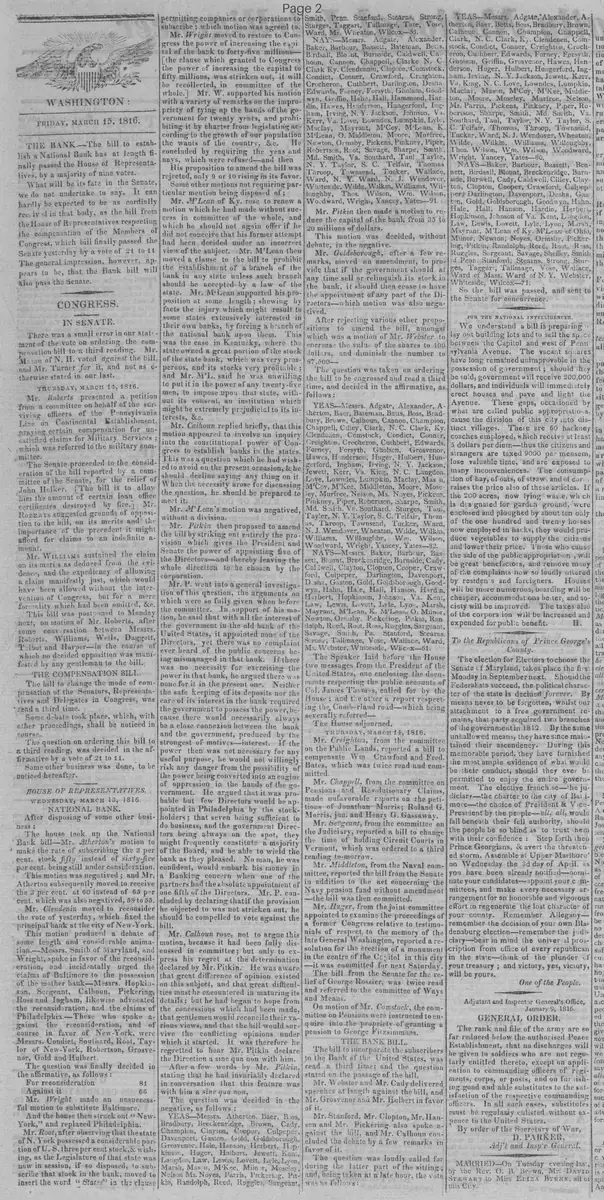
FRIDAY, MARCH 15, 1816.
THE BANK.--The bill to establish a National Bank has at length finally passed the House of Representatives, by a majority of nine votes. What will be its fate in the Senate we do not undertake to say. It can hardly be expected to be as cordially received in that body, as the bill from the House of Representatives respecting the compensation of the Members of Congress, which bill finally passed the Senate yesterday by a vote of 21 to 11. The general impression, however, appears to be, that the Bank bill will also pass the Senate.
CONGRESS.
IN SENATE.
There was a small error in our statement of the vote on ordering the compensation bill to a third reading. Mr. Mason of N. H. voted against the bill, and Mr. Turner for it, and not as otherwise stated in our last.
THURSDAY, MARCH 14, 1816.
Mr. Roberts presented a petition from a committee on behalf of the surviving officers of the Pennsylvania Line on Continental Establishment, praying certain compensation for unsatisfied claims for Military Services: which was referred to the military committee.
The Senate proceeded to the consideration of the bill reported by a committee of the Senate, for the relief of John Holker. The bill is to allow him the amount of certain loan office certificates destroyed by fire. Mr. Roberts suggested grounds of opposition to the bill, on its merits and the importance of the precedent it might afford for claims to an indefinite amount.
Mr. Williams sustained the claim on its merits as deduced from the evidence, and the expediency of allowing a claim manifestly just, which would have been allowed without the intervention of Congress, but for a mere formality which had been omitted, &c.
This bill was postponed to Monday next, on motion of Mr. Roberts, after some conversation between Messrs. Roberts, Williams, Wells, Daggett, Talbot and Harper--in the course of which no decided opposition was manifested by any gentleman to the bill.
THE COMPENSATION BILL.
The bill to change the mode of compensation of the Senators, Representatives and Delegates in Congress, was read a third time.
Some debate took place, which, with other proceedings, shall be noticed in course.
The question on ordering this bill to a third reading was decided in the affirmative by a vote of 21 to 11.
Some other business was done, to be noticed hereafter.
HOUSE OF REPRESENTATIVES.
WEDNESDAY, MARCH 13, 1816.
NATIONAL BANK.
After disposing of some other business;
The house took up the National Bank bill--Mr. Atherton's motion to make the rate of subscribing the 3 per cent. stock fifty instead of sixty-five per cent. being still under consideration.
This motion was negatived; and Mr. Atherton subsequently moved to receive the 3 per cent. at 60 instead of 65 per cent. which was also negatived, 58 to 55.
Mr. Clendenin moved to reconsider the vote of yesterday, which fixed the principal bank at the city of New-York.
This motion produced a debate of some length and considerable animation.--Messrs. Smith of Maryland, and Wright, spoke in favor of the reconsideration, and incidentally urged the claims of Baltimore to the possession of the mother bank--Messrs. Hopkinson, Sergeant, Calhoun, Pickering, Ross and Ingham, likewise advocated the reconsideration. and the claims of Philadelphia,--Those who spoke against the reconsideration, and of course in favor of New-York, were Messrs. Condict, Southard, Root, Taylor of New-York, Robertson, Grosvenor, Gold and Hulbert.
The question was finally decided in the affirmative, as follows:
For reconsideration 81
Against it 66
Mr. Wright made an unsuccessful motion to substitute Baltimore.
And the house then struck out "New-York," and replaced Philadelphia.
Mr. Root, after observing that the state of N. York possessed a considerable portion of U. S. three per cent stock, & wishing, as the Legislature of that state was now in session, if so disposed, to subscribe that stock in the bank, moved to insert the word "States" in the clause permitting companies or corporations to subscribe; which motion was agreed to.
Mr. Wright moved to restore to Congress the power of increasing the capital of the bank to forty-five millions--the clause which granted to Congress the power of increasing the capital to fifty millions, was stricken out, it will be recollected, in committee of the whole. Mr. W. supported his motion with a variety of remarks on the impropriety of tying up the hands of the government for twenty years, and prohibiting it by charter from legislating according to the growth of our population the wants of the country, &c.
He concluded by requiring the yeas and nays, which were refused--and then his proposition to amend the bill was rejected, only 9 or 10 rising in its favor.
Some other motions not requiring particular mention being disposed of;
Mr. M'Lane of Ky. rose to renew a motion which he had made without success in committee of the whole. and which he should not again offer if he did not conceive that his former attempt had been decided under an incorrect view of the subject. Mr. M'Lane then moved a clause to the bill to prohibit the establishment of a branch of the bank in any state unless such branch should be accepted by a law of the state. Mr. M'Lane supported his proposition at some length; shewing, by facts the injury which might result to some states extensively interested in their own banks, by forcing a branch of the national bank upon them. This was the case in Kentucky, where the state owned a great portion of the stock of the state bank, which was very prosperous, and its stocks very profitable; and Mr. M'L. said he was unwilling to put it in the power of any twenty-five men, to impose upon that state, without its consent, an institution which might be extremely prejudicial to its interests, &c.
Mr. Calhoun replied briefly, that this motion appeared to involve an inquiry into the constitutional power of Congress to establish banks in the states. This was a question which he had wished to avoid on the present occasion, & he should decline saying any thing on it. When the necessity arose for discussing the question, he should be prepared to meet it.
Mr. M'Lean's motion was negatived, without a division.
Mr. Pitkin then proposed to amend the bill by striking out entirely the provision which gives the President and Senate the power of appointing five of the Directors--and thereby leaving the whole direction to be chosen by the corporation.
Mr. P. went into a general investigation of this question, the arguments on which were so fully given when before the committee. In support of his motion, he said that with all the interest of the government in the old bank of the United States, it appointed none of the Directors, yet there was no complaint ever heard of the public concerns being mismanaged in that bank. If there was no necessity for exercising the power in that bank, he argued there was none for it in the present one. Neither the safe keeping of its deposits nor the care of its interest in the bank required the government to possess the power, because there would necessarily always be a close connexion between the bank and the government, produced by the strongest of motives--interest. If the power then was not necessary for any useful purpose, he would not willingly risk any danger from the possibility of the power being converted into an engine of oppression in the hands of the government. He argued that it was probable but few Directors would be appointed in Philadelphia by the stockholders; that seven being sufficient to do business, and the government Directors being always on the spot, they might frequently constitute a majority of the Board, and be able to wield the bank as they pleased. No man, he was confident, would embark his money in a Banking concern when one of the partners had the absolute appointment of one fifth of the Directors. Mr. P. concluded by declaring that if the provision he objected to was not stricken out, he should be compelled to vote against the bill.
Mr. Calhoun rose, not to argue this motion, because it had been fully discussed in committee; but only to express his regret at the determination declared by Mr. Pitkin. He was aware that great difference of opinion existed on this subject, and that great difficulties must be encountered in maturing its details; but he had began to hope from the concessions which had been made, that gentlemen would reconcile their various views, and that the bill would survive the conflicting opinions under which it started. It was therefore he regretted to hear Mr. Pitkin declare the Direction a sine qua non with him.
After a few words by Mr. Pitkin, stating that he had invariably declared in conversation that this feature was with him a sine qua non,
The question was decided in the negative, as follows:
YEAS--Messrs. Atherton, Baer, Boss, Bradbury, Breckenridge, Brown, Cady, Champion, Clayton, Cooper, Culpeper, Davenport, Gaston, Gold, Goldsborough, Grosvenor, Hale, Hanson, Herbert, Hopkinson, Huger, Hulbert, Jewett, Kent, Langdon, Law, Lewis, Lovett, Lyle, Lyon, Marsh, Mason, M'Kee, Milnor, Moseley, Nelson Ms. Noyes, Parris, Pickering, Pitkin, Randolph, Reed, Ruggles, Sergeant, Smith, Penn. Scarford, Stearns, Strong, Sturges, Taggart, Tallmadge, Tate, Vose, Ward, Ms. Wheaton, Wilcox--55.
NAYS--Messrs. Adgate, Alexander, Baker, Barbour, Bassett, Bateman, Betts, Birdsall, Blount, Burnside, Caldwell, Ca. houn, Cannon, Chappell, Clarke N. C. Clark Ky. Clendenin, Clopton, Comstock, Condict, Conner, Crawford, Creighton, Crocheron, Cuthbert, Darlington, Desha. Edwards, Forney, Forsyth, Gholson, Goodwyn, Griffin, Hahn, Hall, Hammond, Hardin, Hawes, Henderson, Hungerford, Ingham, Irving, N. Y. Jackson, Johnson, Va. Kerr, Va. Love, Lowndes, Lumpkin, Lyle, Maclay, Mayrant, M'Coy, M'Lean, K. M'Lean, O. Middleton, Moore, Murfree, Newton, Ormsby, Pickens, Pinkney, Piper, Robertson, Root, Savage, Sharpe, Smith, Md. Smith, Va. Southard, Taul, Taylor. N. Y. Taylor, S. C. Telfair, Thomas Throop, Townsend, Tucker; Wallace Ward. N. V. Ward, N. J. Wendover. Whiteside. Wilde, Wilkin, Williams, Willoughby, Thos. Wilson, Wm. Wilson, Woodward, Wright, Yancey, Yates--91.
Mr. Pitkin then made a motion to reduce the capital of the bank from 35 to 20 millions of dollars.
This motion was decided, without debate, in the negative.
Mr. Goldsborough, after a few remarks, moved an amendment, to provide that if the government should at any time sell or relinquish its stock in the bank. it should then cease to have the appointment of any part of the Directors--which motion was also negatived.
After rejecting various other propositions to amend the bill, amongst which was a motion of Mr. Webster to encrease the value of the shares to 400 dollars, and diminish the number to 87,500--
The question was taken on ordering the bill to be engrossed and read a third time, and decided in the affirmative, as follows:
YEAS--Messrs. Adgate. Alexander, A. therton, Baer, Bateman, Betts, Boss, Bradbury, Brown, Calhoun, Cannon, Champion, Chappell, Cilley, Clark, N. C. Clark, Ky. Clendenen, Comstock, Condict, Conner, Creighton, Crocheron, Cuthbert, Edwards, Forney, Forsyth, Gholson, Grosvenor, Hawes, Henderson, Huger, Hulbert, Hungerford, Ingham, Irving, N. Y. Jackson, Jewett, Kerr, Va. King, N. C. Langdon, Love, Lowndes, Lumpkin, Maclay, Mason, M'Coy, M'Kee, Middleton, Moore, Moseley, Murfree, Nelson, Ms. Noyes, Pickens, Pinkney, Piper, Robertson, Sharpe, Smith, Md. Smith, Va. Southard, Sturges, Taul Taylor, N. Y. Taylor, S. C. Telfair, Thomas, Throop, Townsend, Tucker, Ward, N. J. Wendover, Wheaton, Wilde, Wilkin, Williams, Willoughby, Wm. Wilson, Woodward, Wright, Yancey, Yates--82.
NAYS--Messrs. Baker, Barbour, Bassett, Blount, Breckenridge, Burnside, Cady, Caldwell, Clayton, Clopton, Cooper, Crawford, Culpeper, Darlington, Davenport, Desha, Gaston, Gold, Goldsborough, Goodwyn, Hahn, Hale, Hall, Hanson, Hardin, Herbert, Hopkinson, Johnson, Va. Kent, Law, Lewis, Lovett, Lyle, Lyon, Marsh, Mayrant, M'Lean, K. M'Lean, O. Milnor, Newton, Ormsby, Pickering, Pitkin, Randolph, Reed, Root, Ross, Ruggles, Sergeant, Savage, Smith, Pa. Stanford, Stearns. Strong, Tallmadge, Vose, Wallace, Ward, Ms. Webster, Whiteside, Wilcox--61.
The Speaker laid before the House two messages from the President of the United States, one enclosing the documents respecting the public accounts of Col. James Thomas, called for by the House: and the other a report respecting the Cumberland road--which being severally referred--
The House adjourned.
THURSDAY, MARCH 14. 1816.
Mr. Creighton, from the committee on the Public Lands, reported a bill to compensate Wm Crawford and Fred. Bates, which was twice read and committed.
Mr. Chappell, from the committee on Pensions and Revolutionary Claims, made unfavorable reports on the petitions of Jonathan Morris; Roland G. Morris, jun. and Henry G. Gassaway.
Mr. Sergeant, from the committee on the Judiciary, reported a bill to change the time of holding Circuit Courts in Vermont, which was ordered to a third reading to-morrow.
Mr. Middleton, from the Naval committee, reported the bill from the Senate in addition to the act concerning the Navy pension fund without amendment the bill was then committed.
Mr. Huger, from the joint committee appointed to examine the proceedings of a former Congress relative to testimonials of respect, to the memory of the late General Washington, reported a resolution for the erection of a monument in the centre of the Capitol in this city --it was committed for next Saturday.
The bill from the Senate for the relief of George Rossier, was twice read and referred to the committee of Ways and Means.
On motion of Mr. Comstock, the committee on Pensions were instructed to enquire into the propriety of granting a pension to George Fitzsimmons.
THE BANK BILL.
The bill to incorporate the subscribers to the Bank of the United States, was read a third time; and the question stated on the passage of the bill.
Mr. Webster and Mr. Cady delivered speeches at length against the bill, and Mr. Grosvenor and Mr. Hulbert in favor of it.
Mr. Stanford. Mr. Clopton, Mr. Hanson and Mr. Pickering also spoke against the bill, and Mr. Calhoun concluded the debate by a few remarks in favor of it.
The question was loudly called for during the latter part of the sitting; and, being taken at a late hour, the vote was as follows:
YEAS--Messrs. Adgate, Alexander, A- therton, Baer, Betts, Boss, Bradbury, Brown, Calhoun, Cannon, Champion, Chappell, Clark, N. C. Clark, Ky. Clendenen, Com- stock, Condict, Conner, Creighton, Croch- eron, Cuthbert, Edwards, Forney, Forsyth, Gholson, Griffin, Grosvenor, Hawes, Hen- derson, Huger, Hulbert, Hungerford, Ing ham. Irving, N. Y. Jackson, Jewett, Kerr, Va. King, N. C. Love, Lowndes, Lumpkin, Maclay, Mason, M'Coy, M'Kee, Middie- ton, Moore, Moseley, Murfree, Nelson, Ms. Parris, Pickens, Pinkney, Piper, Ro- bertson, Sharpe, Smith, Md. Smith, Va. Southard, Taul, Taylor, N. Y. Taylor, S. C. Telfair, Thomas, Throop, Townsend, Tucker, Ward, N. J. Wendover, Wheaton, Wilde, Wilkin, Williams, Willoughby, Thos. Wilson, Wm. Wilson, Woodward, Wright, Yancey, Yates--80.
NAYS--Baker, Barbour, Bassett, Bennett, Birdsall, Blount, Breckenridge, Burn- side, Burwell, Cady, Caldwell, Cilley, Clay- ton, Clopton, Cooper, Crawford, Culpep per, Darlington, Davenport, Desha, Gas ton, Gold, Goldsborough, Goodwyn, Hahn. Hale, Hall, Hanson, Hardin, Herbert, Hopkinson, Johnson of Va. Kent, Langdon, Law, Lewis, Lovett, Lyle, Lyon, Marsh, Mayrant, M'Lean of Ky. M'Lean of Ohio, Miinor, Newton; Noyes, Ormsby, P'icker- ing, Pitkin, Randolph, Reed, Root, Ross. Ruggles, Sergeant, Savage, Sheffey, Smith of Penn. Stanford, Stearns. Strong, Stur- ges, Taggart, Talimage, Vose, Wallace, Ward of Mass. Ward of N. Y. Webster, Whiteside, Wilcox--71.
So the bill was passed, and sent to the Senate for concurrence.
What sub-type of article is it?
What themes does it cover?
What keywords are associated?
What entities or persons were involved?
Where did it happen?
Story Details
Key Persons
Location
Washington
Event Date
1816 03 13 To 1816 03 15
Story Details
The National Bank bill passes the House after debates on subscription rates, location (Philadelphia chosen over New York and Baltimore), branch establishments, directorship appointments, and capital; voted 80-71. Senate passes compensation bill 21-11 and discusses relief for John Holker. Other petitions and reports handled.