Thank you for visiting SNEWPapers!
Sign up free
The New Hampshire Gazette
Portsmouth, Rockingham County, New Hampshire
What is this article about?
At a Common Hall in London's Guildhall on February 19, liverymen debated and approved a petition to the House of Commons urging peace negotiations with the French Republic, amid heated exchanges between supporters and opponents.
Clipping
OCR Quality
Full Text
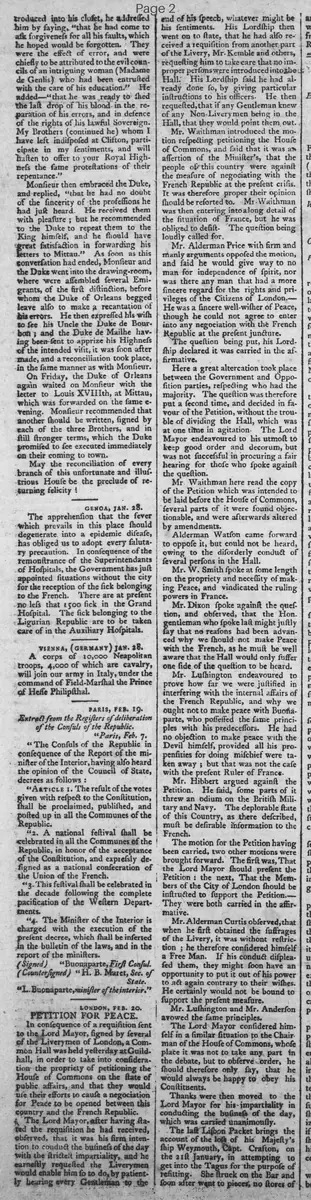
PETITION FOR PEACE.
In consequence of a requisition sent to the Lord Mayor, signed by several of the Liverymen of London, a Common Hall was held yesterday at Guildhall, in order to take into consideration the propriety of petitioning the House of Commons on the state of public affairs, and that they would use their efforts to cause a negociation for Peace to be opened between this country and the French Republic.
The Lord Mayor, after having stated the requisition he had received, observed, that it was his firm intention to conduct the business of the day with the strictest impartiality, and he earnestly requested the Liverymen would enable him so to do, by patiently hearing every Gentleman to the end of his speech, whatever might be his sentiments. His Lordship then went on to state, that he had also received a requisition from another part of the Livery, Mr. Kemble and others, requesting him to take care that no improper persons were introduced into the Hall. His Lordship said he had already done so, by giving particular instructions to his officers. He then requested, that if any Gentleman knew of any Non-Liverymen being in the Hall, that they would point them out.
Mr. Waithman introduced the motion respecting petitioning the House of Commons, and said that it was an assertion of the Minister's, that the people of this country were against the measure of negotiating with the French Republic at the present crisis. It was therefore proper their opinion should be resorted to. Mr. Waithman was then entering into a long detail of the situation of France, but he was obliged to desist. The question being loudly called for.
Mr. Alderman Price with firm and manly arguments opposed the motion, and said he would give way to no man for independence of spirit, nor was there any man that had a more sincere regard for the rights and privileges of the Citizens of London. He was a sincere well-wisher of Peace, though he could not agree to enter into any negociation with the French Republic at the present juncture.
The question being put, his Lordship declared it was carried in the affirmative.
Here a great altercation took place between the Government and Opposition parties, respecting who had the majority. The question was therefore put a second time, and decided in favour of the Petition, without the trouble of dividing the Hall, which was at one time in agitation. The Lord Mayor endeavoured to his utmost to keep good order and decorum, but was not successful in procuring a fair hearing for those who spoke against the question.
Mr. Waithman here read the copy of the Petition which was intended to be laid before the House of Commons several parts of it were found objectionable, and were afterwards altered by amendments.
Alderman Watson came forward to oppose it, but could not be heard, owing to the disorderly conduct of several persons in the Hall.
Mr. W. Smith spoke at some length on the propriety and necessity of making Peace, and vindicated the ruling powers in France.
Mr. Dixon spoke against the question, and observed, that the Hon. gentleman who spoke last might justly say that no reasons had been advanced why we should not make Peace with the French, as he must be well aware that the Hall would only suffer one side of the question to be heard.
Mr. Lushington endeavoured to prove how far we were justified in interfering with the internal affairs of the French Republic, and why we ought not to make peace with Buonaparte, who possessed the same principles with his predecessors. He had no objection to make peace with the Devil himself, provided all his propensities for doing mischief were taken away; but that was not the case with the present Ruler of France.
Mr. Hibbert argued against the Petition. He said, some parts of it threw an odium on the British Military and Navy. The deplorable state of this Country, as there described, must be desirable information to the French.
The motion for the Petition having been carried, two other motions were brought forward. The first was, That the Lord Mayor should present the Petition : the next, That the Members of the City of London should be instructed to support the Petition. They were both carried in the affirmative.
Mr. Alderman Curtis observed, that when he first obtained the suffrages of the Livery, it was without restriction : he therefore considered himself a Free Man. If his conduct displeased them, they might soon have an opportunity to put it out of his power to act again contrary to their wishes. He certainly would not be bound to support the present measure.
Mr. Lushington and Mr. Anderson avowed the same principles.
The Lord Mayor considered himself in a similar situation to the Chairman of the House of Commons, whose place it was not to take any part in the debate, but to observe order, he should therefore only say, that he would always be happy to obey his Constituents.
Thanks were then moved to the Lord Mayor for his impartiality in conducting the business of the day, which was carried unanimously.
What sub-type of article is it?
What keywords are associated?
What entities or persons were involved?
Where did it happen?
Foreign News Details
Primary Location
London
Event Date
Feb. 19
Key Persons
Outcome
the petition was carried in the affirmative after debate and altercation; lord mayor to present it, city members instructed to support it.
Event Details
A Common Hall was held at Guildhall following a requisition from liverymen to consider petitioning the House of Commons for peace negotiations with the French Republic. The Lord Mayor presided impartially. Mr. Waithman moved the petition, opposed by Alderman Price and others. Despite disorder and one-sided hearings, the motion passed without division. The petition was read, amended, and approved. Additional motions for presentation by the Lord Mayor and support by City members also passed.