Thank you for visiting SNEWPapers!
Sign up free
Literary
June 21, 1935
The Midland Journal
Rising Sun, Cecil County, Maryland
What is this article about?
A mother's letter expresses disappointment that her son rejects inheriting his father's successful dentistry practice to pursue journalism. A reply advises supporting his passion, noting it ensures better success than disinterest, illustrated by Napoleon's early failure as a writer before military fame.
Clipping
OCR Quality
98%
Excellent
Full Text
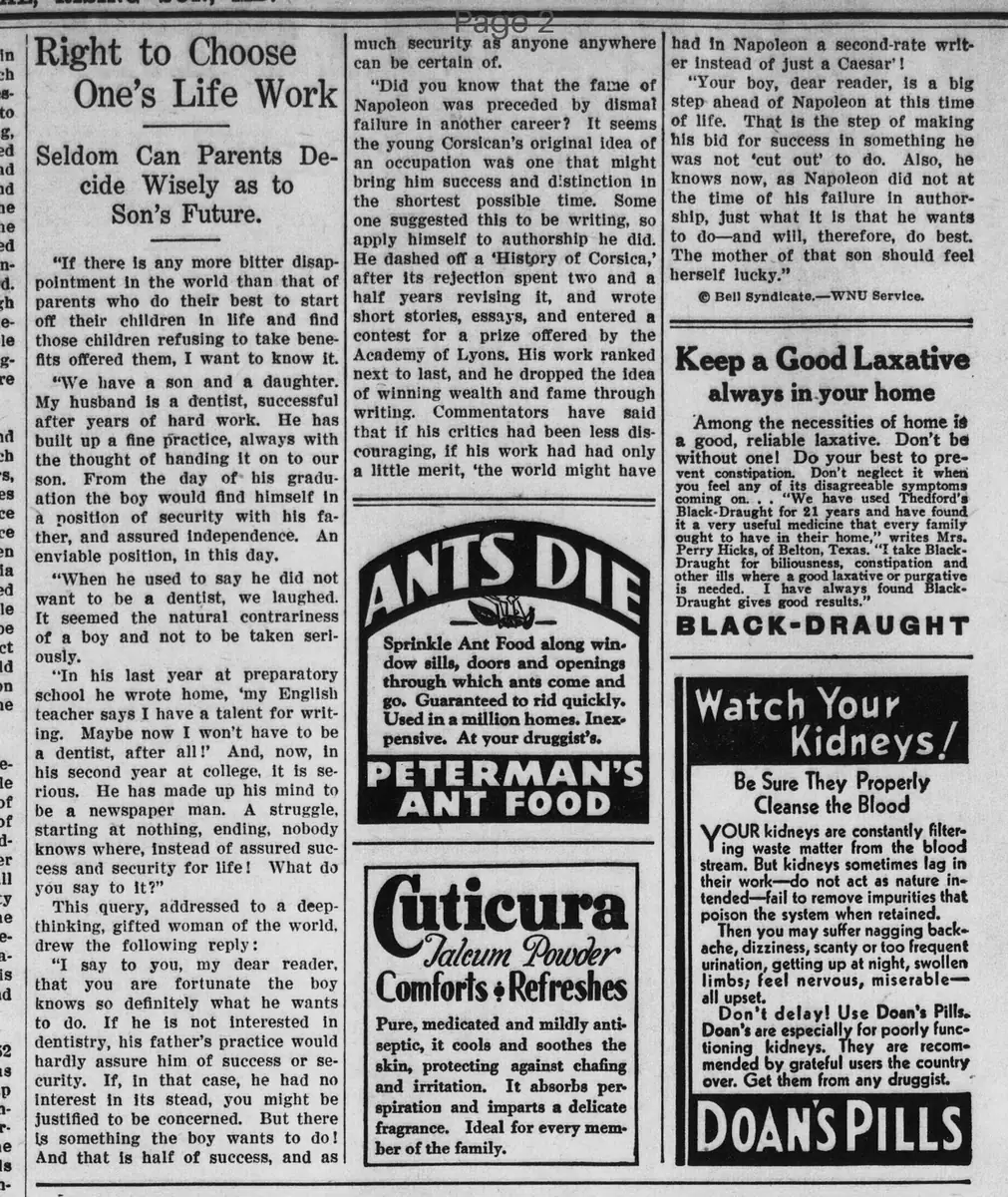
Right to Choose One's Life Work
Seldom Can Parents Decide Wisely as to Son's Future.
"If there is any more bitter disappointment in the world than that of parents who do their best to start off their children in life and find those children refusing to take benefits offered them, I want to know it.
"We have a son and a daughter. My husband is a dentist, successful after years of hard work. He has built up a fine practice, always with the thought of handing it on to our son. From the day of his graduation the boy would find himself in a position of security with his father, and assured independence. An enviable position, in this day.
"When he used to say he did not want to be a dentist, we laughed. It seemed the natural contrariness of a boy and not to be taken seriously.
In his last year at preparatory school he wrote home. 'My English teacher says I have a talent for writing. Maybe now I won't have to be a dentist, after all!' And, now, in his second year at college, it is serious. He has made up his mind to be a newspaper man. A struggle, starting at nothing, ending, nobody knows where, instead of assured success and security for life! What do you say to it?"
This query, addressed to a deep-thinking, gifted woman of the world, drew the following reply:
"I say to you, my dear reader, that you are fortunate the boy knows so definitely what he wants to do. If he is not interested in dentistry, his father's practice would hardly assure him of success or security. If, in that case, he had no interest in its stead, you might be justified to be concerned. But there is something the boy wants to do! And that is half of success, and as much security as anyone anywhere can be certain of.
"Did you know that the fame of Napoleon was preceded by dismal failure in another career? It seems the young Corsican's original idea of an occupation was one that might bring him success and distinction in the shortest possible time. Some one suggested this to be writing, so apply himself to authorship he did. He dashed off a History of Corsica, after its rejection spent two and a half years revising it, and wrote short stories, essays, and entered a contest for a prize offered by the Academy of Lyons. His work ranked next to last, and he dropped the idea of winning wealth and fame through writing. Commentators have said that if his critics had been less discouraging, if his work had had only a little merit, 'the world might have had in Napoleon a second-rate writer instead of just a Caesar!'
"Your boy, dear reader, is a big step ahead of Napoleon at this time of life. That is the step of making his bid for success in something he was not 'cut out' to do. Also, he knows now, as Napoleon did not at the time of his failure in authorship, just what it is that he wants to do—and will, therefore, do best. The mother of that son should feel herself lucky."
© Bell Syndicate.—WNU Service.
Seldom Can Parents Decide Wisely as to Son's Future.
"If there is any more bitter disappointment in the world than that of parents who do their best to start off their children in life and find those children refusing to take benefits offered them, I want to know it.
"We have a son and a daughter. My husband is a dentist, successful after years of hard work. He has built up a fine practice, always with the thought of handing it on to our son. From the day of his graduation the boy would find himself in a position of security with his father, and assured independence. An enviable position, in this day.
"When he used to say he did not want to be a dentist, we laughed. It seemed the natural contrariness of a boy and not to be taken seriously.
In his last year at preparatory school he wrote home. 'My English teacher says I have a talent for writing. Maybe now I won't have to be a dentist, after all!' And, now, in his second year at college, it is serious. He has made up his mind to be a newspaper man. A struggle, starting at nothing, ending, nobody knows where, instead of assured success and security for life! What do you say to it?"
This query, addressed to a deep-thinking, gifted woman of the world, drew the following reply:
"I say to you, my dear reader, that you are fortunate the boy knows so definitely what he wants to do. If he is not interested in dentistry, his father's practice would hardly assure him of success or security. If, in that case, he had no interest in its stead, you might be justified to be concerned. But there is something the boy wants to do! And that is half of success, and as much security as anyone anywhere can be certain of.
"Did you know that the fame of Napoleon was preceded by dismal failure in another career? It seems the young Corsican's original idea of an occupation was one that might bring him success and distinction in the shortest possible time. Some one suggested this to be writing, so apply himself to authorship he did. He dashed off a History of Corsica, after its rejection spent two and a half years revising it, and wrote short stories, essays, and entered a contest for a prize offered by the Academy of Lyons. His work ranked next to last, and he dropped the idea of winning wealth and fame through writing. Commentators have said that if his critics had been less discouraging, if his work had had only a little merit, 'the world might have had in Napoleon a second-rate writer instead of just a Caesar!'
"Your boy, dear reader, is a big step ahead of Napoleon at this time of life. That is the step of making his bid for success in something he was not 'cut out' to do. Also, he knows now, as Napoleon did not at the time of his failure in authorship, just what it is that he wants to do—and will, therefore, do best. The mother of that son should feel herself lucky."
© Bell Syndicate.—WNU Service.
What sub-type of article is it?
Essay
What themes does it cover?
Liberty Freedom
Moral Virtue
What keywords are associated?
Career Choice
Parental Expectations
Personal Passion
Napoleon Failure
Journalism Vs Dentistry
What entities or persons were involved?
© Bell Syndicate.—Wnu Service.
Literary Details
Title
Right To Choose One's Life Work
Author
© Bell Syndicate.—Wnu Service.
Subject
Seldom Can Parents Decide Wisely As To Son's Future.
Key Lines
"If There Is Any More Bitter Disappointment In The World Than That Of Parents Who Do Their Best To Start Off Their Children In Life And Find Those Children Refusing To Take Benefits Offered Them, I Want To Know It."
"I Say To You, My Dear Reader, That You Are Fortunate The Boy Knows So Definitely What He Wants To Do."
Commentators Have Said That If His Critics Had Been Less Discouraging, If His Work Had Had Only A Little Merit, 'The World Might Have Had In Napoleon A Second Rate Writer Instead Of Just A Caesar!'