Thank you for visiting SNEWPapers!
Sign up free
The Madison Daily Leader
Madison, Lake County, South Dakota
What is this article about?
A report details the Spanish army's composition: 80,000 permanent, 155,000 active reserve, over 1,000,000 sedentary reserve. Over 210,000 sent to Cuba in recent years, with 51,081 total casualties including 13,700 from yellow fever. As of March 1, 1898, 185,300 troops total, but effective force estimated at 120,000 amid unreliable reports and pay issues.
Clipping
OCR Quality
Full Text
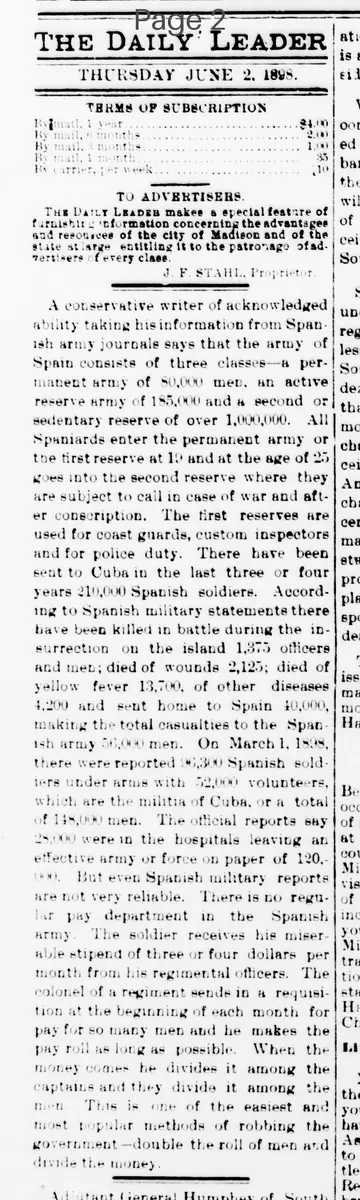
THURSDAY
JUNE 2, 1898.
TERMS OF SUBSCRIPTION
By mail, 1 year $4.00
By mail 6 months $2.00
By mail 3 months $1.00
By carrier 1 month 35c
By carrier per week 10c
TO ADVERTISERS
The Daily Leader makes a special feature of furnishing information concerning the advantages and resources of the city of Madison and of the state at large entitling it to the patronage of advertisers of every class.
J.F. STAHL, Proprietor
A conservative writer of acknowledged ability taking his information from Spanish army journals says that the army of Spain consists of three classes—a permanent army of 80,000 men, an active reserve army of 155,000 and a second or sedentary reserve of over 1,000,000. All Spaniards enter the permanent army or the first reserve at 20 and at the age of 25 goes into the second reserve where they are subject to call in case of war and after conscription. The first reserves are used for coast guards, custom inspectors and for police duty. There have been sent to Cuba in the last three or four years 210,000 Spanish soldiers. According to Spanish military statements there have been killed in battle during the insurrection on the island 13 officers and men; died of wounds 2,125; died of yellow fever 13,700, of other diseases 1,200 and sent home to Spain 10,000, making the total casualties to the Spanish army 51,081 men. On March 1, 1898, there were reported 33,300 Spanish soldiers under arms with 52,000 volunteers, which are the militia of Cuba, or a total of 185,300 men. The official reports say 25,000 were in the hospitals leaving an effective army or force on paper of 120,000. But even Spanish military reports are not very reliable. There is no regular pay department in the Spanish army. The soldier receives his miserable stipend of three or four dollars per month from his regimental officers. The colonel of a regiment sends in a requisition at the beginning of each month for pay for so many men and he makes the pay roll as long as possible. When the money comes he divides it among the captains and they divide it among the men. This is one of the easiest and most popular methods of robbing the government—double the roll of men and divide the money.
What sub-type of article is it?
What keywords are associated?
Where did it happen?
Foreign News Details
Primary Location
Cuba
Event Date
As Of March 1, 1898
Outcome
killed in battle: 13; died of wounds: 2,125; died of yellow fever: 13,700; died of other diseases: 1,200; sent home: 10,000; total casualties: 51,081. as of march 1, 1898: 33,300 under arms, 52,000 volunteers, total 185,300; 25,000 in hospitals; effective force: 120,000.
Event Details
Spanish army consists of permanent force of 80,000, active reserve of 155,000, sedentary reserve over 1,000,000. Spaniards enter at 20, move to second reserve at 25. First reserves for coast guards, customs, police. 210,000 sent to Cuba in last 3-4 years. Reports unreliable; no regular pay, officers divide funds after inflating rolls.