Thank you for visiting SNEWPapers!
Sign up free
The New Hampshire Gazette
Portsmouth, Rockingham County, New Hampshire
What is this article about?
1844 letter exchange between Postmaster General Wickliffe and Judge Joseph Story clarifying that Story did not rule U.S. post office laws unconstitutional in the Kimball case, countering false newspaper reports. Story affirms concurrence with Judge Sprague's opinion.
Merged-components note: Continuation of the correspondence letter from the Postmaster General to Judge Story.
Clipping
OCR Quality
Full Text
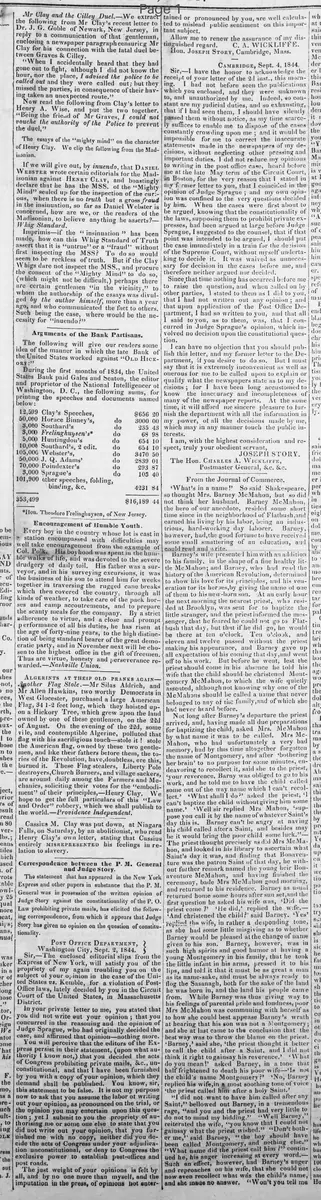
Washington City, Sept. 2, 1844.
Sir,—The enclosed editorial slips from the Express of New York, will satisfy you of the propriety of my again troubling you on the subject of your opinion in the case of the United States vs. Kimball, for a violation of Post-Office laws, lately decided by you in the Circuit Court of the United States, in Massachusetts District.
In your private letter to me, you stated that you did not write out your opinion; that you concurred in the reasoning and the opinion of Judge Sprague, who had originally decided the case, and affirmed that opinion—nothing more.
You will perceive that the editors of the Express persist in their statement, (upon what authority I know not,) that you decided the acts of Congress prohibiting private mails, &c., unconstitutional, and that I have been furnished by you with a copy of your opinion, which they demand shall be published. You know, sir, this statement to be false. It is not my purpose now to ask that you assume the labor of writing out your opinion, as pronounced on the trial, or the opinion you may entertain upon this question; yet I submit to you the propriety of authorising me or some one else to state that you did not write out your opinion, that you furnished me with no copy, neither did you decide the acts of Congress under your adjudication unconstitutional, or deny to Congress the exclusive power to establish post-offices and post roads.
The just weight of your opinions is felt by all, and by no one more than myself, and the imputation in the press, of opinions not entertained or pronounced by you, are well calculated to mislead public sentiment on this important subject.
Allow me to renew the assurance of my distinguished regard.
C. A. WICKLIFFE.
Hon. JOSEPH STORY, Cambridge, Mass.
CAMBRIDGE, Sept. 4, 1844.
Sir,—I have the honor to acknowledge the receipt of your letter of the 2d inst., this morning. I had not before seen the publications which you enclosed, and they were unknown to, and unauthorized by me. Indeed, so constant are my judicial duties, and so exhausting, that if I had seen them, I should have silently passed them without notice, as my time scarcely suffices to enable me to dispose of the cases constantly crowding upon me; and it would be impossible for me to correct the inaccurate statements made in the newspapers of my decisions, without neglecting other pressing and important duties. I did not reduce my opinions to writing in the post office case, heard before me at the late May term of the Circuit Court, in Boston, for the very reason that I stated in my former letter to you, that I coincided in the opinion of Judge Sprague; and my own opinion was confined to the very questions decided by him. When the cases were first about to be argued, knowing that the constitutionality of the laws, supposing them to prohibit private expresses, had been argued at large before Judge Sprague, I suggested to the counsel, that if that point was intended to be argued, I should put the case immediately in a train for the decision of the Supreme Court, without myself undertaking to decide it. It was waived as unnecessary for decision in the cases before me, and therefore neither argued nor decided.
Since that time nothing has occurred before me to raise the question, and when called on by other parties, I stated to them as I did to you, that I had not written out any opinion; and that upon application of the Post Office Department, I had so written to you, and that all I said to you, as to them, was, that I concurred in Judge Sprague's opinion, which involved no decision upon the constitutional question.
I can have no objection that you should publish this letter, and my former letter to the Department, if you desire to do so. But I must say that it is extremely inconvenient as well as onerous for me to be called upon to explain or qualify what the newspapers state as to my decisions; for I have been long accustomed to know the inaccuracy and incompleteness of many of the newspaper reports. At the same time, it will afford me sincere pleasure to furnish the department with all the information in my power, of all the decisions made by me, which may in any manner touch the public interests.
I am, with the highest consideration and respect, truly your obedient servant,
JOSEPH STORY
The Hon. CHARLES A. WICKLIFFE,
Postmaster General, &c. &c.
What sub-type of article is it?
What themes does it cover?
What keywords are associated?
What entities or persons were involved?
Where did it happen?
Story Details
Key Persons
Location
Washington City; Cambridge, Mass.; Boston
Event Date
Sept. 2, 1844; Sept. 4, 1844
Story Details
Postmaster General Wickliffe writes to Judge Story requesting clarification on his opinion in United States vs. Kimball case, denying newspaper claims that Story ruled post office laws unconstitutional. Story replies confirming he did not write an opinion, concurred with Judge Sprague, and the constitutional issue was not decided.