Thank you for visiting SNEWPapers!
Sign up free
Story
July 13, 1887
The True Northerner
Paw Paw, Van Buren County, Michigan
What is this article about?
A looking glass maker in St. Louis explains the three types of commercial mirrors: French plate, German plate, and American shocks. He describes their qualities, U.S. manufacturing challenges, and the two silvering processes using mercury or nitrate of silver, emphasizing the need for skill and cleanliness.
Clipping
OCR Quality
98%
Excellent
Full Text
Mirrors—How They are Made.
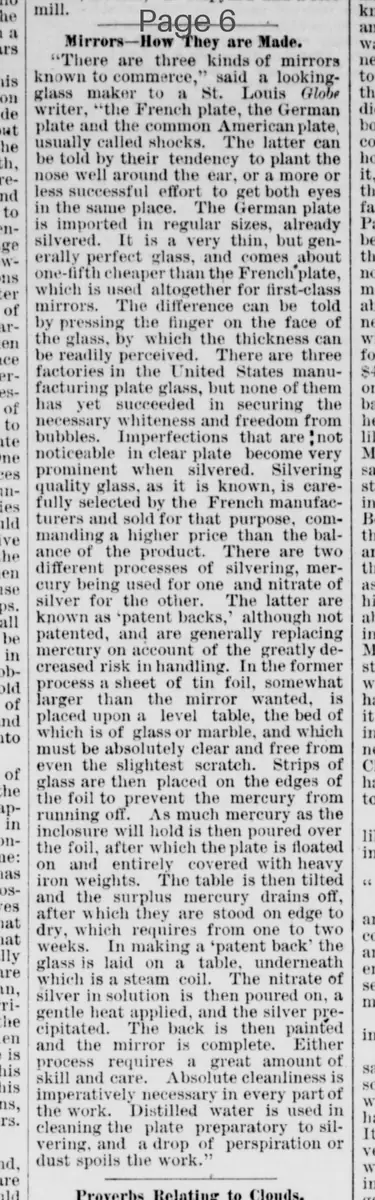
"There are three kinds of mirrors known to commerce," said a looking glass maker to a St. Louis Globe writer, "the French plate, the German plate and the common American plate usually called shocks. The latter can be told by their tendency to plant the nose well around the ear, or a more or less successful effort to get both eyes in the same place. The German plate is imported in regular sizes, already silvered. It is a very thin, but generally perfect glass, and comes about one-fifth cheaper than the French plate, which is used altogether for first-class mirrors. The difference can be told by pressing the finger on the face of the glass, by which the thickness can be readily perceived. There are three factories in the United States manufacturing plate glass, but none of them has yet succeeded in securing the necessary whiteness and freedom from bubbles. Imperfections that are not noticeable in clear plate become very prominent when silvered. Silvering quality glass, as it is known, is carefully selected by the French manufacturers and sold for that purpose, commanding a higher price than the balance of the product. There are two different processes of silvering, mercury being used for one and nitrate of silver for the other. The latter are known as 'patent backs,' although not patented, and are generally replacing mercury on account of the greatly decreased risk in handling. In the former process a sheet of tin foil, somewhat larger than the mirror wanted, is placed upon a level table, the bed of which is of glass or marble, and which must be absolutely clear and free from even the slightest scratch. Strips of glass are then placed on the edges of the foil to prevent the mercury from running off. As much mercury as the inclosure will hold is then poured over the foil, after which the plate is floated on and entirely covered with heavy iron weights. The table is then tilted and the surplus mercury drains off, after which they are stood on edge to dry, which requires from one to two weeks. In making a 'patent back' the glass is laid on a table, underneath which is a steam coil. The nitrate of silver in solution is then poured on, a gentle heat applied, and the silver precipitated. The back is then painted and the mirror is complete. Either process requires a great amount of skill and care. Absolute cleanliness is imperatively necessary in every part of the work. Distilled water is used in cleaning the plate preparatory to silvering, and a drop of perspiration or dust spoils the work."
"There are three kinds of mirrors known to commerce," said a looking glass maker to a St. Louis Globe writer, "the French plate, the German plate and the common American plate usually called shocks. The latter can be told by their tendency to plant the nose well around the ear, or a more or less successful effort to get both eyes in the same place. The German plate is imported in regular sizes, already silvered. It is a very thin, but generally perfect glass, and comes about one-fifth cheaper than the French plate, which is used altogether for first-class mirrors. The difference can be told by pressing the finger on the face of the glass, by which the thickness can be readily perceived. There are three factories in the United States manufacturing plate glass, but none of them has yet succeeded in securing the necessary whiteness and freedom from bubbles. Imperfections that are not noticeable in clear plate become very prominent when silvered. Silvering quality glass, as it is known, is carefully selected by the French manufacturers and sold for that purpose, commanding a higher price than the balance of the product. There are two different processes of silvering, mercury being used for one and nitrate of silver for the other. The latter are known as 'patent backs,' although not patented, and are generally replacing mercury on account of the greatly decreased risk in handling. In the former process a sheet of tin foil, somewhat larger than the mirror wanted, is placed upon a level table, the bed of which is of glass or marble, and which must be absolutely clear and free from even the slightest scratch. Strips of glass are then placed on the edges of the foil to prevent the mercury from running off. As much mercury as the inclosure will hold is then poured over the foil, after which the plate is floated on and entirely covered with heavy iron weights. The table is then tilted and the surplus mercury drains off, after which they are stood on edge to dry, which requires from one to two weeks. In making a 'patent back' the glass is laid on a table, underneath which is a steam coil. The nitrate of silver in solution is then poured on, a gentle heat applied, and the silver precipitated. The back is then painted and the mirror is complete. Either process requires a great amount of skill and care. Absolute cleanliness is imperatively necessary in every part of the work. Distilled water is used in cleaning the plate preparatory to silvering, and a drop of perspiration or dust spoils the work."
What sub-type of article is it?
Curiosity
What keywords are associated?
Mirror Types
Plate Glass
Silvering Process
Mercury Method
Nitrate Silver
Manufacturing Challenges
What entities or persons were involved?
Looking Glass Maker
St. Louis Globe Writer
Where did it happen?
St. Louis
Story Details
Key Persons
Looking Glass Maker
St. Louis Globe Writer
Location
St. Louis
Story Details
A looking glass maker describes three types of mirrors, their distinguishing features, importation and production details, and the two silvering methods involving mercury or nitrate of silver, highlighting the required precision and cleanliness.