Thank you for visiting SNEWPapers!
Sign up free
Editorial
March 4, 1788
The Daily Advertiser
New York, New York County, New York
What is this article about?
Dean Robert Boucher Nickolls's letter argues against the slave trade on moral, religious, and practical grounds, citing biblical condemnation, historical examples, and benefits to planters, merchants, Britain, and humanity if abolished. Addressed to Samuel Hoare, it praises potential legacy for George III.
Clipping
OCR Quality
98%
Excellent
Full Text
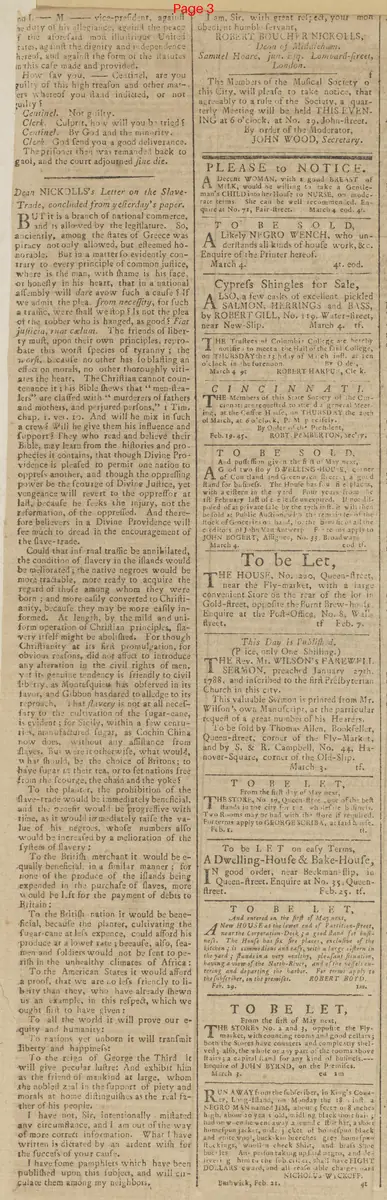
Dean NICKOLLS's Letter on the Slave-Trade, concluded from yesterday's paper.
But it is a branch of national commerce, and is allowed by the legislature. So, anciently, among the states of Greece was piracy not only allowed, but esteemed honorable. But in a matter so evidently contrary to every principle of common justice, where is the man, with shame in his face or honesty in his heart, that in a national assembly will dare avow such a cause? If we admit the plea from necessity, for such a traffic, where shall we stop? Is not the plea of the robber who is hanged, as good? Fiat justitia, ruat caelum. The friends of liberty must, upon their own principles, reprobate this worst species of tyranny; the worst, because no other has so blasting an effect on morals, no other thoroughly vitiates the heart. The Christian cannot countenance it; his Bible shows that "men-stealers are classed with murderers of fathers and mothers, and perjured persons," I Tim. chap. I. ver. 10. And will he mix in such a crew? Will he give them his influence and support? They who read and believe their Bible, may learn from the histories and prophecies it contains, that though Divine Providence is pleased to permit one nation to oppress another, and though the oppressing power be the scourge of Divine Justice, yet vengeance will revert to the oppressor at last, because he seeks the injury, not the reformation, of the oppressed. And therefore believers in a Divine Providence will see much to dread in the encouragement of the slave-trade.
Could that infernal traffic be annihilated, the condition of slavery in the islands would be meliorated; the native negroes would be more tractable, more ready to acquire the regard of those among whom they were born; and more easily converted to Christianity, because they may be more easily informed. At length, by the mild and uniform operation of Christian principles, slavery itself might be abolished. For though Christianity at its first promulgation, for obvious reasons, did not affect to introduce any alteration in the civil rights of men, yet its genuine tendency is friendly to civil liberty, as Montesquieu has observed in its favor, and Gibbon has dared to allege to its reproach. That slavery is not at all necessary to the cultivation of the sugar-cane, is evident; for Sicily, within a few centuries, manufactured sugar, as Cochin China now does, without any assistance from slaves. But were it otherwise, what would, what should, be the choice of Britons; to have sugar in their tea, or to set nations free from the scourge, the chain and the yoke?
To the planter, the prohibition of the slave-trade would be immediately beneficial, and the benefit would be progressive with time, as it would immediately raise the value of his negroes, whose numbers also would be increased by a melioration of the system of slavery.
To the British merchant it would be equally beneficial, in a similar manner; for none of the produce of the islands being expended in the purchase of slaves, more would be left for the payment of debts to Britain.
To the British nation it would be beneficial, because the planter, cultivating the sugar-cane at less expense, could afford his produce at a lower rate; because, also, seamen and soldiers would not be sent to perish in the unhealthy climates of Africa.
To the American States it would afford a proof, that we are no less friendly to liberty than they, who have already shown us an example, in this respect, which we ought to have given.
To all the world it will prove our equity and humanity.
To nations yet unborn it will transmit liberty and happiness.
To the reign of George the Third it will give peculiar lustre: And exhibit him as the friend of mankind at large, whom the noblest zeal in the support of piety and morals at home distinguishes as the real father of his people.
I have not, Sir, intentionally misstated any circumstance, and I am out of the way of more correct information. What I have written is dictated by an ardent wish for the success of your cause.
I have some pamphlets which have been published upon this subject, and will circulate them among my neighbors.
I am, Sir, with great respect, your most obedient humble servant,
ROBERT BOUCHER NICKOLLS,
Dean of Middleham.
Samuel Hoare, jun. Esq. Lombard-street, London.
But it is a branch of national commerce, and is allowed by the legislature. So, anciently, among the states of Greece was piracy not only allowed, but esteemed honorable. But in a matter so evidently contrary to every principle of common justice, where is the man, with shame in his face or honesty in his heart, that in a national assembly will dare avow such a cause? If we admit the plea from necessity, for such a traffic, where shall we stop? Is not the plea of the robber who is hanged, as good? Fiat justitia, ruat caelum. The friends of liberty must, upon their own principles, reprobate this worst species of tyranny; the worst, because no other has so blasting an effect on morals, no other thoroughly vitiates the heart. The Christian cannot countenance it; his Bible shows that "men-stealers are classed with murderers of fathers and mothers, and perjured persons," I Tim. chap. I. ver. 10. And will he mix in such a crew? Will he give them his influence and support? They who read and believe their Bible, may learn from the histories and prophecies it contains, that though Divine Providence is pleased to permit one nation to oppress another, and though the oppressing power be the scourge of Divine Justice, yet vengeance will revert to the oppressor at last, because he seeks the injury, not the reformation, of the oppressed. And therefore believers in a Divine Providence will see much to dread in the encouragement of the slave-trade.
Could that infernal traffic be annihilated, the condition of slavery in the islands would be meliorated; the native negroes would be more tractable, more ready to acquire the regard of those among whom they were born; and more easily converted to Christianity, because they may be more easily informed. At length, by the mild and uniform operation of Christian principles, slavery itself might be abolished. For though Christianity at its first promulgation, for obvious reasons, did not affect to introduce any alteration in the civil rights of men, yet its genuine tendency is friendly to civil liberty, as Montesquieu has observed in its favor, and Gibbon has dared to allege to its reproach. That slavery is not at all necessary to the cultivation of the sugar-cane, is evident; for Sicily, within a few centuries, manufactured sugar, as Cochin China now does, without any assistance from slaves. But were it otherwise, what would, what should, be the choice of Britons; to have sugar in their tea, or to set nations free from the scourge, the chain and the yoke?
To the planter, the prohibition of the slave-trade would be immediately beneficial, and the benefit would be progressive with time, as it would immediately raise the value of his negroes, whose numbers also would be increased by a melioration of the system of slavery.
To the British merchant it would be equally beneficial, in a similar manner; for none of the produce of the islands being expended in the purchase of slaves, more would be left for the payment of debts to Britain.
To the British nation it would be beneficial, because the planter, cultivating the sugar-cane at less expense, could afford his produce at a lower rate; because, also, seamen and soldiers would not be sent to perish in the unhealthy climates of Africa.
To the American States it would afford a proof, that we are no less friendly to liberty than they, who have already shown us an example, in this respect, which we ought to have given.
To all the world it will prove our equity and humanity.
To nations yet unborn it will transmit liberty and happiness.
To the reign of George the Third it will give peculiar lustre: And exhibit him as the friend of mankind at large, whom the noblest zeal in the support of piety and morals at home distinguishes as the real father of his people.
I have not, Sir, intentionally misstated any circumstance, and I am out of the way of more correct information. What I have written is dictated by an ardent wish for the success of your cause.
I have some pamphlets which have been published upon this subject, and will circulate them among my neighbors.
I am, Sir, with great respect, your most obedient humble servant,
ROBERT BOUCHER NICKOLLS,
Dean of Middleham.
Samuel Hoare, jun. Esq. Lombard-street, London.
What sub-type of article is it?
Slavery Abolition
Moral Or Religious
Social Reform
What keywords are associated?
Slave Trade
Abolition
Morality
Christianity
British Commerce
Liberty
Humanity
What entities or persons were involved?
Robert Boucher Nickolls
Samuel Hoare
George The Third
Montesquieu
Gibbon
Editorial Details
Primary Topic
Arguments Against The Slave Trade And For Its Abolition
Stance / Tone
Strongly Anti Slave Trade Moral Exhortation
Key Figures
Robert Boucher Nickolls
Samuel Hoare
George The Third
Montesquieu
Gibbon
Key Arguments
Slave Trade Contrary To Justice And Comparable To Piracy
Biblical Condemnation Of Man Stealing
Divine Vengeance On Oppressors
Abolition Would Improve Conditions For Slaves And Lead To End Of Slavery
Slavery Unnecessary For Sugar Cultivation As Shown By Historical Examples
Benefits To Planters, Merchants, Britain, America, And World From Prohibition
Enhances George Iii's Legacy As Friend Of Mankind